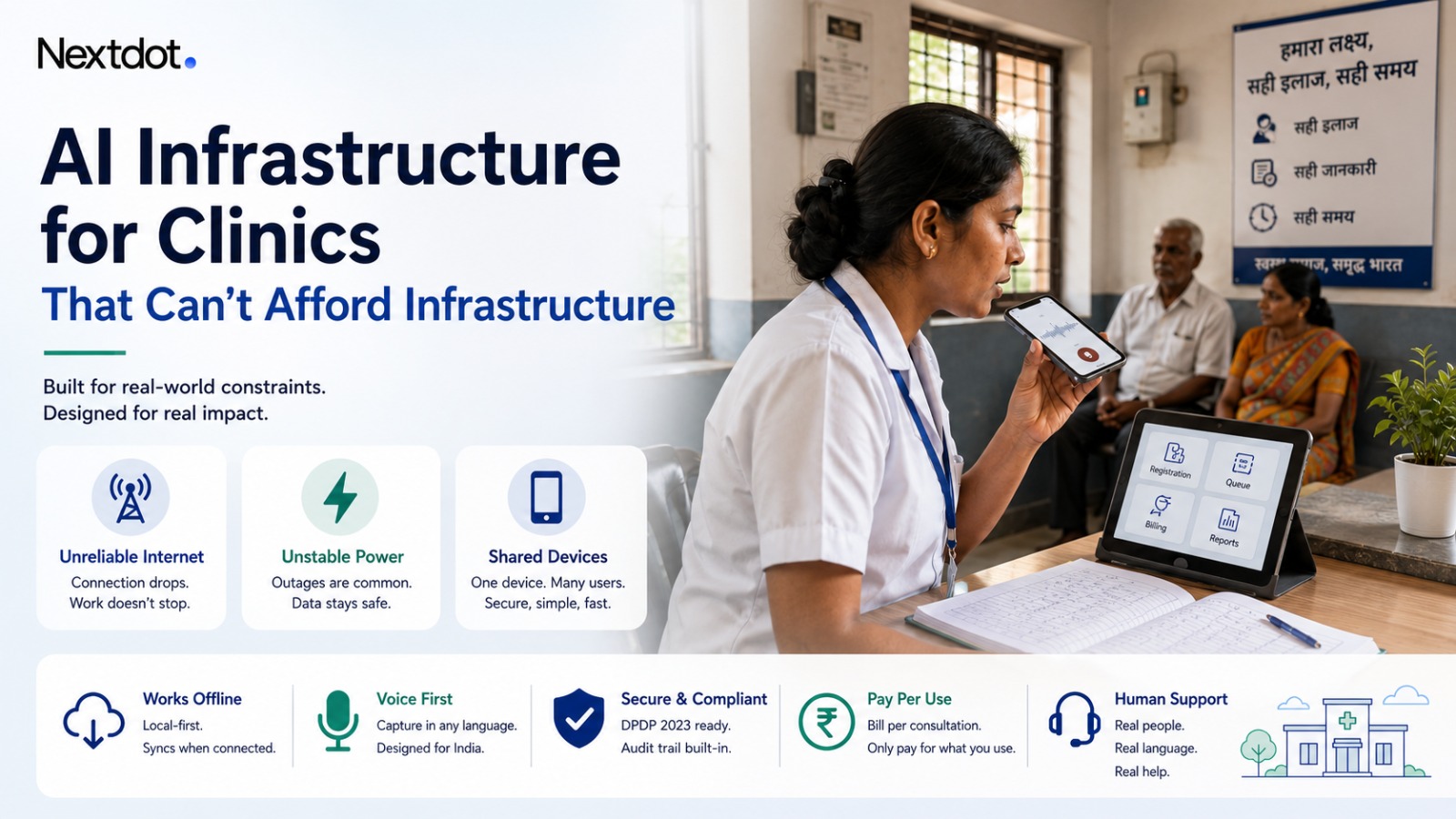
Most AI built for Indian healthcare assumes a server room, a network engineer, and a fibre line that stays up. A 30-bed nursing home in a district town has none of those, and it never will. The owner runs the pharmacy, the billing counter, and the front desk from the same three people. There is no IT team. There is one shared computer at reception, a couple of Android phones, and a power supply that drops for hours at a stretch.
The question is not whether such a clinic wants AI. Plenty do. The question is whether anything on the market was designed for the constraints it actually operates under. Almost nothing was. So the honest place to start is with the environment, not the software.
The infrastructure that actually exists
Rural internet penetration in India sits at 48.31 subscribers per 100 people as of end-March 2026, against 126.80 in urban areas (TRAI quarterly data, March 2026). That number describes coverage, not reliability. A clinic can have a connection and still lose it for an hour at midday when the tower congests or the sky opens up.
Power is the harder problem. Average rural electricity availability rose to roughly 21.9 hours a day in 2024, but the average hides the pattern that matters. Households across Uttar Pradesh, Jharkhand, Haryana, Assam and Bihar still report six or more hours of outage in a day, and outages arrive in blocks, not in convenient overnight windows. For a clinic, that means the system of record has to survive a dead router and a dark reception desk during OPD hours.
Devices are shared. Rural mobile penetration is about 58.8 per 100 people against 125.3 in urban areas (TRAI, 2025), and in practice a single Android phone often serves a whole household or a whole front desk. The clinic does not have one device per staff member. It has one device that four people touch across a shift.
This is the ground truth. A district health officer signing off on any AI tool should test it against these three facts first: the line will drop, the power will drop, and the device is shared.
Cost architecture: price it per consultation, not per seat
The pricing model kills more small-clinic deployments than the technology does. Enterprise AI is sold per seat, per site, or as an annual license in the range large hospital groups pay. A clinic-chain operator running eight OPDs cannot carry a per-seat SaaS line that assumes named users with dedicated logins. The users are not named. They rotate.
The architecture that works bills against a unit the clinic already understands: the consultation, the document, the call. If a scribe costs a few rupees per completed consultation and produces a clean note the doctor would otherwise write by hand, the owner can do that math in his head at the billing counter. If it costs a fixed monthly sum whether the OPD saw 20 patients or 200, he cannot, and he will not sign.
Two design consequences follow. First, the model tier has to match the task. A structured OPD note or a triage summary does not need the most expensive model on the market. Routing routine work to a smaller, cheaper model and reserving a larger one for genuinely hard cases is the difference between a viable per-consultation price and one that never clears. Second, the hardware budget has to be near zero. The clinic is not buying a server. Anything that requires on-premise GPU hardware is disqualified before the conversation starts. The compute lives in the cloud and the clinic pays only for what it uses.
Design for the line dropping, because it will
Intermittent connectivity is the constraint that separates tools built for this market from tools ported into it. A system that needs a live connection for every action stops the OPD dead the moment the tower congests. That is not a rare failure. In this environment it is a daily one.
The workable pattern is local-first capture with deferred sync. The front-desk app holds registration, the queue, and billing in local storage on the device. It keeps working with the network unplugged. When connectivity returns, it syncs in the background and reconciles. The doctor never waits on a spinner during a consultation, and the receptionist never tells a patient to come back after lunch because the software is down.
For anything that genuinely needs the cloud, voice transcription and clinical summarisation among them, the design has to degrade gracefully rather than fail. Audio for a consultation can be captured and queued on the device, then transcribed when the line comes back, with the doctor reviewing the note at the end of the session instead of in real time. The clinic loses a few minutes of immediacy. It does not lose the record. A tool that treats a dropped connection as an error state, rather than as the expected state, will be abandoned inside a month.
The shared-device problem is a clinical safety problem
One device, four users, no individual logins. This is not a minor UX inconvenience. In a clinical setting it is a records-integrity risk. If the app cannot tell who captured a note or who ran a triage check, the audit trail is worthless, and under DPDP 2023 the clinic is the entity holding personal health data it cannot properly account for.
The design answer is lightweight, fast identity that suits a shared device. Not a password screen that a rushed receptionist will defeat by staying permanently logged in as one user. A quick-switch profile, a PIN, or a tap-to-identify step that takes two seconds and stamps every action with the person who took it. The friction has to be low enough that staff actually use it and high enough that the record knows whose hands were on the device. Session timeouts matter here too, because a shared phone left unlocked on the counter is a data-exposure event waiting to happen.
Get this right and a shared device is workable. Ignore it and the clinic has an unaccountable system that no district health officer should approve.
Voice, because the typing does not happen
The receptionist in a district clinic is not going to type structured data into forms between patients. The doctor is not going to break eye contact to fill dropdown fields. In practice, text-first data entry in these settings produces thin, late, or fabricated records. Voice is the interface that fits the actual workflow, and it fits the shared-device reality too, because speaking into one phone needs no per-user setup.
The technical catch is that the voice is rarely clean English or clean Hindi. It is Bhojpuri-inflected Hindi, it is code-switched, it is a medicine name dropped into a regional sentence. General-purpose speech-to-text models trained mostly on Western-accented English degrade sharply on this input, and a scribe that mishears a drug name is worse than no scribe at all. This is the specific reason Nextdot's clinical work leans on Sarvam AI's speech models for the Indian-language layer: they are built on Indian language and dialect data, so they hold up on the regional inflection and code-switching that a district OPD actually produces, running against audio captured on an ordinary low-end Android phone rather than a studio mic. Ambient capture through Nextdot's NextScribe is designed around exactly this input, review-first, so the doctor confirms the note rather than trusting a raw transcript.
What breaks, and who fixes it when there is no IT team
The maintenance question is the one vendors dodge. In a large hospital, when the AI misbehaves, an internal team files a ticket. In a nursing home, the person who notices is the owner, and his only lever is to stop using the tool. So the support model has to assume zero local technical capability.
That means updates push silently and never require someone on-site to run them. It means the failure modes are visible and self-explanatory in plain language, so the receptionist can see that a note is still syncing rather than assuming it is lost. It means a human support line that answers in the local language and understands that the person calling is mid-OPD with a queue building. And it means the tool degrades to a safe manual fallback the clinic already knows, paper, when it cannot function, instead of blocking the workflow entirely. The measure of a well-designed system here is not how it behaves when everything works. It is how little damage it does when the line, the power, or the model fails.
Where not to cut
Costs get cut. Clinical safety and data accountability do not. A district health officer or a clinic-chain operator evaluating any of this should hold three lines firm. Every AI-generated clinical note is reviewed by the clinician before it enters the record, with no silent auto-filing. Every action is attributable to a person, even on a shared device. And personal health data is handled to DPDP 2023 standards regardless of how small the clinic is, because the law does not scale its expectations down for a 30-bed facility.
Everything else is negotiable against budget. Model tier, sync frequency, feature depth, all of it can flex to hit a price the clinic can actually pay. The floor is that the system stays safe when it is offline, dark, and shared, which is the condition it will spend most of its life in. Build for that condition and AI reaches the clinics where most of India actually gets treated. Build for the server room, and it never leaves the metros.