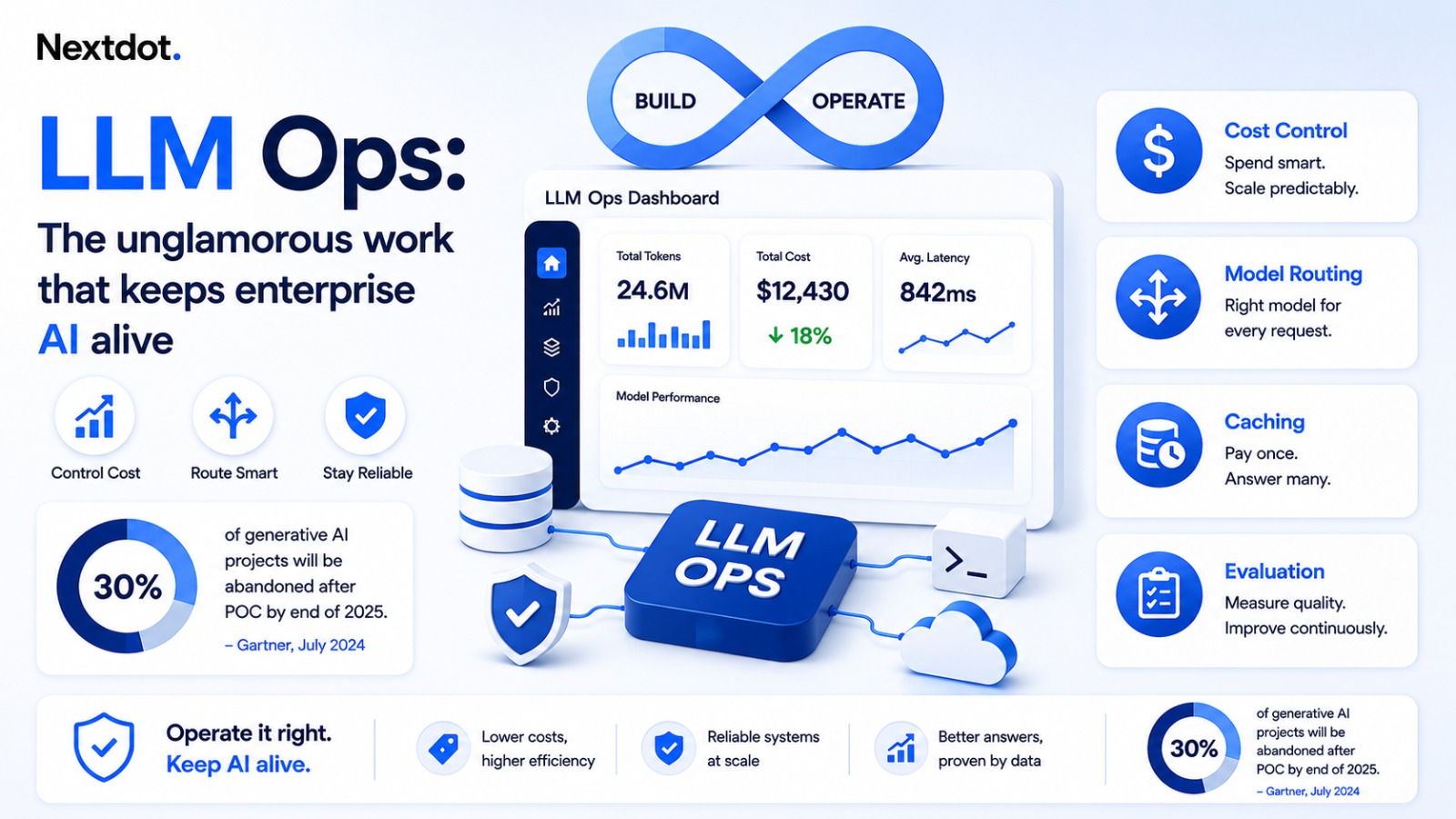
The demo is the easy part. A model answers a hard question in front of the board, someone signs a budget, and the project is declared real. Six weeks into production the same system is quietly costing four times the estimate, returning wrong answers on inputs nobody tested, and nobody on the team can say why. Gartner predicted that 30 percent of generative AI projects would be abandoned after proof of concept by the end of 2025, citing escalating costs, poor data quality, and unclear value among the reasons (Gartner, July 2024). Most of those projects did not fail because the model was bad. They failed because the layer that keeps a model alive in production was never built.
That layer is LLM Ops. It is the least glamorous work in enterprise AI and the part that decides whether anything survives contact with real traffic. If your team can demo but cannot operate, you do not have an AI system. You have a prototype with a large bill attached.
What LLM Ops actually is
LLM Ops is the operational discipline around a language model in production. It covers everything that happens after the prompt is written and before the answer reaches a user, plus everything you need to know afterwards to trust that the answer was correct.
Think of it as four load-bearing concerns. Cost control, so the system stays economically viable at real volume. Model routing, so each request goes to the cheapest model that can actually handle it. Caching, so you stop paying to answer the same question twice. Evaluation, so you know whether a change made the system better or quietly broke it. None of these appear in a demo. All of them determine whether the system is running or dead a quarter later.
The reason this work gets skipped is structural. A demo runs on one prompt, one model, low traffic, and a human watching every output. Production runs on thousands of concurrent requests, mixed difficulty, no human in the loop, and a finance team reading the invoice. The engineering that closes that gap is invisible when it works and catastrophic when it is missing.
Cost control: the bill nobody modelled
Per-token prices have been falling for two years, which has convinced a lot of buyers that inference is getting cheap. Aggregate spend tells the opposite story. Menlo Ventures reported that enterprise spending on model APIs more than doubled in the first half of 2025, rising from 3.5 billion dollars to 8.4 billion dollars, even as per-token costs dropped (Menlo Ventures, 2025 Mid-Year LLM Market Update). Prices per token fell and total bills climbed, because consumption grew faster than prices fell.
Agentic systems are the main reason. A single agent that reads a document, plans, calls tools, and checks its own work can burn many times the tokens of a simple chatbot reply. When a workflow loops or chains steps, token use compounds. Teams that scaled past the pilot often discovered the true unit cost only when the first full-traffic invoice arrived.
Cost control in LLM Ops means treating tokens like any other metered resource. You need per-feature and per-customer cost attribution, so you know which workflow is expensive and whether it earns its keep. You need budgets and rate limits that degrade gracefully instead of failing when a runaway loop starts spending. You need a token accounting habit at the design stage, because a workflow that costs eight rupees per run at pilot volume can cost more than the revenue it supports at scale. The finance question and the architecture question are the same question, and the team that answers it late pays for the answer twice.
Model routing: stop sending easy work to expensive models
The single most common waste in enterprise AI is sending every request to the largest available model. It is the safe default. It is also the reason the bill is what it is.
Most production traffic is not hard. Classifying an incoming message, extracting a few fields from a form, answering a routine query against a known document: a small, cheap model handles these correctly at a fraction of the cost and latency of a frontier model. The genuinely difficult requests, the ones that need multi-step reasoning or careful judgment, are a minority of the traffic and deserve the expensive model. Routing is the logic that decides which is which.
Done well, routing is a system in its own right. A lightweight classifier or a set of rules inspects each request and assigns it to a tier. Easy requests go to a smaller model. Hard requests go to a larger one. Requests that a small model attempts but fails on escalate automatically, so the cheap path is tried first and the expensive path is the fallback rather than the default. The savings are real precisely because the traffic distribution is so skewed toward the easy end.
Routing also buys resilience. When one model provider has an outage or a latency spike, a routing layer can redirect traffic to an alternate model instead of taking the whole system down. A system with a single hardcoded model has a single point of failure with someone else's uptime attached to it. Build the routing layer once and you get cost efficiency and failover from the same piece of infrastructure.
Caching: paying once to answer a question once
A surprising share of production traffic is repetitive. Users ask the same questions, systems retrieve against the same documents, and prompts share long stretches of identical context. Without caching, you pay full price to compute the same answer again and again.
There are two kinds of caching worth building. The first is prompt caching, where the model provider stores the processed form of a long, stable prefix, a system prompt or a large reference document, so that repeated calls reuse it instead of reprocessing it. Providers commonly price these cache reads well below the cost of fresh input tokens, which makes long-context, high-repetition workloads dramatically cheaper and faster [verify]. The second is response caching, where you store the full answer to a request and return it directly when the same or a semantically similar request arrives, skipping the model entirely.
Caching is where the unglamorous framing earns its keep. Getting it right means deciding what is safe to cache and for how long, invalidating entries when the underlying data changes, and never serving a stale answer in a context where correctness is regulated. In healthcare and other regulated settings, a cached answer that is out of date is not a performance problem. It is a compliance and liability problem. The cache is only as good as the invalidation logic behind it, and that logic is engineering, not configuration.
Evaluation pipelines: knowing whether a change helped
The hardest thing about operating a language model is that it can get worse without anything visibly breaking. A prompt tweak, a model version update on the provider's side, or a change in the incoming data can quietly degrade output quality while every server stays green. If your only signal is user complaints, you find out last, after the damage is done.
Evaluation pipelines are the answer, and this is the part most teams skip entirely. You need a held-out set of representative inputs with known good outputs, run automatically against every change before it ships. You need production sampling, where a slice of real traffic is scored continuously, by rules, by a separate model acting as a judge, or by human review on the highest-stakes outputs. You need to catch regressions when the provider silently updates a model underneath you, which happens, and which will move your outputs whether you were watching or not.
Without an evaluation pipeline, every deployment is a guess and every model update is a risk you cannot measure. With one, you can change prompts, switch models, and tune routing with evidence instead of hope. This is the difference between operating a system and merely hosting one. It is also the single clearest test of whether a team has run AI in production before, because the teams that have been burned build this first and the teams that have not do not know to ask.
The work that decides survival
None of this shows up in a pitch. Cost attribution, routing tiers, cache invalidation, and evaluation suites are invisible when they work. They are also the entire reason a system is still running a year after launch instead of sitting in the 30 percent that got quietly switched off.
The pattern is consistent across every enterprise AI deployment that lasts. The team treats the model as one component in an operated system, not as the system itself. They instrument cost from day one. They route by difficulty. They cache what is safe and invalidate what changes. They evaluate continuously so they know, with evidence, whether today's system is better than last week's. This is the work that keeps enterprise AI alive, and it is precisely the work that most buyers do not think to ask about until the bill or the wrong answer forces the question.
When you evaluate an AI vendor or an internal team, do not ask whether they can build a demo. Everyone can build a demo now. Ask how they control cost at scale, how they route, what they cache and how they invalidate it, and how they know when the system regresses. The answers to those four questions tell you whether you are looking at a system that will survive production, or a prototype with a large bill attached.