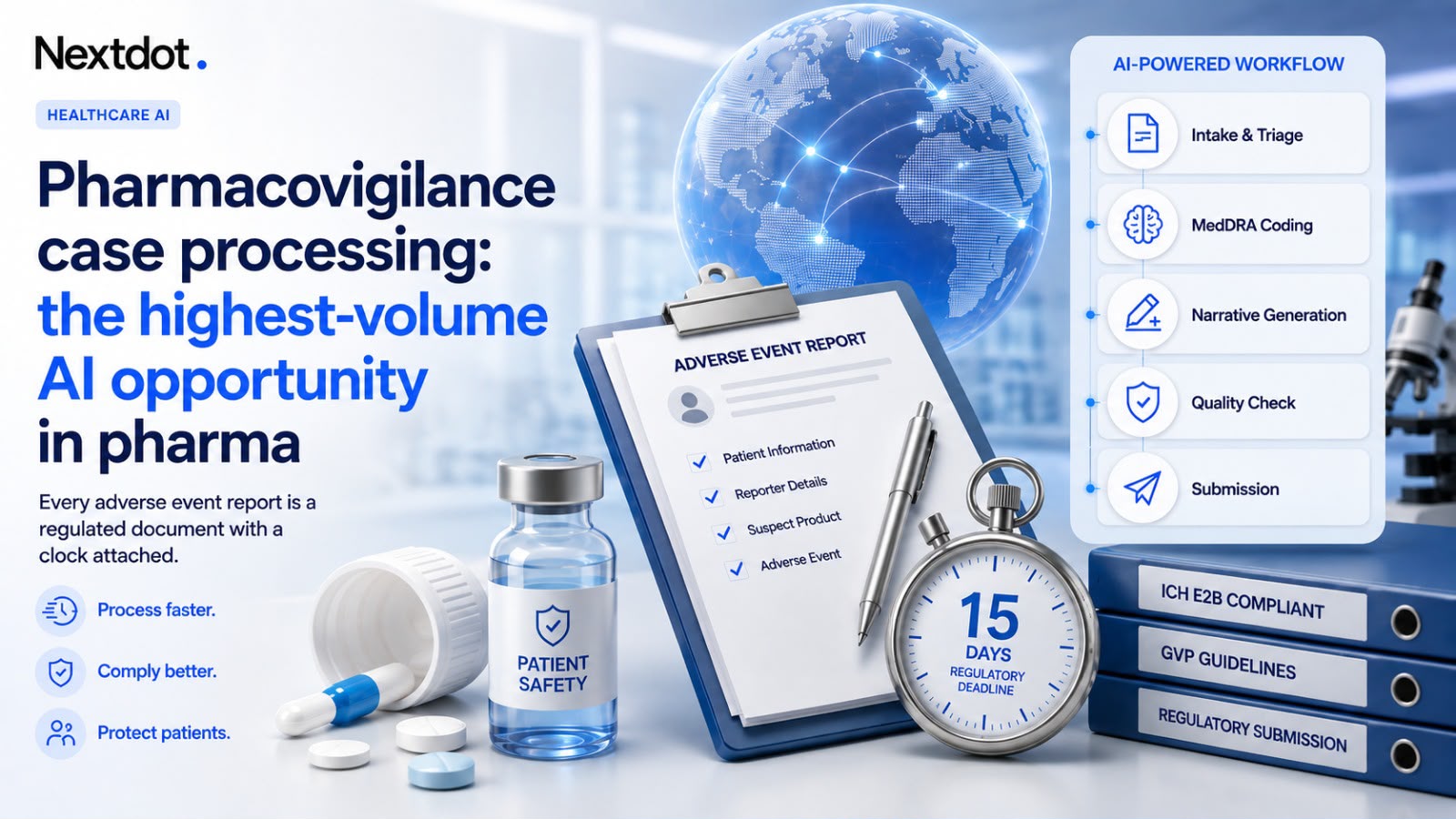
Pharmacovigilance case processing: the highest-volume AI opportunity in pharma
Every marketed drug produces a stream of adverse event reports, and every one of those reports is a regulated document with a clock attached. A serious, unexpected case in most jurisdictions has to reach the regulator inside fifteen calendar days. Miss enough of those windows and a marketing authorisation is genuinely at risk. This is the quiet operational load sitting under every pharma safety department, and it is the clearest high-volume case for applied AI anywhere in the industry.
Start with the scale, because the scale is the whole argument. The FDA's adverse event database held 30,179,725 reports as of 31 December 2024 and takes in roughly 1.5 million new reports a year (FDA Adverse Event Reporting System, data as of 31 December 2024). That is one regulator, in one country, for drugs and therapeutic biologics alone. Add the EU, Japan, and the WHO global database in Uppsala that India feeds through the Pharmacovigilance Programme of India, and the individual case safety report, the ICSR, becomes the highest-frequency regulated artifact a pharma company produces. Global reporting has been climbing for years, pushed by digital intake channels, patient support programmes, and social media monitoring, with more than 20 million new adverse drug reaction reports logged worldwide in 2024 [verify].
Now the part that turns volume into an AI question rather than a hiring question. Each case is still processed largely by hand, the processing is repetitive and expensive, and the work is unforgiving of error. A safety operation that scales by adding case processors is buying linear cost against a workload that grows faster than headcount budgets do.
What one case actually takes
To see where AI fits, you have to see the assembly line it would join. A single ICSR moves through a fixed sequence, and none of the steps are optional.
Intake comes first, and it is messy by nature. A case arrives as a call centre transcript, a scanned form, an email from a physician, a line in a published journal, a fax, or a portal submission. Someone has to read it and decide whether it is even a valid case, which means confirming the four minimum criteria: an identifiable patient, an identifiable reporter, a suspect product, and an adverse event.
Triage follows. Is the event serious by the regulatory definition, meaning death, hospitalisation, a congenital anomaly, or a life-threatening outcome. Is it expected against the product label, or unexpected. Those two judgements set the reporting clock and decide whether the case is expedited or periodic.
Then data entry into the safety database, structured to the ICH E2B standard so it can be transmitted electronically. Then medical coding, where every reported event, indication, and item of medical history is mapped to a MedDRA term so cases become countable across a global dataset. Then medical review of causality and seriousness. Then a written case narrative, the plain-language account a reviewer reads to understand what happened. Then quality control, then submission through the regulatory gateway, and throughout, duplicate detection so the same event reported through three channels does not become three phantom cases.
That is a lot of skilled, deadline-bound labour per case. Multiply it by a mid-size portfolio and the economics explain themselves.
Where AI actually fits, step by step
The instinct is to ask whether AI can do case processing. The better question is which steps it should touch and which it must not.
Intake and triage is the strongest fit. Extracting structured fields from an unstructured source, an email, a transcript, a literature abstract, is exactly what current language models are good at. A model can read an inbound report, pull the patient details, the suspect drug, the event terms, and the reporter, and flag whether the four validity criteria are met. It can make a first pass at seriousness so the fifteen-day cases surface immediately instead of waiting in a queue. This is triage acceleration, not autonomous decision-making, and that distinction matters for every downstream conversation with a regulator.
MedDRA coding is the second clear fit, and also the one that punishes overconfidence. Mapping a reporter's phrase, say "my heart was racing", to the correct Lowest Level Term inside a dictionary of tens of thousands of terms is high-volume, rules-heavy, and consistency-sensitive. A model can propose codes at speed. It will also occasionally propose a term that is plausible and wrong, and in pharmacovigilance a miscoded event does more than misspell a field. It changes how a signal aggregates. So coding is a suggestion engine with mandatory human confirmation, not an autocoder you trust silently.
Narrative generation is where the volume economics get most attractive and the risk gets most subtle. The narrative is a structured retelling of facts already captured in the case, which makes it well suited to generation from the structured record. Done properly, a model drafts the narrative from the coded fields, a medical reviewer edits and signs, and the reviewer spends their time on judgement instead of transcription. Done badly, the model introduces a detail that is not in the source case, and you have a regulated document that says something the reporter never said. The guardrail is strict grounding: the narrative may only contain what the case record contains, and every draft is reviewed against the source before it counts as anything.
Duplicate detection and literature screening round out the set. Both are pattern-matching at volume across large text corpora, and both are places where a model earns its keep by shrinking a haystack a human still has to check.
The volume economics, stated plainly
The reason this is the highest-volume opportunity in pharma AI is arithmetic. Case processing cost scales with case count. Case count is rising. Traditional response is to outsource to lower-cost geographies or add processors, both of which keep cost roughly linear with volume. AI changes the slope. It moves the human effort from data handling to medical judgement rather than removing the people.
The realistic model is time reallocation, not headcount elimination. Intake extraction, first-pass coding, and narrative drafting are the hours that a well-scoped system compresses. Medical review, causality assessment, and final sign-off stay with qualified people, because those are the steps a regulator will ask you to defend. A safety operation that gets this split right can absorb a rising case load without a proportional rise in cost, and it can hit fifteen-day deadlines more reliably because triage no longer waits on a person to open the queue. That reliability, the shrinking of missed or late expedited reports, is worth more than the labour saving on most days, since a compliance failure in pharmacovigilance is a regulatory event, not a line item.
The pharmacovigilance and drug safety market reflects this pressure. Independent analysts put the broader pharmacovigilance market at 9.64 billion dollars in 2025, growing toward 10.86 billion in 2026 (The Business Research Company, 2026) [verify]. Case volume is the cost driver underneath that number.
Validation is the real project
Here is the part vendors skip and buyers should not. In pharmacovigilance, the AI is the easy half. The hard half is proving to a regulator that the AI is fit for its regulated purpose, and that is a validation project, not a model project.
Any computerised system that touches a GxP record falls under the same expectations as the rest of the safety database. In the United States that means 21 CFR Part 11 for electronic records and signatures, and the GAMP 5 framework from ISPE as the de facto route to computer system validation. The FDA finalised its Computer Software Assurance guidance in September 2025, which reframes validation effort around risk, a change that matters for AI systems specifically because it lets teams concentrate assurance on the steps that can actually harm a patient or a submission. In the EU, ICH E2B(R3) governs how cases are transmitted and GVP Module VI governs how ICSRs are managed. India's framework runs through the Pharmacovigilance Programme of India under the Indian Pharmacopoeia Commission, with a national network of ADR monitoring centres feeding VigiBase, and CDSCO's marketing-authorisation-holder obligations sitting over pharma companies directly [verify].
What that adds up to in practice is a set of requirements most AI pilots are not built to meet. Every model output that enters a case needs an audit trail showing what was generated, what a human changed, and who approved it. The system needs versioning, because a model that silently updates is a validated system that quietly became unvalidated. It needs defined behaviour when it is unsure, surfacing low-confidence extractions and codes for review rather than guessing. And it needs a human accountable at every point where a regulated judgement is made, because when a signal is missed, no regulator will accept "the model coded it" as an answer.
This is why the right posture for AI in pharmacovigilance is assistive by design. The system reads, extracts, proposes, and drafts. A qualified person decides. That posture is the architecture a regulated safety function actually requires, and it deserves no apology. It is the same compliance-aware, human-in-the-loop stance that regulated AI demands across pharma more broadly.
What a safety leader should take from this
Pharmacovigilance case processing is the highest-volume AI opportunity in pharma because the work is enormous, structured, repetitive, and rising, and because most of it is document handling rather than medical judgement. The value is real and it is bounded. AI compresses intake, coding, and narrative drafting. It does not decide causality, it does not sign a case, and it does not talk to the regulator on your behalf.
A Head of Regulatory or a PV lead evaluating this should hold any vendor to three tests. Show me the audit trail on every AI-touched field. Show me the validation package that survives an inspection. Show me where the human decision sits, in writing. A system that answers those three cleanly is worth piloting. One that leads with time saved and goes quiet on validation is selling you a compliance exposure with a productivity label on it.