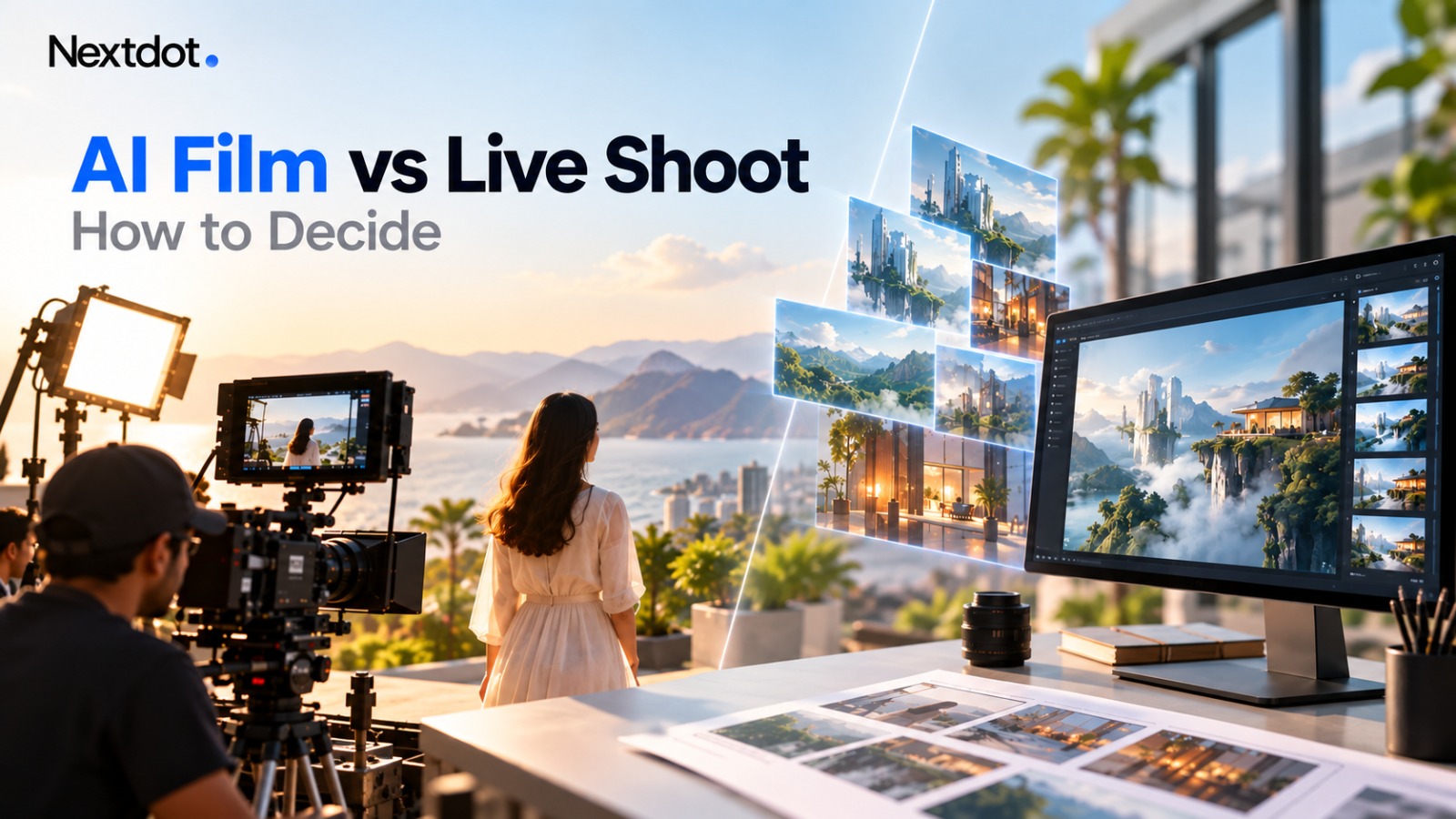
A brand film should be shot live where the audience needs to trust a real face, a real product or a real emotion, and generated where the shot asks for a world, a camera move or a volume of versions that a crew cannot deliver at a sane cost. Many of the strongest brand films in 2026 are hybrids, and the split is decided shot by shot. Make that decision in pre-production, before anyone writes a budget line, because the budget follows the split and rarely the other way round.
The usual framing asks whether the whole film should be AI or live. That question produces two bad outcomes. A fully generated film that asks viewers to believe in synthetic people they instinctively distrust, or a fully shot film that burns a day of crew and location money on a sequence a model would have rendered better. The CMO who asks the question per shot can avoid both.
The decision unit is the shot
A brand film is a sequence of shots, and each shot has a job. "AI filmmaking: what separates cinematic from generic" covered what makes a directed shot read as cinematic. This piece starts one step earlier: once you know what each shot has to do, how should it be made?
Sort every shot in the script against two questions. First, does the viewer need to believe this happened in front of a camera? Second, would a live crew need something physically impossible, dangerous, or wildly expensive to capture it? A shot that answers yes to the first question leans live. A shot that answers yes to the second leans generated. A shot that answers yes to both is where the real craft conversation starts, usually with a plate shot live and an environment or effect generated around it.
What still belongs on a live set
Four kinds of shot still earn a camera, a crew and a call sheet.
Hero talent. When a recognisable face carries the film, whether a brand ambassador, a founder or a doctor, the audience reads micro-expressions that current generation handles unevenly. Coca-Cola's 2024 holiday campaign, made by three AI studios using four generative models, drew public criticism, with viewers calling the film soulless (Source: NBC News, 18 November 2024). A brand can survive a stylised generated world. Viewers are far less forgiving of a synthetic face that asks for trust.
Real product in hand. If the film sells a device, a pack or a dosage form, the product on screen must be the product on the shelf. Generation can drift on labels, proportions and small text between shots, and in a regulated category that drift turns into a claims problem. Shoot the product. Shoot the hands that hold it.
Emotional close-ups. The shot that carries the film's feeling, a patient's relief or a parent's face at a door, is the shot the audience watches hardest. One unconvincing close-up can discredit the whole piece.
Anything a regulator or a court may examine as fact. A real hospital ward, a real procedure, a real testimonial. If the shot implies "this happened", shooting it keeps the brand's footing clean. "What healthcare brands need from creative in a regulated market" covers the claim substantiation rules that make this matter for healthcare brands in India.
What generation does better than a crew
Four other kinds of shot now favour generation on cost, time and sometimes quality.
World-building. Establishing shots of places the brand cannot afford to reach, or places that do not exist: a city at a specific hour, a stylised landscape, a period setting. A crew needs travel, permits and weather. A model needs a look reference and direction.
Impossible camera moves. A single move that starts at street level, rises through a building and ends inside a room. These moves cost rigs, drones, motion control and compositing on a live set. Generation handles many of them in a single directed pass, though holding the subject stable across the move still takes skilled direction.
Variant-heavy cutdowns. A brand film now ships as a hero cut plus dozens of versions for formats, languages, regions and audiences. Silverside AI delivered 110 versions of its Coca-Cola holiday spot, including 27 key market localisations with skylines customised to each city (Source: Marketing Brew, 21 November 2024). A live shoot captures one performance. Generation turns one approved master into the versions a media plan needs.
Anatomy and mechanism visualisation. For healthcare brands, the inside of the body is the one location a camera cannot visit without a procedure. How a stent opens, how a molecule binds, how a joint moves after surgery. Generated visualisation can replace a slow 3D animation pipeline for many of these shots, and medical review of every frame still applies, because an anatomically wrong frame is a claim.
The hybrid is the default
Put the two lists together and most brand films split. The founder speaks to camera, shot live. The world behind the story, generated. The product in a patient's hand, shot live. The mechanism inside the body, generated. The regional versions, generated from the approved master.
A hybrid film has one weak point: the seam. Live footage carries real lens character, grain and light. Generated footage carries its own texture. If nobody plans the match, the audience feels the cut even if they cannot name it. Hybrid work therefore needs one look specification that governs both halves: lens, grade, light direction and colour temperature. That specification is written before the shoot, so the director of photography lights the live plates to match the generated world, and the generated shots are directed to match the plates.
This is why the decision belongs in pre-production. A shoot planned without knowing which shots will be generated lights, frames and schedules for the wrong film. "The shot list is the prompt: pre-production for AI film" covers the pre-production documents in detail: the shot list, look reference and continuity bible that make generation directable.
Where the cost actually moves
The honest cost answer is that a hybrid film moves cost around more than it removes it.
Generation takes cost out of the lines that scale with physical reality: locations, travel, sets, permits, extra shoot days, and the per-version cost of cutdowns. How much it saves depends entirely on the shot mix, so treat any single savings percentage quoted before the shot list exists as a guess.
Generation adds cost in lines that did not exist before: direction of generated shots, iteration rounds, look development, continuity checks across generated sequences, rights clearance, and compliance review of every synthetic frame. The most expensive failure is a generated sequence that fails review late and has to be reshot live, because at that point the brand pays for both.
Time behaves the same way. Generation removes waiting for locations, weather and talent availability. It adds iteration. The schedule is set by the shot list: how many shots, how many of them are generated, and how long review takes on each. Any vendor quoting a timeline without seeing the shot list is quoting a guess.
The practical rule for a CMO: ask for the budget broken out by shot, with each shot marked live, generated or hybrid. A vendor who can produce that breakdown has made the decision deliberately. A vendor who quotes a single "AI film" number has not.
Settle rights and labelling before the first frame
Two questions change the shot sort, so answer them before the sort is final.
Likeness. Nextdot never generates or clones a real person's face or voice without that person's written consent and a re-use clause. Doctors who appear in creative need explicit consent plus a compliance check. If the consent is not in place, the shot is live or it is cut. We advise that the consent names the languages, films, channels and duration it covers. Whether a given consent form covers a generated likeness is a question to take to counsel.
Labelling. India's IT Amendment Rules 2026, notified on 10 February 2026 and in force from 20 February 2026, bring synthetically generated content into the due diligence obligations of the platforms that carry it, including prominent labels on synthetic visuals (Source: MeitY, IT Amendment Rules 2026). Which of those obligations reach the brand itself is a question to take to counsel. Nextdot ships labelling as a standard option on AI-generated creative, recommends it, and records the client's choice. The brand decides. It should decide knowing which of its shots are synthetic, which is one more reason to keep the shot sort on paper.
How the Creative Intelligence Pod runs the decision
The Creative Intelligence Pod delivers brand films that mix live shoots with generated shots. A named QC owner signs off, separate from the editor, and every healthcare video gets a medical accuracy review before it ships. The shot list, character sheets and continuity bible are client-owned creative memory and go with the client at exit.
Whoever makes the film, we recommend the live, generated or hybrid call sits on the shot list before the budget is drafted, with each shot carrying its job, its production route, its consent status and its review owner.
The decision itself is simple. Shoot what the viewer must believe. Generate what the camera cannot reach or cannot repeat at scale. Plan the seam. Put all three on paper before a single rupee is committed.
Frequently asked questions
Is AI video cheaper than a live shoot?
Sometimes, and it depends on the shot mix. Generation cuts costs tied to physical production, such as locations, travel, sets, extra shoot days and the cost of each additional version. It adds costs in direction, iteration, look development, continuity checks, rights clearance and compliance review. Any single saving figure quoted before the shot list exists is a guess, so ask for a budget broken out shot by shot.
When should a brand not use AI video?
When the shot asks the audience to trust a real face, a real product or a real event. Hero talent, the product in hand, emotional close-ups and anything that implies "this really happened" should be shot live. Generating any real person's likeness also needs that person's written consent first.
What is a hybrid AI and live-action film?
A hybrid film combines live-action and generated shots in one piece. People, products and emotional moments are shot live, while environments, impossible camera moves, anatomy visualisation and format variants are generated. A single look specification covering lens, grade and light governs both halves.
How long does an AI brand film take to make?
It depends on the shot count, the share of generated shots and how long review takes. Generation removes waiting for locations, weather and talent, and adds iteration and review. Any credible timeline starts from the locked shot list with each shot marked live, generated or hybrid.