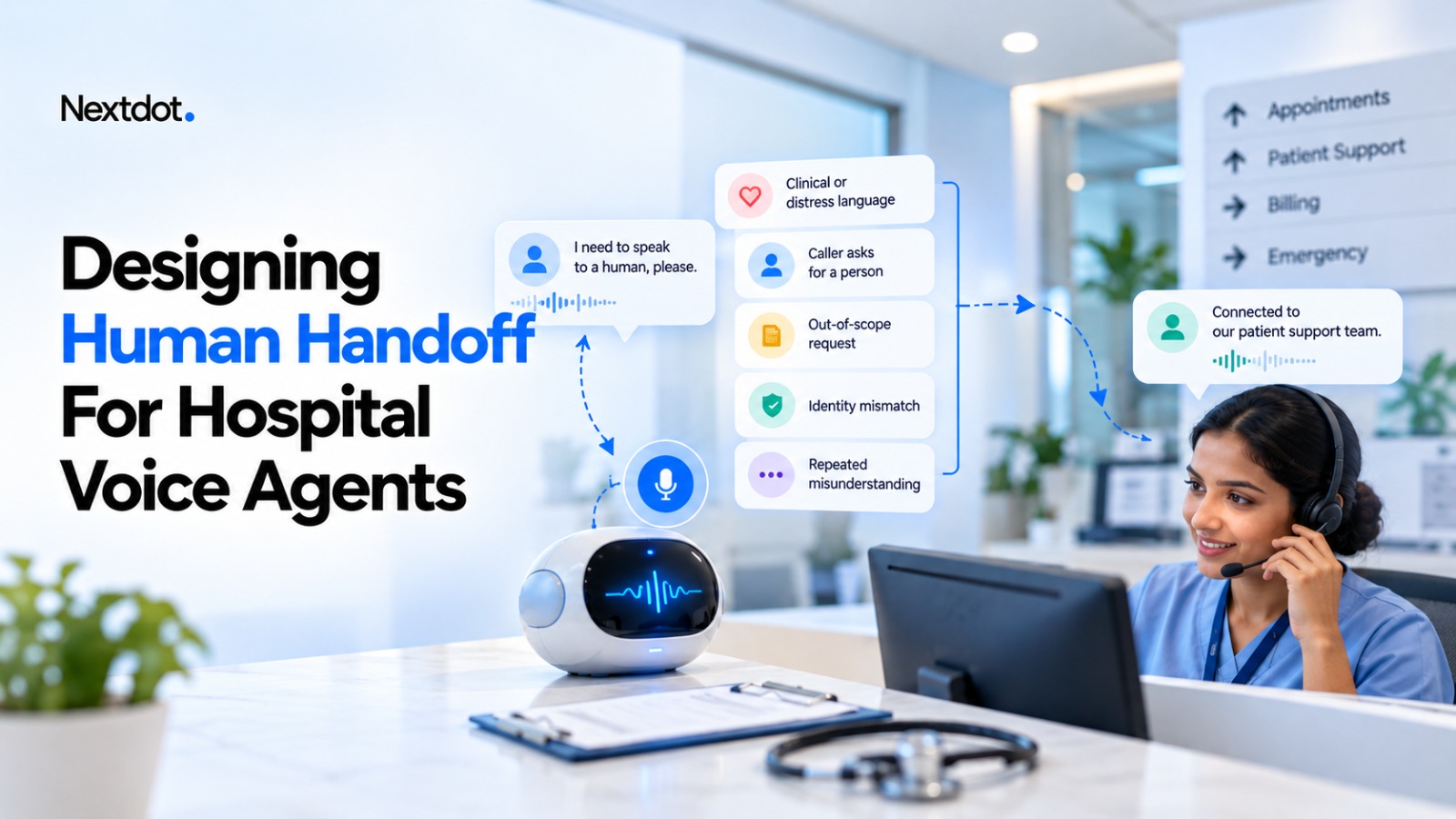
A hospital voice agent should hand a caller to a human on a short list of explicit triggers, pass the call's full context with the transfer so the patient does not have to repeat themselves, check the queue before it promises anyone, and follow a separate path after hours. Every one of those decisions is specific to the hospital, because hospitals rarely route a chest-pain call, a billing dispute or an insurance query the same way. Design the handoff first and the rest of the agent second. For systems built toward domain superintelligence (SI), the handoff marks where trust ends.
Why the handoff is the design centre
Across the inbound voice agents Nextdot runs in hospital contact centres, the most common live failure is the handoff to a human. Latency comes second. The failures cluster at the edge of that job, in the few seconds when the agent has to admit it has reached its limit and move the caller somewhere useful.
Callers notice this edge more than anything else. A Gartner survey of 5,728 customers found that 64 percent would prefer companies did not use AI in customer service, and the top concern behind that preference was that AI makes it harder to reach a human (Source: Gartner press release, 9 July 2024). A hospital caller is often elderly, anxious or calling for someone who is unwell. If the path to a person feels blocked, the whole deployment reads as a wall, however well the agent books appointments.
Domain superintelligence (SI) needs a hard edge
Nextdot builds its hospital voice agents toward domain SI: a system built to work at expert level inside one bounded workflow, with the audit trail, integration and human accountability that a regulated enterprise needs. On a hospital line, that workflow is the booking itself. The more capable the agent becomes inside it, the more the boundary matters, and the handoff is the boundary. Capability leaves clinical judgement with the clinician and the hospital, leaves DPDP obligations where the contract allocates them, and leaves the duty to reconstruct what happened on the call where it was.
When to escalate on a hospital line
"Autonomous vs Controlled: How to Design the Human Handoff in an Agentic System" covers general escalation triggers: confidence thresholds, irreversibility, blast radius and policy gates. A hospital phone line needs a sharper list, because the caller is live and worried. Five triggers do most of the work.
The caller asks for a person. Treat the request as final on the first ask. An agent that tries to retain the caller with one more question teaches that caller to shout "operator" on every future call.
Clinical or distress language. Chest pain, breathlessness, bleeding, a fall, a child who will not wake, or a caller who is crying. The agent leaves triage to clinicians and routes to whatever the hospital has named as its urgent path, and it does so before finishing any booking in progress.
Repeated misunderstanding. Two failed turns on the same slot, whether a name, a date or a department, is the signal. A third attempt costs more goodwill than a transfer does.
Out-of-scope intent. Billing disputes, complaints, insurance and TPA queries, medico-legal requests and anything the intended-use statement excludes. The agent should say plainly where it is sending the caller.
Identity or record mismatch. If the caller's details do not match the record the agent retrieved, the agent stops acting on that record. Continuing risks attaching an appointment to the wrong patient, which is a system-behaviour failure and sits with the vendor.
Each trigger needs a named owner at the hospital who signs off on its wording and its destination. That sign-off is what makes the tree defensible later.
Warm transfer: the context has to arrive before the caller does
A cold transfer drops the caller into a queue and leaves the human agent to start from zero. A warm transfer carries the call's context across with it, so the person who picks up already knows who is calling, in which language, why, and what has been done so far.
For a hospital, the context packet usually carries:
- Caller number and, where verified, the patient identifier the agent matched
- The language and register the caller used, including code-switching, so the human can answer in kind
- The detected intent and the trigger that caused the transfer
- What the agent already completed or attempted, such as a slot held, a doctor searched or a record looked up
- A two-line plain summary of what the caller said
The packet has to land on the human agent's screen at the moment the call connects. If it arrives thirty seconds later, the human asks the caller to start again, and the caller hears the same failure a cold transfer produces.
Every transfer should also leave a record: what triggered it, what context was passed, and what the human did next. Observability runs on every Nextdot deployment, with audit logs, versioned prompts and models, and human override capture. The override record is how a hospital learns which triggers fire too often and which fire too late.
Queue state belongs inside the agent's decision
An agent that transfers blind to the queue makes a promise it cannot keep. In practice: the agent says "connecting you now", the caller waits, the queue is twelve deep, and the caller hangs up blaming the AI.
The agent needs to read queue depth and expected wait before it offers a transfer, and it needs a planned behaviour for each state. When the wait is short, transfer warm. When the wait is long, tell the caller the honest wait and offer a callback with the context already captured. When the queue has no staffed agents at all, move to the after-hours path. Clinical and distress calls skip this logic and go straight to the urgent route, whatever the queue shows.
A callback request that stores the full context packet means the returning human starts the conversation already informed. A callback that stores only a phone number is a cold transfer with a delay.
After hours is a separate design
Many hospital contact centres run reduced staff at night, and some desks close entirely. The voice agent keeps answering, so the after-hours path needs its own tree.
Three decisions matter. First, the urgent route: where a caller with clinical or distress language goes when the day desk is shut, usually the emergency department's own line or the hospital's published emergency number. Second, the deferred queue: which requests get logged for a morning callback, with context, and who owns clearing that queue at the start of the shift. Third, honesty about availability. The agent should tell the caller that no one from that desk is available until a stated time. An agent that implies a human is coming when none is on shift manufactures exactly the frustration the Gartner survey describes.
Whether the agent tells callers it is an AI is the hospital's decision as Data Fiduciary, covered in "AI Disclosure in Patient Calls: What Hospitals Will Have to Decide". Nextdot ships disclosure as a configurable capability and recommends enabling it.
Why every hospital's escalation tree is different
Escalation paths are organisation-specific. One hospital routes cardiac symptom calls to a cardiology nurse line. Another sends every urgent call to the emergency desk. One runs an international patient desk with its own languages. Another folds insurance queries into billing.
A handoff tree copied from another hospital will route some real patients to the wrong desk. So the first working session of a voice agent build is about routing, and prompt work comes after it. Map every desk, its hours, its languages, its escalation owner and its overflow rule, then write the triggers against that map. The agent's conversational design follows from the tree.
The tree also changes. Desks merge, hours shift, a new site opens. The routing logic should be configuration the hospital's contact-centre team can review, versioned alongside the prompts, so that a change to a desk's hours does not wait for an engineering release.
What a CIO should measure
Four numbers tell you whether the handoff works: the share of calls transferred, broken down by trigger; the share of transfers answered by a human versus abandoned in the queue; how often the human re-asks for information the agent already captured; and the time from trigger to a human voice. Design the per-transfer record so all four can be pulled by trigger from day one.
Formal evaluation with clinician-labelled ground truth does not yet run on every Nextdot account, and extending it is a current engineering priority. Audit logs and human override capture do run on every deployment. Ask any vendor for last month's transfers, broken down by trigger. The answer will tell you more about the agent than a demo does.
Frequently asked questions
When should a voice agent transfer to a human?
A hospital voice agent should transfer when the caller asks for a person, when the caller uses clinical or distress language, after two failed attempts to understand the same detail, when the request falls outside the agent's intended use, such as billing disputes or complaints, and when the caller's details do not match the retrieved record. Each trigger should route to a destination the hospital has named and signed off.
What is a warm transfer?
A warm transfer moves a caller from the voice agent to a human along with the call's context: who is calling, their language, their intent, what the agent already did and why it transferred. The context appears on the human agent's screen as the call connects, so the caller does not repeat themselves. A cold transfer passes the call with no context.
What happens to a call after hours?
After hours, the voice agent follows a separate routing tree. Urgent and distress calls go to the hospital's emergency line. Non-urgent requests are logged with full context for a callback when the desk opens, with a named owner for that queue. The agent says honestly when a person will be available.
Why do voice agent handoffs fail?
Handoffs fail when context is lost in transfer and the caller has to start again, when the agent transfers into a long or unstaffed queue without warning, when escalation triggers are too slow or retain callers who asked for a person, and when the routing tree was copied from another organisation instead of mapped to the hospital's own desks and hours.
What is domain superintelligence (SI)?
Domain superintelligence (SI) is a system built to work at expert level inside one bounded workflow, with the audit trail, integration and human accountability that a regulated enterprise needs. More capability leaves liability, DPDP obligations and the duty to reconstruct a decision where they already sit. About the author: Nextdot's hospital voice stack is designed by an engineering team that includes two of our engineers holding the Anthropic Claude Certified Architect (CCA-F) credential.