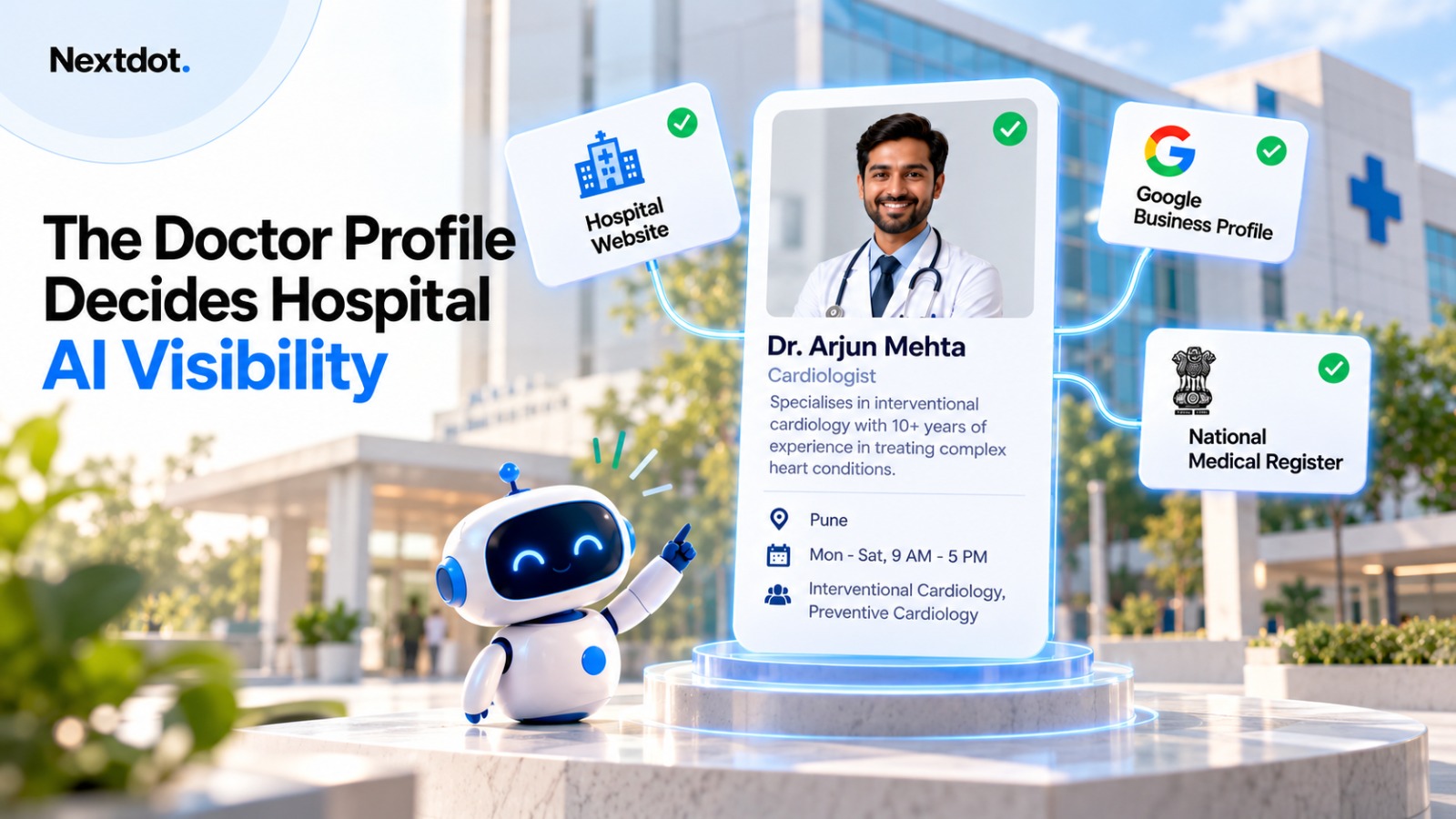
To get your doctors recommended by AI assistants, manage each consultant as a single verified record that reads the same on your hospital site, the doctor's Google Business Profile, the major directories and the National Medical Register. Patients ask for a specialist by condition and city, and when an answer engine does recommend, it names a person. The consultant profile is the record that engine has to match, and most hospitals fund it last.
Patients ask for a person, and the engine answers with one
Look at how the question arrives: "best cardiologist for a blocked artery in Pune". The patient names a condition, a place and, implicitly, a human being. The hospital is where that human works.
The engines respond in kind. A study published online in the International Journal of Medical Informatics in June 2026 ran 40,500 queries through ChatGPT asking it to recommend orthopaedic surgeons (Haupt et al., 2026). In 52.8 percent of responses it declined to recommend anyone. Where it did answer, it named individual surgeons, and in the coded subset only 44.6 percent of the surgeons it named were valid. The study covered US surgeons, so read it as evidence of the mechanism, and treat any Indian rate as unknown until someone measures it.
Two things follow for a hospital CMO. First, when the engine commits to an answer, the answer is a doctor's name. Second, in that study the engine got the name wrong more often than right, so a doctor with a clean, corroborated record holds a real advantage over a doctor whose facts are scattered. Your hospital wins or loses AI answers one consultant at a time.
Where the money goes, and where the answer comes from
On a typical large hospital website, the homepage carries the brand film, the accreditations and the centres of excellence. Somewhere below sits a "Find a Doctor" directory, often generated from an HR export, with a headshot, a degree string and an OPD timing nobody has touched since the doctor joined.
The brand page absorbs the design budget and the agency attention. Yet the consultant page is the one an answer engine has to match when a patient asks for a named specialist.
"Why Your Hospital Is Invisible to AI Assistants, and How to Fix It" set out why hospitals go missing from these answers. The next step is to run each doctor profile as an operational record, with an owner, a lifecycle and a measurement line of its own.
The four records that must agree
A doctor at a large hospital exists in at least four public places that answer engines read or that feed what they read.
The hospital profile page. This is the only record the hospital fully controls. It should carry the facts every other record will be checked against.
The Google Business Profile. Google's own guidelines treat doctors as individual practitioners who may hold a profile separate from the hospital's, provided they are public-facing and reachable at the verified location during stated hours (Google Business Profile Help, "Guidelines for representing your business on Google", accessed 30 September 2026). Many hospitals never decide who creates, claims or updates these practitioner listings, so some doctors have none, some have two, and some have one a patient created with the wrong timings.
The directories. Practo, Justdial and insurer panels each hold their own version of the doctor, entered at different times by different people.
The National Medical Register. The National Medical Commission launched the National Medical Register portal on 23 August 2024, with registration opening the following month and the stated aim of covering more than 13 lakh doctors (Business Standard, 15 September 2024). It is the regulator's record of who is licensed to practise, and the reference every other record should reconcile to. When a hospital's spelling of a doctor's name drifts from the registered name, the hospital is the one introducing the contradiction.
The facts that must match across all four are few: the name as registered, the qualifications, the specialty label, the hospital and branch, the OPD days and hours, and the consultation languages. Six fields. Ask your team for one sheet that lists them for every consultant, with a named owner and a last-verified date. If that sheet is slow to produce, it is where your hospital AEO starts.
A doctor record has a lifecycle, and it breaks at the transitions
Hospitals treat the doctor profile as a page. It behaves more like an employee record, and it breaks at the same moments.
A doctor joins. HR captures the registration number. Marketing gets a photo and CV weeks later, and the Google listing may never be created. In the gap, the engine has nothing to match.
A doctor leaves. In our view this is the most expensive transition. The profile page stays up because nobody owns taking it down, the directory listings keep showing the hospital as the affiliation, and the engine keeps sending patients to a consultant who now practises across town. The call centre then fields bookings for a doctor who is off the roster. "When the AI gets your hospital wrong: correcting answers you do not control" covers how to fix an answer once it is wrong. The cheaper route is a departure checklist that removes or redirects the record on the doctor's last day.
A doctor practises in more than one place. Visiting consultants and doctors with a private clinic alongside a hospital appointment are common in Indian cities. Each location needs its own consistent statement of days and hours, or the engine blends them into a single wrong answer.
A doctor's focus changes. A general orthopaedic surgeon moves into joint replacement. The CV updates. The old directory entries stay as they were.
None of these is a marketing event, so marketing hears late.
Who owns the doctor record
Our position: medical administration owns the facts, and marketing owns publishing them. The credentialing or medical services team already verifies registration, qualifications and privileges when a doctor joins. That team is the natural source of truth for the six fields. Marketing takes that verified record and publishes it to the hospital site, the Google profiles and the directories, on a fixed cadence and on every lifecycle event.
When marketing owns both, the facts come from whatever the doctor's CV said on the day the page was built. Write the ownership down, name a person on each side, and add the six fields to the joining and exit checklists. It costs little, and it removes a common source of wrong answers at the point where they start.
This also bears on the conduct questions set out in "The Compliant Way for Indian Doctors to Be Found by AI, Without Advertising". A record built from credentialing data sticks to facts, and it leaves out the testimonials and outcome claims that raise solicitation questions. How the conduct rules apply to any specific page element is a question for counsel before it goes live.
What a consultant profile page needs
The page itself should state, in plain text a patient and a machine can both read: the registered name, qualifications, specialty and sub-specialty, the conditions and procedures the doctor treats, branch and OPD schedule, consultation languages, and a dated last-updated line. Conditions matter most, because the patient's question starts with a condition. A cardiologist whose page says "interventional cardiology" and nothing about angioplasty gives the engine little to match against a patient asking about a blocked artery.
Structured data belongs on this page too. "Structured data for hospitals: what answer engines actually read" covers which schema types to use and where markup helps. The point here is narrower: markup on a page with wrong or stale facts only publishes the error more cleanly.
Measure per doctor
"Share of answer: how to measure whether AI recommends your hospital" sets out share of answer as the metric, run on a fixed prompt panel across several engines every month. For hospital AEO, cut that panel by consultant. Take your top revenue specialties, list the conditions patients ask about in each, and record which named doctors the engines return for your city, whether any of them are yours, and whether the facts they state are right. A hospital-level score hides the pattern. A consultant-level view can show that a handful of senior doctors carry the hospital's AI visibility while most of the roster is absent.
Where to start: the Doc Mirror audit
The audit is the first step, before any page gets rewritten. Doc Mirror, the visibility audit Nextdot built, queries ChatGPT, Perplexity, Gemini and Google AI Overviews to see how a doctor or hospital is described, and audits Google, search results, YouTube and page speed alongside. It repeats those queries over time to track share of answer against named competitors, and it reads and validates the schema.org markup on hospital and doctor pages. For a priority specialty, it shows which doctors the engines name and where their facts differ from your records. Auditing the whole roster is covered in "Every doctor on the roster: running a hospital-wide AI visibility audit".
The brand page will keep its budget. Give the consultant profiles an owner, a lifecycle and a monthly check, because that is where the AI answer about your hospital actually gets decided.
Frequently asked questions
Why does AI recommend doctors instead of hospitals?
Patients ask for a specialist by condition and city, and a doctor is the entity that matches that question. When an answer engine commits to a recommendation, it names individual practitioners, as a 2026 study of 40,500 ChatGPT queries for orthopaedic surgeons showed (Haupt et al., International Journal of Medical Informatics, 2026). The hospital appears as the doctor's affiliation.
What should a doctor profile page include?
A doctor profile page should include the doctor's name exactly as registered with the medical council, qualifications, specialty and sub-specialty, the conditions and procedures they treat, branch and OPD schedule, consultation languages, and a dated last-updated line. Keep it factual, with no testimonials or outcome claims, and ask counsel how Indian medical conduct rules apply to anything beyond the plain facts.
Does Google Business Profile affect AI answers?
Google Business Profile is one of the public records that shape how a doctor is described online, and Google's guidelines allow doctors to hold individual practitioner profiles separate from the hospital's. Answer engines draw on the wider web and do not publish how much weight they give any single source. The practical rule is that the profile must match the hospital page and the other records exactly, because contradictions give the engine conflicting facts to choose between.
How do you keep doctor information consistent?
Make medical administration the owner of the facts and marketing the owner of publication. Keep one sheet of six fields per consultant with a last-verified date, push every change to the hospital site, Google Business Profile and directories, and add the update to the joining and exit checklists.