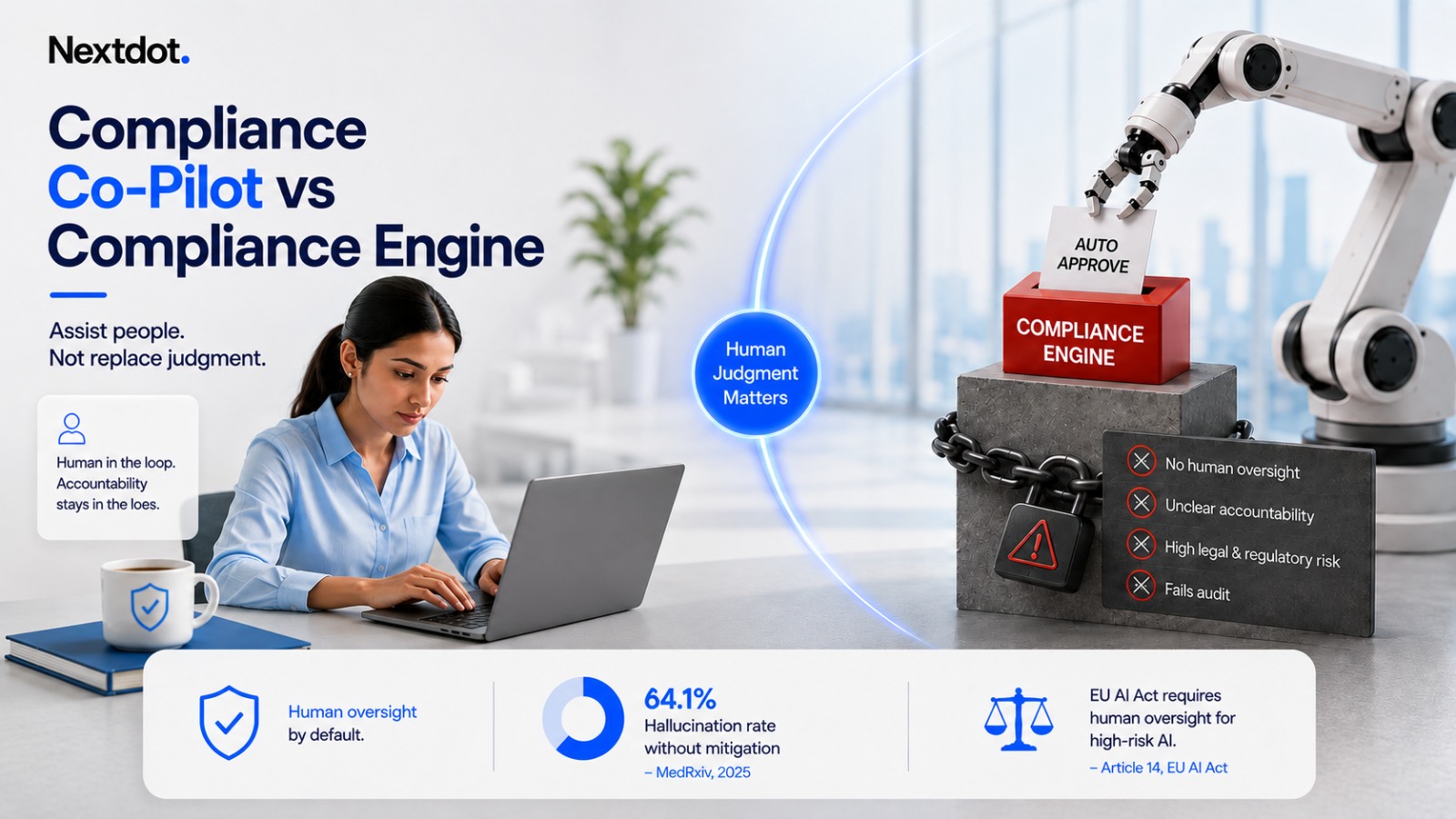
Compliance AI in a regulated industry should be assistive, not fully automated. A compliance engine tries to make the decision. A compliance co-pilot does the reading, retrieval, cross-referencing, and drafting, then puts a named human on the final call and records that they made it. In pharma, in hospitals, in any field where a wrong answer creates legal exposure, the second design is the one that survives audit. The first design moves the accountability nowhere it can legally sit, and that is precisely the flaw that gets it pulled from production.
The distinction is not a feature preference. It is a decision about where liability lands, and liability in these industries does not bend to how you architected the software.
The engine promises to remove the human. The regulator will not let you
The pitch for a compliance engine is throughput. Feed it the promotional copy, the adverse event report, the regulatory submission, and it returns a verdict: compliant or not, approved or flagged, ship or hold. No reviewer in the loop, no bottleneck, no salary attached to every judgment. On a slide, it is the better product.
It falls apart on contact with two facts.
The first is that the models are not reliable enough to be trusted unsupervised on the exact tasks compliance covers. A 2025 study measuring hallucination rates on clinical case summaries found error rates of 64.1 percent without mitigation, dropping to 43.1 percent with structured prompting, and the best-performing model still fabricated content 23 percent of the time even with mitigation active (Source: MedRxiv clinical case summary hallucination study, 2025). Those are not numbers you attach to an unreviewed compliance verdict. A system that is wrong roughly one time in four, on the category of content where being wrong is the whole risk, cannot be the last step.
The second fact is structural, and it does not improve as the models improve. Even a model that is right 99 percent of the time still produces a decision that a regulator will hold a named person accountable for. In clinical AI, liability decomposes by failure class. Clinical judgment sits with the clinician and, vicariously, with the hospital, and under Indian law it sits there regardless of what the vendor contract says. No regulatory pathway moves that accountability to a software company. A compliance engine that renders the final verdict is selling a hospital or a pharma company an outcome it cannot legally hand off. When the auditor asks who approved the release, "the engine did" is not an answer that closes the finding.
Assistive is the design that matches where the liability already sits
A co-pilot inverts the sequence. The machine does the labour-intensive part: reading the full document set, pulling the relevant regulation, checking the claim against the label, surfacing the three passages a reviewer needs to see, drafting the response. The human does the part that carries legal weight: the judgment, the sign-off, the accountability.
This is not a slower version of automation. It is the only version that fits the accountability structure of a regulated industry. The reviewer was always going to be liable. The co-pilot makes them faster at the work while leaving the liability exactly where the law already put it. Nobody has to pretend the accountability moved, because it did not.
This is the design philosophy behind NextComply, and the naming is deliberate. It is a compliance co-pilot, not a compliance engine. That distinction states which decisions the software is allowed to make, and the answer is that the software does the preparation while a named human makes the call.
Regulators outside India have already written this preference into law. The EU AI Act requires that high-risk AI systems be designed so that they can be effectively overseen by a human during use, with mechanisms for a person to monitor the system, interpret its output, and override or stop it (Source: EU AI Act, Article 14, Human Oversight, artificialintelligenceact.eu). The obligation is not that a human be nearby. It is that a human be able to understand what the system did and take a different decision. That is the difference between a co-pilot and an engine, written into a statute. Article 14 does not bind an India-only deployment, but it is the global reference standard for what a defensible high-risk AI system looks like, and Indian regulated buyers are increasingly reading it that way.
The difference shows up in the audit, not the demo
Both designs look similar in a demonstration. Both read the document, both flag the issue, both produce output in seconds. The gap opens later, when someone asks the questions that decide whether a system stays in production.
Show me the last thirty decisions this system made and who signed off on each one. On the engine, there is no signer, because the design removed the human whose name closes the loop. On the co-pilot, every decision carries a named reviewer, a timestamp, the model version, the prompt version, and what the human did with the recommendation, including the times they overrode it. That capture is standard on every Nextdot deployment: audit logs, versioned models and prompts, and human override records. It is what lets an organisation reconstruct a specific decision months later, which is the precondition for any liability allocation to be enforceable at all.
A separate discipline sits alongside that capture. Formal evaluation with clinician-labelled ground truth, measuring the system's outputs against what a qualified human says the right answer was, is how you quantify accuracy rather than assert it. Nextdot runs this where the ground-truth labels exist, and extending it further is a current engineering priority. It does not yet run on every account, and any vendor implying otherwise across a whole book of deployments is overstating what has been built. Observability tells you what the system did. Formal eval tells you how often it was right. The honest position is that the first is universal and the second is being extended, and a buyer should ask a vendor to distinguish the two rather than accept a blanket accuracy claim.
Where full automation is actually fine, and where it is not
The argument is not that AI should never act without a human. It is that the human belongs at the point where a wrong output creates legal or clinical exposure.
Retrieval, summarisation, first-pass drafting, formatting a submission to a required structure, checking a document against a static rule set: these can run with the human reviewing output rather than authoring each step, because a mistake there is caught downstream at low cost. The final compliance judgment is different. A wrong call there ships a non-compliant claim, misses a reportable adverse event, or releases a promotional piece that the regulator later pulls, and each of those has a name attached to it under the law. Automate the preparation. Keep the human on the verdict.
Drawing that line correctly is most of the work. Draw it too conservatively and you have rebuilt the manual process with extra steps. Draw it too aggressively and you have built an engine that will not survive its first serious audit. A compliance co-pilot is the system that draws the line where the liability already falls, and does everything up to that line at machine speed.
Frequently asked questions
Should compliance AI be automated or assistive?
Assistive. In regulated industries the final compliance judgment carries legal accountability that sits with a named human, usually the reviewer, clinician, or their employer, and no software architecture moves it. AI should do the reading, retrieval, cross-referencing, and drafting at machine speed, then present the work for a human to approve. Full automation of the final decision removes the person the regulator holds responsible, which is why those systems tend to get pulled after their first audit.
What is a compliance co-pilot?
A compliance co-pilot is an assistive system that prepares compliance work for a human decision-maker rather than making the decision itself. It reads the document set, retrieves the relevant regulation, checks claims against source material, and drafts responses, while the final sign-off stays with a named reviewer. Every recommendation and every human action is logged with the model version and prompt version, so a specific decision can be reconstructed under audit. NextComply is built on this design.
Why do regulated industries need assistive AI?
Because a wrong compliance output in these industries creates legal or clinical exposure that a person is accountable for, and language models are not reliable enough to carry that unsupervised. A 2025 study found the best model still hallucinated 23 percent of the time on clinical case summaries even with mitigation (Source: MedRxiv, 2025). More fundamentally, even a highly accurate model produces decisions a regulator attributes to a named human, so the accountability cannot be handed to the software regardless of its accuracy.
Can compliance be fully automated?
The preparation can: retrieval, summarisation, first-pass drafting, and checking against static rules, where an error is caught downstream at low cost. The final compliance judgment cannot be safely automated, because a wrong verdict ships a non-compliant outcome that a named person is legally answerable for. The EU AI Act encodes this by requiring effective human oversight of high-risk systems, including the ability to interpret output and override it (Source: EU AI Act, Article 14). Automate the work up to the decision. Keep the human on the decision.