AI can draft parts of a regulatory submission, and it is already good enough to be worth doing on the high-volume, template-heavy modules. It cannot decide what goes into the submission, it cannot make a regulatory judgement, and it cannot be the reason a claim ends up in a dossier. The useful line runs between drafting text from source data you already hold and generating the substance of a regulatory position, and every regulator that has spoken on this has drawn the line in roughly the same place.
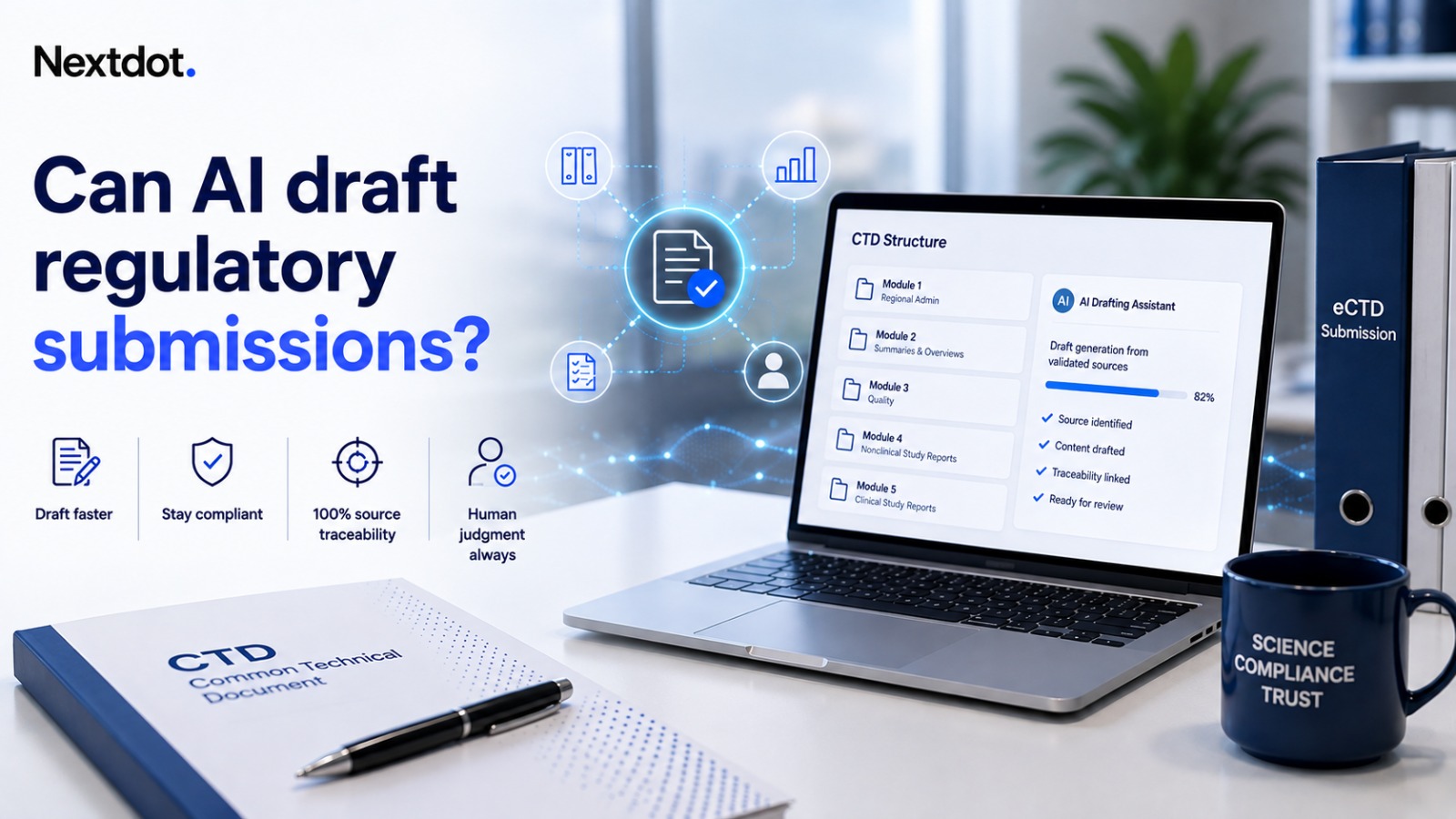
The Common Technical Document is the natural place to start, because its structure is what makes selective drafting possible in the first place. A submission built to the CTD, or filed electronically as an eCTD, is not one document. It is five modules with fixed contents: Module 1 for the regional administrative information, Module 2 for the summaries and overviews, Module 3 for quality, Module 4 for nonclinical study reports, and Module 5 for clinical study reports. Some of that content is regurgitation of data that already exists in a validated system. Some of it is argument. AI belongs in the first category and nowhere near the second.
Which CTD modules actually suit AI drafting
Start with Module 2, the summaries. The Quality Overall Summary in 2.3, the nonclinical and clinical summaries in 2.6 and 2.7, are by design a faithful condensation of material that already sits in Modules 3, 4 and 5. A model that can read a study report and produce a structured summary in the required format is doing exactly the task these modules describe. The source is fixed, the target structure is fixed, and the reviewer who signs it has the full study report open beside the draft. This is the strongest fit in the whole dossier.
Module 1 is the next candidate, for a duller reason. Cover letters, application forms, administrative and labelling components follow regional templates that change little between filings. Drafting these from a filled-in data sheet is closer to document assembly than writing, and it is where a regulatory team loses hours it will never get back.
Parts of Module 3 suit assisted drafting too, specifically the narrative sections of the quality dossier where a manufacturing process or an analytical method is being described in prose from batch records and validation data that already exist. The specifications, the numbers, the method parameters are not for a model to originate. The connective text around them is.
Modules 4 and 5 are where care has to sharpen. Individual study reports contain a lot of standardised structure, and summarising a completed report is defensible. But the interpretation, the benefit-risk argument, the clinical conclusion, is a regulatory position. A model can assemble the paragraph. It cannot be the author of the judgement, and the audit trail has to make that unambiguous.
The pattern across all five modules is consistent. Where the module restates data that already lives in a controlled system, AI drafting saves real time. Where the module makes an argument to the regulator, the human makes the argument and the model does not.
Where AI must not go
The disqualifying use is generating substance the source data does not support. A model asked to write a favourable summary will write a favourable summary, and it will do it fluently, and the fluency is the danger. A regulatory writer reads a claim and asks where the number came from. A language model, left to fill a gap, will produce a sentence that reads exactly like the sourced ones around it. In a dossier, an unsourced sentence that looks sourced is not a small defect. It is the thing an inspector is trained to find.
So the rule for regulatory drafting is stricter than the rule for marketing copy or internal knowledge work. Every factual statement in a machine-drafted section has to trace to a specific location in the source data, and the drafting system has to make that trace visible rather than assumed. This is source traceability, and in regulatory affairs it is not a nice-to-have. It is the condition under which drafting is allowed to happen at all.
There is a second boundary that teams miss. AI drafting must not silently become AI deciding. A model that flags a discrepancy between two study reports is helping. A model that resolves the discrepancy and writes the reconciled version without surfacing that it did so has crossed from drafting into regulatory decision-making, and no reviewer can catch what the system did not show them.
How regulators actually view AI-drafted submissions
Regulators have been clearer on this than most vendors admit. In January 2025 the FDA issued its first draft guidance on the subject, "Considerations for the Use of Artificial Intelligence to Support Regulatory Decision-Making for Drug and Biological Products" (Source: FDA, draft guidance, 7 January 2025). Its central proposal is a risk-based credibility assessment framework: before an AI model's output is used to support a regulatory decision, the sponsor has to establish that the model is credible for that specific context of use, and document how. The heavier the model's influence on a safety, efficacy or quality decision, the more evidence of credibility the regulator expects.
Read that guidance for what it implies about drafting. It is scoped to AI that produces information supporting regulatory decision-making, and it explicitly sets aside uses that do not affect patient safety, product quality or study reliability. Drafting a Module 1 cover letter is nowhere near that line. Summarising a study report sits closer, because the summary influences how a reviewer reads the evidence, and the credibility and traceability of that summary start to matter. The guidance does not ban AI. It asks whether you can show your work.
The regulator's own behaviour reinforces the same split. The FDA now runs an internal generative AI tool, Elsa, launched in June 2025 to help its staff summarise reports, compare labels and draft internal documents, and it has been explicit that the tool augments reviewers rather than replacing them, with staff responsible for directing it and verifying its output (Source: FDA, Elsa announcement, 2 June 2025). The agency drafting with AI on the review side, under human verification, is the same posture it expects from sponsors on the submission side. Assisted drafting, verified by an accountable human, is acceptable. Autonomous authorship is not.
Indian sponsors sit inside this same reality. India is moving its filings toward electronic submission, and the CTD structure that makes selective drafting possible is the structure the CDSCO expects a dossier to follow. There is no Indian guidance that treats AI-drafted submission text as exempt from the requirement that every claim be substantiated and every document be attributable. If anything, the safer assumption for an Indian regulatory team is that CDSCO will expect at least what the FDA and EMA already expect, and to build the audit trail to that standard from the first filing.
The audit trail is the actual product
If there is one thing a regulatory team should take from this, it is that the drafting is the easy part and the audit trail is the hard part. Any capable model can produce a competent Module 2 summary. Far fewer drafting setups can answer the question a regulator or an internal QA auditor will eventually ask: for this specific sentence, what source did it come from, which model and prompt version produced it, and which named person reviewed and approved it before it entered the dossier.
That question is not hypothetical. It is the question an inspection turns on. So the components that matter in an AI drafting workflow are not the model choice. They are source-linking on every generated statement, versioning of the models and prompts used, capture of the human review and override at each step, and a record that survives an audit years after the filing. A drafting tool without that trail is a liability generator with good grammar.
This is the same discipline Nextdot builds into regulated deployments generally: the system has to be able to reconstruct what happened, because the accountability allocation between the sponsor, the tool and the reviewer is only enforceable if the record exists. In regulatory affairs the point is sharper than usual. The submission is a legal document, the signatory is a named person, and the tool's job is to make that person faster without ever becoming the author of record.
Used inside those limits, AI is a real gain for a regulatory writing function that is chronically behind. It takes the template-heavy modules off the critical path and gives the writer more time on the modules that carry argument. Used outside them, it produces submissions that read well and fall apart under the first pointed question. The difference is not the model. It is whether the drafting system was built to show its work.
Frequently asked questions
Can AI write regulatory submissions?
AI can draft parts of a regulatory submission, specifically the sections that restate data already held in a validated system: administrative templates, and summaries built from existing study reports. It cannot originate a regulatory claim, make a benefit-risk judgement, or be the author of record. Every machine-drafted statement must trace to a source and be reviewed and approved by a named person before it enters the dossier.
Which CTD modules can AI draft?
The best fit is Module 2, the summaries and overviews, because they are a faithful condensation of Modules 3, 4 and 5, which already exist. Module 1 administrative and labelling templates are also strong candidates. Narrative sections of the Module 3 quality dossier can be assisted where specifications and numbers come from validated records. The interpretive conclusions in Modules 4 and 5 are regulatory positions and should stay with the human author.
How do regulators view AI-drafted submissions?
Regulators accept AI as an assistant under human verification, not as an autonomous author. The FDA's January 2025 draft guidance proposes a risk-based credibility assessment: the more an AI output influences a safety, efficacy or quality decision, the more the sponsor must document that the model is credible for that use. The FDA applies the same augment-not-replace posture to its own internal drafting tool. Indian sponsors filing to CDSCO should assume an equivalent standard.
What audit trail is needed for AI drafting?
The workflow must be able to answer, for any generated sentence: what source it came from, which model and prompt version produced it, and which named person reviewed and approved it. That means source-linking on every factual statement, versioning of models and prompts, capture of human review and overrides, and a record that survives an inspection years after the filing. Without that trail, AI-drafted submission text is a liability rather than a time saving.