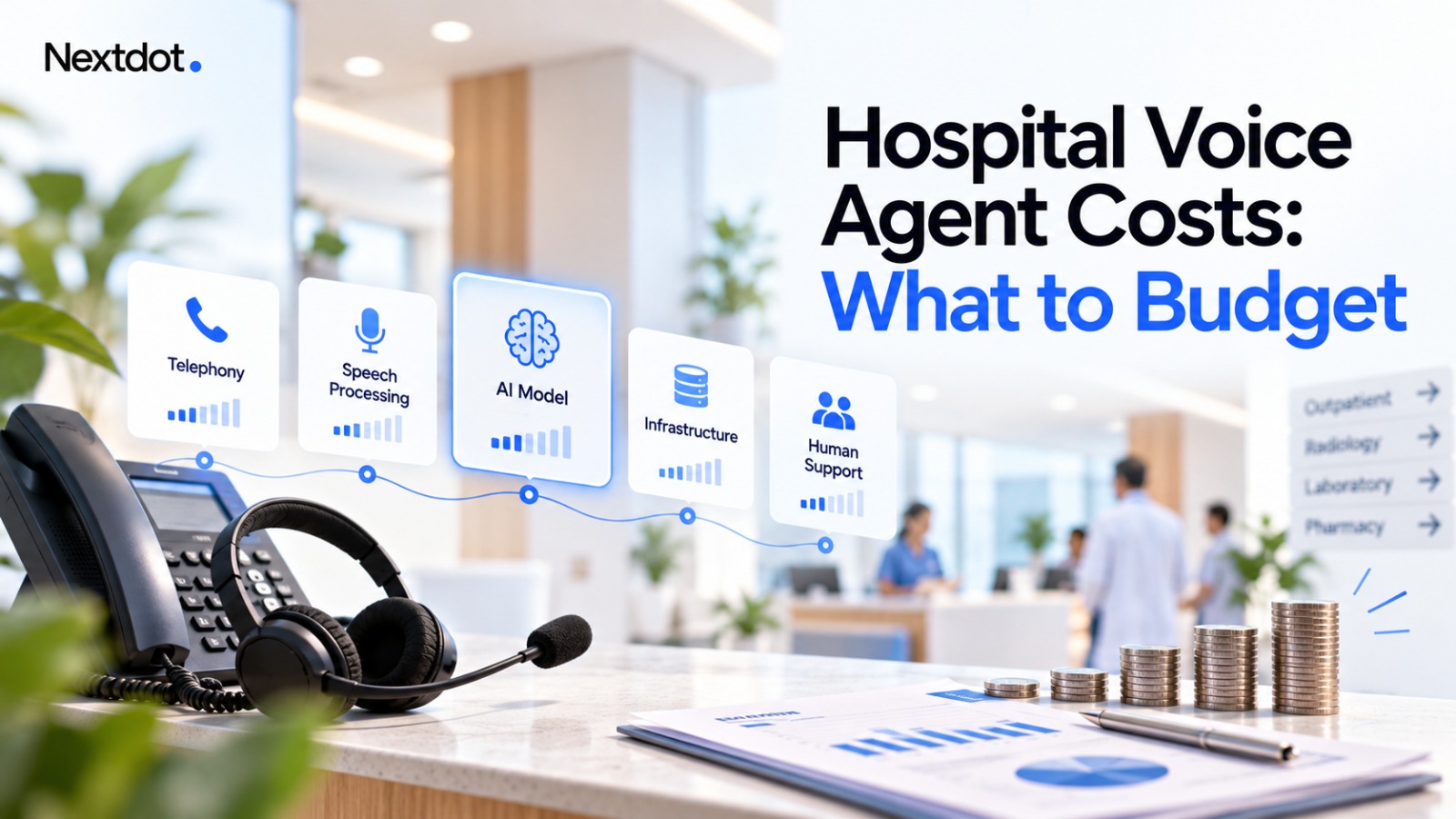
A hospital voice agent costs a one-time build and integration fee plus a monthly run cost made of telephony, speech and model usage per minute, reserved concurrency, human fallback, and a tuning and monitoring retainer. The per-minute rate is the smallest and most visible line. The number worth budgeting against is cost per resolved call, compared with the fully loaded cost of the human seat that would otherwise take the same call.
Most voice proposals a CIO sees lead with a per-minute rate because it is easy to compare and easy to make look small. It is also the wrong unit. A patient who calls to book a cardiology slot and gets transferred to a human after ninety seconds has cost you the agent's ninety seconds, the human's four minutes, and the telephony for both legs. The proposal priced the first part. You pay for all three.
The two cost lines, and why the second one decides the case
Every hospital voice deployment carries two kinds of cost.
The first is build and integration. It covers mapping your intents, wiring the agent to your HMIS and appointment system, designing the escalation tree with your contact-centre team, telephony setup on your existing lines or SIP trunks, and testing before patients hear it. It is paid once, with a smaller repeat each time you add a department, a language or a new integration. Nextdot structures voice builds this way, as a setup fee plus a monthly recurring charge. We do not publish the figures, because two hospitals with the same call volume can need very different integration work.
The second is the run cost, and it compounds. It has five parts, covered below. Buyers under-budget the run cost far more often than the build, because the build is quoted in one number and the run cost arrives as five lines billed by several parties, some of them your own staff.
Gartner put the stakes plainly: labour can represent up to 95 percent of contact-centre costs, and it predicted that one in ten agent interactions would be automated by 2026 (Source: Gartner press release, 31 August 2022). That is the prize. It is also a warning. If labour is most of the cost, a voice agent that sends too many calls back to humans saves very little, however cheap its minutes are.
Cost per minute is the number vendors quote
A per-minute rate bundles four things: speech-to-text on the caller's audio, the language model call that decides what to say, text-to-speech on the reply, and the orchestration and hosting that hold the call together. Each has its own pricing basis. Speech is billed on audio duration, the model on tokens, and hosting on compute and uptime.
Three things move the per-minute figure more than the vendor's list price.
Call length. A booking call that runs three minutes because the agent reads out six slot options costs more than one that offers two and asks. Script design is a cost decision.
Model choice. A larger model on every turn costs more per minute and usually adds latency too. Routing simple turns to a smaller model is the main lever, and we covered it in "Where the Latency Goes" and in "Token Costs, Caching and Model Routing".
Language mix. Hindi, English and code-switched calls may run on different speech configurations with different rates and different error profiles. An agent that mishears a Hindi date and has to confirm twice has doubled the minutes on that turn.
Ask any vendor to break the per-minute figure into these components. If they cannot, you cannot tell which lever to pull when the bill rises.
Telephony and concurrency: the capacity you pay for when nobody calls
Telephony is a separate line from the agent. You pay your carrier or trunk provider for the minutes on both the inbound leg and any transfer leg, and you pay for channel capacity.
Concurrency is where budgets break. A hospital contact centre does not receive calls evenly. Monday mornings, the hour after OPD opens, and the day after a health camp all spike. The agent must carry the peak, so you reserve capacity for the peak: SIP channels, model throughput and hosting headroom. That reserved capacity costs money on quiet Sunday nights too.
The question to put to a vendor is simple. What is the committed concurrency, what does it cost when idle, and what happens to the 41st caller when you have reserved 40 channels? If the answer is a busy tone, you have moved the cost into lost appointments. If the answer is an overflow to the human queue, you have moved it into human fallback. Either way the cost exists, and a proposal that prices only average load has hidden it.
Nextdot deployments are inbound only today. Outbound calling, reminders and follow-ups carry a different telephony cost profile and a different regulatory profile, and this piece does not price them.
Human fallback is the cost that decides the business case
In our deployments, the most common place a live voice agent fails is the handoff to a human. That makes human fallback both a quality issue and often the largest variable cost in the run.
Every call that transfers carries four costs: the agent minutes spent before the transfer, the telephony for the transfer leg, the human agent's handling time, and the extra handling time when context did not travel with the call and the caller repeats everything. The last one is the cost nobody quotes. A cold transfer can make the human leg longer than a call the human took directly, because the caller is now annoyed and the agent's partial work has to be checked. We set out how to design the transfer so context arrives first in "The Handoff Is the Product".
So the metric that matters is containment by intent. Appointment booking, report status and department directions may contain well. Billing disputes, insurance pre-authorisation and anything clinical should escalate by design, and those calls should never be counted as agent failures. A blended containment figure hides this. Ask for containment per intent, measured on your own call recordings during a pilot, before you model savings. Any containment rate a vendor quotes before seeing your calls is a guess.
The tuning and monitoring retainer
A voice agent does not stay accurate by itself. Doctors change schedules, departments move, new tariffs arrive, the HMIS gets upgraded and an API response changes shape. Callers find phrasings the test set never covered. Every one of these needs someone to notice, change a prompt or an integration, and re-test before the change reaches patients.
That work is a monthly retainer, and it should cover four things you can inspect: call review against a sample each month, prompt and model version control with a record of what changed and why, regression testing when anything changes, and observability that lets you reconstruct any call. At Nextdot, audit logs, versioned models and prompts, and human override capture run on every deployment. Formal evaluation against clinician-labelled ground truth does not yet run on every account, and extending it is a current engineering priority. Ask any vendor what runs on every deployment and what does not, and expect a direct answer.
A buyer who cuts the retainer to save money usually buys it back later as a rising transfer rate. The agent's containment slides quarter by quarter as the hospital changes around it, and the savings go with it.
What to compare against a human agent seat
The honest comparison sets the cost per resolved call on the agent against the cost per resolved call on a human seat, for the same intents.
For the human seat, load the full cost: salary and benefits, supervision, training and attrition backfill, workstation and licences, telephony, and the shift coverage needed for nights and Sundays. Divide by resolved calls.
For the agent, sum the per-minute usage, the telephony, the reserved concurrency, the human fallback cost on transferred calls, and the monthly retainer, then divide by calls the agent resolved without a human. Amortise the build over a realistic period, usually the life of the current HMIS integration.
Three results come out of that sum, and each is useful. On high-volume, well-structured intents the agent often wins. On intents that transfer often, the agent can cost more than the human seat it was meant to replace, and should be scoped out or redesigned. After hours, the comparison changes entirely, because the alternative is often no answer at all, and the cost of a missed booking belongs in the model.
A budgeting checklist for the CIO
Before signing, get these in writing:
- The per-minute rate split into speech, model, voice and hosting.
- Committed concurrency, its idle cost, and the behaviour above the limit.
- Containment per intent, measured on your own calls during a pilot.
- The human fallback cost per transferred call, including handling time on your side.
- What the monthly retainer covers, with named deliverables.
- Who pays when the HMIS changes and the integration breaks.
- How any call can be reconstructed from logs if a patient complains.
A vendor who answers all seven has priced the system you will run. A vendor who answers only the first has priced the demo.
Frequently asked questions
How much does an AI voice agent cost?
A hospital voice agent costs a one-time build and integration fee plus a monthly run cost. The run cost covers speech, model and voice usage per minute, telephony and reserved concurrency, human fallback on transferred calls, and a tuning and monitoring retainer. Integration scope drives the build figure, so ask for a quote against your own systems and call mix.
Is a voice agent cheaper than a human call centre agent?
It is often cheaper on high-volume, structured intents such as appointment booking and report status, when most of those calls resolve without a transfer. It can cost more on intents that transfer often, because you pay for the agent's minutes and the human's time on the same call. Compare cost per resolved call by intent.
What is cost per resolved call?
Cost per resolved call is the total run cost of the voice agent, including telephony, concurrency, fallback and the retainer, divided by the calls it completed without a human. It compares fairly with a human seat because it counts the calls the agent could not finish.
What hidden costs come with voice AI?
The common ones are reserved concurrency paid for during quiet hours, the human handling time on transferred calls, longer human calls after a cold transfer, re-integration when the HMIS or appointment system changes, and the monthly tuning needed to stop containment from sliding as the hospital changes. About the author: Nextdot's hospital voice stack is designed by an engineering team that includes two of our engineers holding the Anthropic Claude Certified Architect (CCA-F) credential.