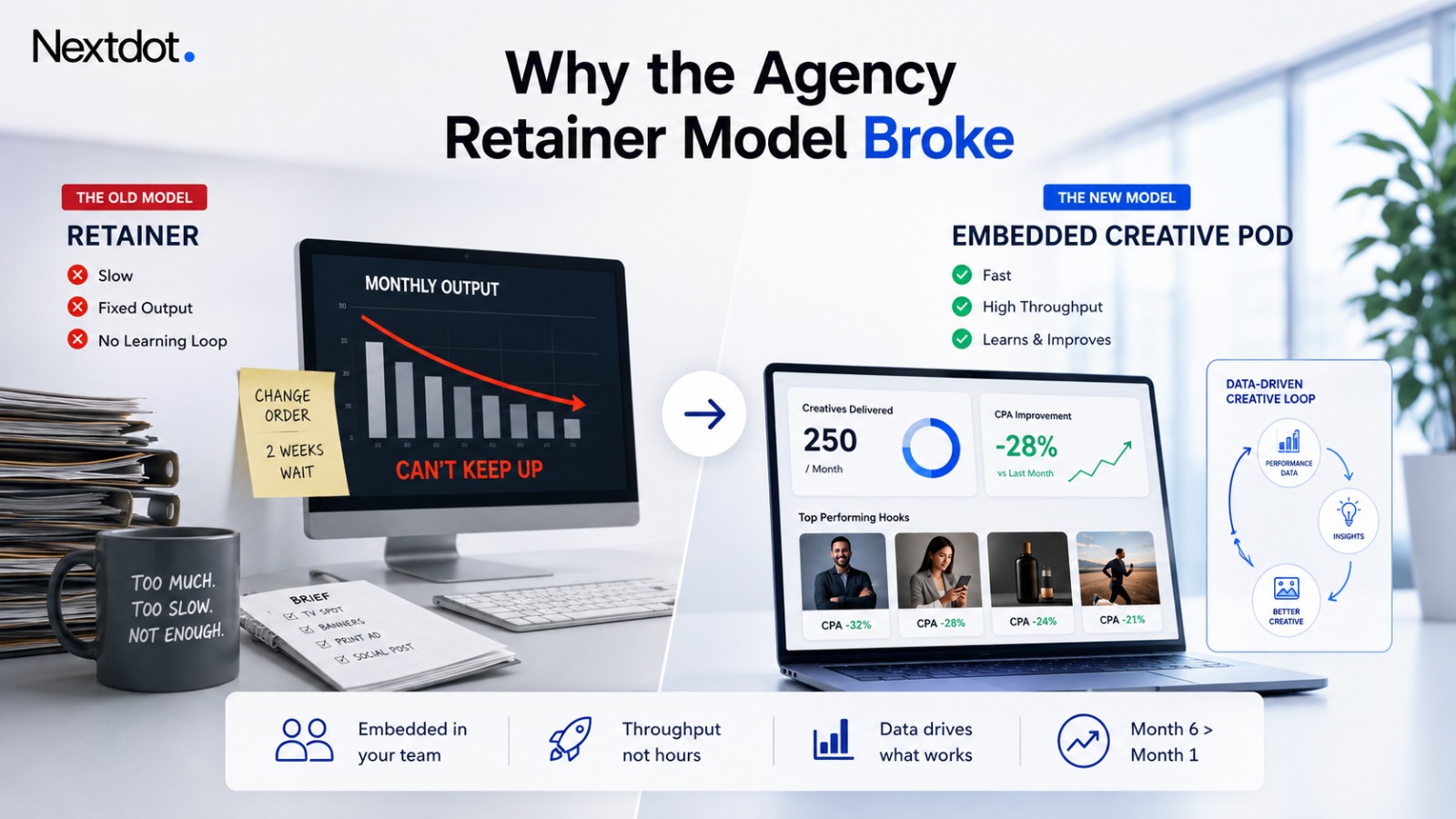
The agency retainer broke because it prices a fixed monthly fee against a fixed monthly output, at a moment when the output a brand needs stopped being fixed. You now need more creative, in more formats, refreshed faster, than any retainer was ever scoped to produce. The retainer did not get expensive. It got slow, and slow is the one thing a performance channel does not forgive. What replaced it is an embedded model that prices throughput and learns from your performance data, so month six is better than month one instead of the same as it.
If you run marketing at a large brand, you already feel this. The retainer that felt reasonable in 2019 now produces a fraction of what your channels demand, and every additional deliverable is a scope conversation, a change order, a two-week wait. The problem is structural. It is worth being precise about why.
The retainer was built for a world with fewer surfaces
A retainer is a peace treaty between a client who wants unlimited work and an agency that wants predictable revenue. It sets a monthly fee, an implied volume, and a servicing team sized to that volume. For twenty years that worked, because the number of creative surfaces a brand had to feed was small and moved slowly. A television spot, a print layout, a handful of banners, a quarterly campaign. Output was measured in weeks, and a retainer team sized for weeks could keep up.
That world is gone. A single performance campaign on Meta now wants dozens of variants because the platform demotes fatigued creative and rewards fresh assets. Instagram, TikTok, YouTube Shorts, and connected TV each want native formats, not a resized version of the same file. The demand curve for creative went vertical while the retainer's supply curve stayed flat.
The strain shows up in the numbers. In a survey of marketers, 72 percent said they reuse or slightly modify assets across platforms, while only 25 percent tailor creative for both social and connected TV (Source: research reported by PPC Land, 9 July 2025). Reuse is not a preference. It is what teams do when the model feeding them cannot produce enough native work, so the same asset gets stretched across surfaces it was never built for, and performance leaks at every one.
Why brands stopped waiting: the in-housing signal
The clearest evidence that the retainer stopped working is where the money went. Brands did not just complain. They built their own teams.
The share of ANA member marketers running an in-house agency reached 82 percent in 2023, up from 78 percent in 2018 and 58 percent in 2013 (Source: ANA in-house agency study, reported by Marketing Dive, May 2023). That is not a fad. That is a decade of senior marketers deciding that a fee-per-month arrangement with an outside shop could not keep pace with what their channels needed, and pulling the work closer.
Read the motive carefully, because it is the part most agencies got wrong. The reason to bring creative in-house shifted from saving money to gaining control and speed. In more recent research, most marketers described the in-house team as a strategic partner rather than a cost-cutting move (Source: ANA and WFA in-housing research, reported by Adweek, 2025). CMOs were not chasing a cheaper retainer. They were chasing a faster one, and a smarter one, and the traditional retainer could offer neither.
In-housing has its own bill, though, and it is a large one. You are now hiring, managing, and retaining a creative department, carrying the fixed cost through slow quarters, and rebuilding institutional memory every time someone leaves. Most brands that in-housed did it to escape the retainer's ceiling, then discovered they had bought a different ceiling: their own headcount.
What the retainer and the in-house team both miss
Both models share a blind spot. Neither is built to get better on its own.
A retainer agency produces to a brief and moves on. An in-house team produces to a brief and moves on faster. In both cases the creative is trained on gut, on the last campaign, on whatever the account lead believes works. The performance data that would tell them what actually converted, which hook held attention, which format beat the others on cost per acquisition, sits in the client's ad platform, unread by the people making the next round of creative.
That gap is the expensive one. When your creative program does not learn from its own results, you pay to rediscover the same lesson every quarter. The retainer bills you for volume that repeats last month's mistakes. The in-house team burns salary doing the same. The output looks busy. It does not compound.
Marketers know this is the real bottleneck. In one study, 61 percent of marketing teams named limited time, budget, or staff as the barrier to producing the creative they need (Source: Ipsos and Smartly, From Overwhelm to Opportunity, April 2026). The constraint is not talent or taste. It is a production model that cannot scale volume and cannot turn its own results into better work.
What replaced it: the embedded pod
The model that answers both failures is an embedded creative pod: a dedicated unit that sits inside your marketing team, produces at a fixed monthly volume, and reads your performance data to improve what it makes next.
Three things make it different from the retainer you are trying to leave.
It prices throughput, not time. A retainer sells you a team and hopes the volume works out. A pod sells you a committed output at quality, at a fixed monthly cost, so the number of creatives you receive is the deliverable, not a servicing debate. The anchor benchmark Nextdot runs is 250 fresh creatives a month for a single hospital brand, statics and reels across performance and branding. That is a volume no comparable retainer team produces without a change order and a delay.
It is embedded, not external. The pod operates as a department inside your marketing function, with the context and the standing access a rotating account team never has. Briefs are not re-explained every cycle. The system remembers what was approved, what was rejected, and why, so the institutional memory you would lose to in-house churn stays with the pod.
It learns from performance. The pod has read-only access to your performance data: cost per acquisition, cost per thousand impressions, and conversions on the paid side, reach, shares, and saves on the organic side. That data trains the next month's creative. The pod stops guessing which hook works because the numbers already told it. This is the loop the retainer and the in-house team both skip, and it is the reason a pod's month six should beat its month one.
For a CMO, the calculation is straightforward. You are not choosing between an expensive agency and a cheaper one. You are choosing between a model that caps your throughput and forgets your results, and a model that commits to volume and compounds on your own data. The retainer broke because it could not do either. What replaced it was built to do both.
Frequently asked questions
Is the agency retainer model dead?
The fixed-fee, fixed-output retainer is failing for high-volume brands, though it survives for low-volume work. It priced a set monthly output against a set fee, which stopped matching reality once brands needed far more creative, in more native formats, refreshed faster. The evidence is in the shift: 82 percent of ANA member marketers ran an in-house agency by 2023, up from 58 percent in 2013 (Source: ANA, reported by Marketing Dive, May 2023), because the retainer could not keep pace.
What is replacing the agency retainer?
An embedded creative pod: a dedicated unit that works inside the client's marketing team, produces at a committed monthly volume, and reads the client's performance data to improve future output. It replaces the retainer's fixed servicing team with a fixed throughput, and it replaces gut-based creative with a feedback loop trained on real results such as cost per acquisition and conversions.
Why do retainers fail for brands now?
Because the number of creative surfaces a brand must feed grew vertically while the retainer's output stayed flat. A single performance channel now wants dozens of fresh variants, and each platform wants native formats. When 72 percent of marketers admit to reusing or lightly editing assets across platforms (Source: research reported by PPC Land, 9 July 2025), it signals a supply model that cannot produce enough native work, so performance leaks across every surface.
What is an embedded creative pod?
An embedded creative pod is a productized replacement for the agency retainer. It is a trained team plus agentic tooling that operates as a creative department inside the client's marketing function, delivers a fixed volume of creative each month at agreed quality, and has read-only access to the client's performance data so each month's output is trained on what actually worked. It is priced on throughput and improvement, not on hours or headcount.