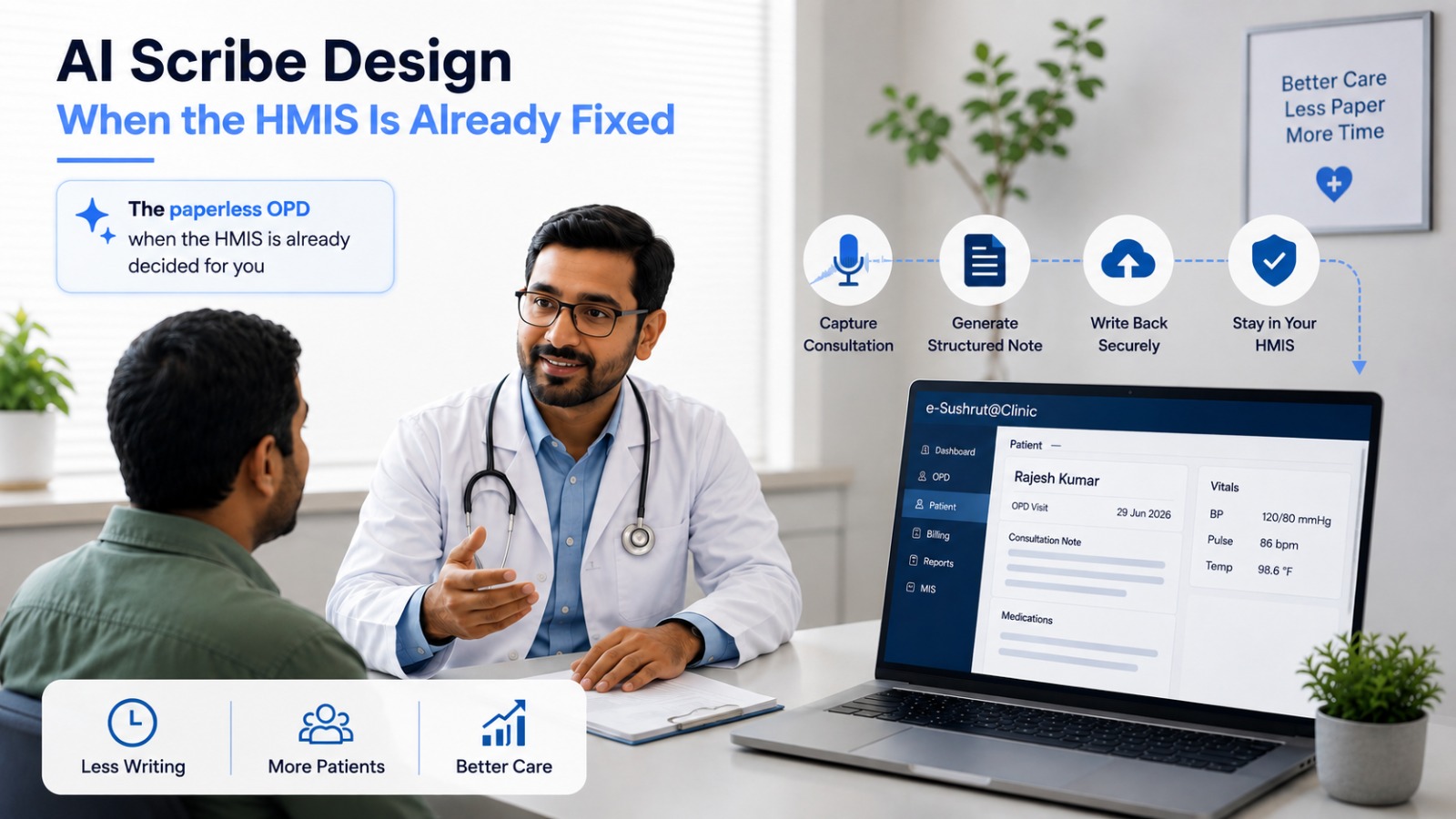
When the HMIS is already chosen, an AI scribe stops being a documentation product and becomes an integration one. Its job is to read the record the HMIS already holds, capture the consultation as it happens, and write a structured note back into that HMIS through whatever interface the vendor exposes. It does not become the system of record, and it does not ask the clinic to switch. The design question moves from "how good is the transcription" to "how cleanly does the note land in the field the front desk and the billing team already read."
That distinction matters more in 2026 than it did a year ago, because for a large and growing share of small Indian clinics the HMIS decision is now made before any AI vendor arrives. e-Sushrut@Clinic, the light cloud-based clinic system the Union government released on 29 June 2026, runs registration, billing, MIS reporting and clinical decision support, and onboards the clinic onto the national health stack. (Source: Medical Dialogues, 29 June 2026.) A clinic that has adopted it has settled its system of record. What it has not settled is the documentation load on the doctor, and that is the gap an integration-first scribe is built to close.
Why the documentation load survives a good HMIS
A capable HMIS does not remove the work of writing the note. It gives the note a place to live and a structure to follow, which is worth a great deal, but the clinician still produces the content, and producing it costs time. Physicians spend roughly sixteen minutes of electronic health record time per outpatient encounter, of which documentation is about a quarter, the largest single slice after chart review. (Source: Annals of Internal Medicine, Overhage and McCallie, 4 February 2020.) That figure comes from Western practices with mature records and typing-first workflows, so read it as an indication of shape rather than an Indian benchmark [verify: comparable per-encounter documentation-time study for Indian OPD volumes]. The shape holds regardless: the note is a fixed tax on every encounter, and a system of record collects that tax rather than removing it.
For a high-throughput OPD the tax compounds. A doctor seeing sixty patients in a morning who loses even a couple of minutes per patient to writing is losing real consulting capacity, and the clinic is losing throughput it cannot price back. This is where the two jobs separate. Dictation, including the speech-to-text built into e-Sushrut@Clinic, lets the doctor speak the note instead of typing it. Ambient scribing captures the doctor-patient conversation as it happens and turns it into a structured note without the doctor stopping to dictate. One removes typing. The other removes the documentation step from the consultation. A clinic where writing time per patient is the binding constraint is the clinic that has a reason to look past the built-in tooling.
Integration-first design, stated concretely
Building a scribe for a fixed HMIS is a different engineering problem from building a greenfield clinical system, and the difference is the whole product. Four things decide whether it works.
The first is read access to the existing record. An ambient note written blind is a transcript. A useful note is anchored to the right patient, the right encounter, the current medication list and the recent history the HMIS already holds. That means the scribe reads from the system of record before it writes to it, and it means the write is attributed to a specific encounter rather than dropped into a general field. The failure mode to design against is a note attributed to the wrong encounter, which under any honest liability allocation is the software's fault, not the clinician's.
The second is capture tuned to how Indian consultations actually sound. A real OPD consultation moves fast and code-switches inside a single sentence, Hindi carrying the conversation while English carries the drug names and the anatomy. A capture layer trained on clean, monolingual, one-speaker audio degrades exactly where the clinic needs it most. This is a stated technical reason to build on speech models tuned for Indian language and code-switched speech rather than a general Western engine, and it is why Nextdot is part of Sarvam's Startup Partner Program: the constraint is Indian-language capture at consultation pace, not transcription in the abstract.
The third is the write path into the HMIS, which is where most of these projects actually stall. e-Sushrut@Clinic is a government system, and Nextdot has not completed HFR, HPR or ABHA linkage or ABDM sandbox work, so what a third-party scribe can write into it, and through which interface, is not something to assert on a slide. [POSITION NEEDED: does e-Sushrut@Clinic expose a documented API or integration interface a third-party ambient scribe can write structured notes into, and under what onboarding terms?] Until that is confirmed, the honest design assumes the write path is constrained and plans for it: the scribe produces a structured note the clinician reviews and commits into the HMIS, rather than silently posting to a record the doctor never checked.
The fourth is the human review step, and it is not a compliance afterthought. The doctor reads and signs the note before it becomes part of the record. That keeps clinical judgment where Indian law already puts it, with the clinician and vicariously the hospital, and it keeps the scribe inside its intended-use envelope: an assistant that drafts, not a system that decides. A clinic operator evaluating a scribe should treat the absence of a mandatory review step as a red flag, not a feature.
The scribe does not replace the HMIS, and should not want to
The temptation in this category is to sell the clinic a better system of record. For a clinic that has already adopted e-Sushrut@Clinic, that is the wrong pitch and an expensive one. The record is decided, it is free or close to it, and it carries the clinic's ABDM obligations. A scribe that tries to displace it is asking the clinic to abandon a national on-ramp to solve a documentation problem, which is a poor trade the clinic will see through.
The correct posture is interoperability. The scribe connects to the HMIS the clinic already runs, does the one job that HMIS does not do well, and stays out of registration, billing and reporting entirely. Nextdot's position across healthcare is adaptable integration into legacy and open systems rather than displacement, and the tier 2 clinic is where that position is least negotiable, because the clinic has neither the budget nor the IT staff to run a migration. This is the design problem NextScribe was built to answer: reading the structured record the HMIS holds, capturing the consultation without the doctor stopping to dictate, and handing back a note the doctor reviews and commits.
What a clinic should actually check before buying
The evaluation is short and specific. Ask the scribe vendor to demonstrate capture on a real code-switched consultation at your patient volume, not a scripted monolingual demo. Ask exactly how the finished note reaches your HMIS: through a documented interface, through a review-and-paste step, or through a claimed integration the vendor cannot evidence. Ask what happens to the note that is wrong, who reviews it, and whether the review step can be skipped. Ask where the audio and the transcript are stored, because a structured consultation record is patient personal data and the clinic carries the consent and access obligations for it under the DPDP Act 2023, whatever the vendor's plumbing does.
A scribe that answers those four questions cleanly is doing integration-first design. One that leads with transcription accuracy and goes quiet on the write path is selling a demo. For a clinic that has already had its system of record chosen for it, the write path is the entire product.
Frequently asked questions
Can an AI scribe work with an existing HMIS?
Yes, and for most clinics that is the only sensible way to deploy one. An integration-first scribe reads the record the HMIS already holds, captures the consultation, and writes a structured note back into the HMIS rather than replacing it. Whether the note can be written automatically or through a clinician review-and-commit step depends on what integration interface the HMIS exposes, which the clinic should confirm before buying.
What is integration-first scribe design?
It is building the scribe around the system of record the clinic has already chosen, instead of around a new one. The design priorities are read access to the existing patient record, capture tuned to how the consultation actually sounds, a defined write path back into the HMIS, and a mandatory human review step before the note is committed. Transcription quality matters, but the integration is what decides whether the product works in a live clinic.
Does an AI scribe replace the HMIS?
No. A well-designed scribe does one job the HMIS does not do well, turning the spoken consultation into a structured note, and stays out of registration, billing and reporting. For a clinic that has adopted e-Sushrut@Clinic or any other system of record, replacing the HMIS would mean giving up the record, the pricing and the compliance on-ramp already in place, which is a poor trade.
How does a scribe write into e-Sushrut?
That depends on what integration interface e-Sushrut@Clinic exposes to third-party software, which is a government system detail a clinic should confirm directly rather than take from a vendor's slide. Nextdot has not completed HFR, HPR or ABHA linkage or ABDM sandbox work, so the honest design assumes the write path may be constrained: the scribe produces a structured note the clinician reviews and commits into the HMIS, keeping the doctor's sign-off in the loop rather than posting silently to the record.