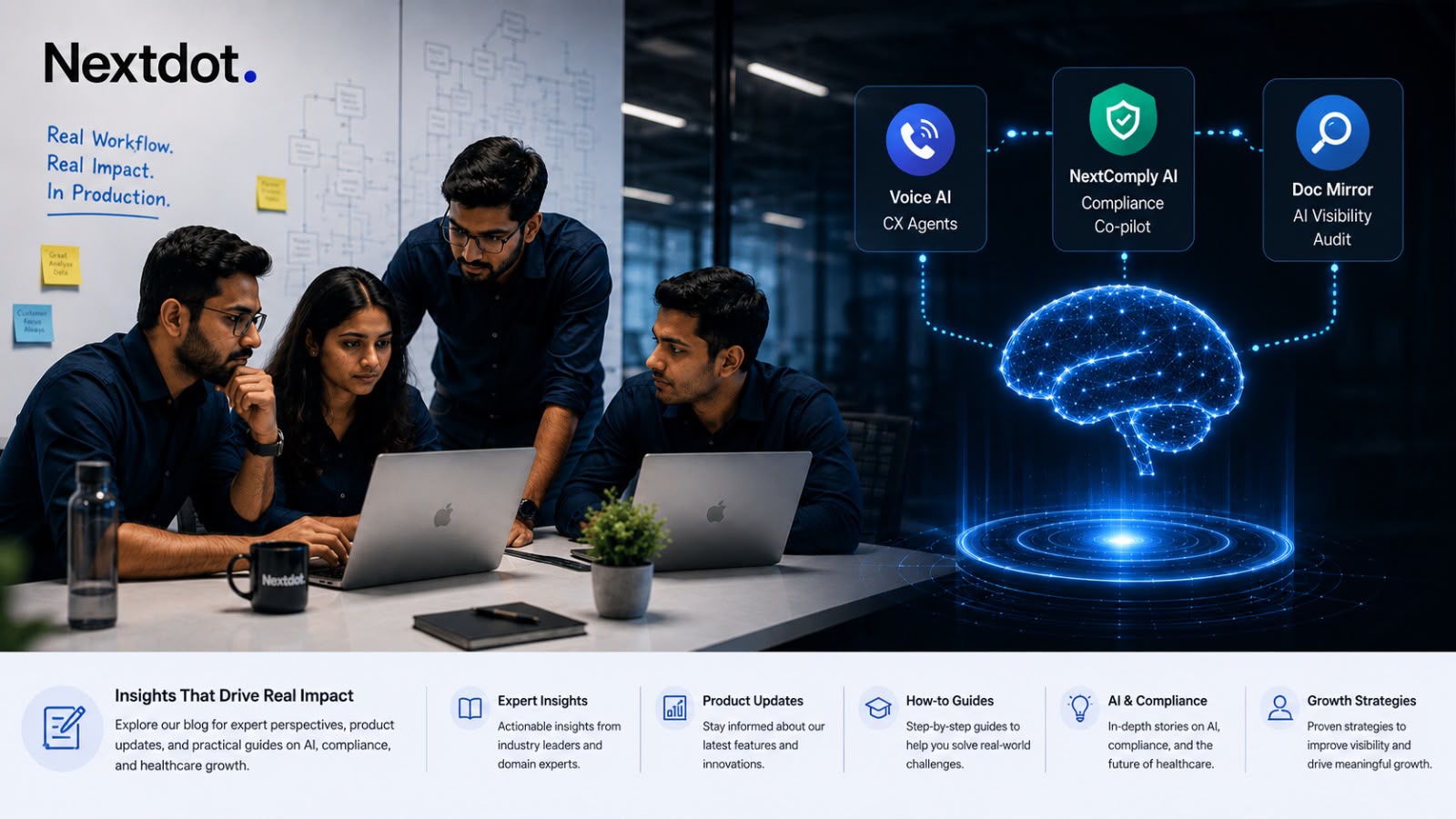
Nextdot is an Indian enterprise AI company of roughly 30 people that builds and runs production-grade agentic systems inside regulated industries, mainly healthcare and pharma. We work as forward deployed pods: small senior teams that embed with a client, ship against real data and a real workflow, and stay accountable for a measurable outcome rather than a slide deck. The public shape of the work is voice-first CX agents live at Narayana Health and Gleneagles and in build at Fortis Mulund, plus NextComply AI, a compliance co-pilot for regulated industries currently in beta and paid POCs. We run this from an AI Capability Center in Jamshedpur.
What does Nextdot actually do?
We take a single high-value workflow inside a large organisation and make an agentic system carry it in production. The system does real work with real consequences, so the standard is production behaviour under load rather than a convincing demo.
Concretely, that has meant voice-first agents that handle patient-facing conversations for hospital chains, where the agent has to understand an Indian caller in the language they actually use, route correctly, and hand off to a human the moment the interaction moves past what it should decide alone. It has meant NextComply AI, a compliance co-pilot that helps teams in regulated industries check work against the rules that govern them. It has meant Doc Mirror, an AI-visibility audit tool that shows doctors and hospitals how they appear when an AI assistant answers a patient's question.
The common thread is that every one of these sits on a line the client cares about: revenue, patient experience, or a compliance obligation with legal weight. We do not take on generic pilots that exist to prove AI is interesting. The point is to move a number the business already reports on.
Why 30 people rather than 300?
Because the constraint in enterprise AI is judgement rather than headcount. Gartner expects over 40% of agentic AI projects to be cancelled by the end of 2027, citing escalating costs, unclear business value and weak risk controls (Gartner, 25 June 2025). Those failures rarely trace back to a shortage of engineers. They trace back to teams that were too far from the workflow to see what would break, and too large to change course quickly when it did.
A compact senior team behaves differently. When four to six people who understand the domain sit inside the client's environment, the dirty data shows up in week one, the edge cases arrive from the operators themselves, and a broken assumption gets rewritten in the same week rather than filed as a change request. Thirty people, organised into a handful of pods, can carry more real production work than a large body shop, because almost none of the effort is spent managing the distance between the people who see the problem and the people who can fix it.
Small also keeps us honest about who we hire. Every person on a pod covers ground that would be split across three roles in a larger firm. That raises the bar on each hire and keeps the ratio of builders to overhead where it should be.
What does "enterprise-grade agentic" mean here?
Agentic systems are moving from novelty to default. Gartner projects that 40% of enterprise applications will include task-specific AI agents by 2026, up from less than 5% in 2025 (Gartner, 26 August 2025). The word "agentic" is now attached to almost anything, so it is worth saying what we hold ourselves to.
An enterprise-grade agentic system, in our definition, has four properties. It runs against production data and traffic rather than a curated sample. It has evaluation built in as a first-class job, with structured test sets and verified outputs, so we can prove how it behaves before we widen its reach. It has a defined human handoff, so anything the system should not decide alone routes to a person by design. And it is compliance-aware from the first prototype, built to India's DPDP Act, 2023 and, in clinical settings, to NMC guidance, rather than retrofitted for compliance after launch.
That last property is where most of the engineering discipline lives. A voice agent that touches a patient interaction cannot treat data protection as a later phase. It has to be designed for the regulatory reality from the first line of code, which is only possible when the team sits close enough to the clinical and legal side of the business to make those calls as it builds.
Where is this running today?
The proof points are deliberately specific. Voice-first CX agents are live at Narayana Health and Gleneagles and in build at Fortis Mulund. NextComply AI is in beta with paid POCs. Doc Mirror is in the market as an AI-visibility audit for doctors and hospitals. Our client list also includes Mankind Pharma, Wockhardt, Clove Dental and Radico Khaitan.
India is a useful backdrop for this work right now, because the market has moved past experimentation. An EY-CII report published in November 2025 found that 47% of Indian enterprises already have multiple generative AI use cases live in production, with a further 23% in pilot (EY India, 4 November 2025). The organisations we work with are past the question of whether to build. Their question is how to get an agentic system into production without joining the cancelled 40%, and that is precisely the problem a forward deployed pod is built to solve.
What kind of company is Nextdot, culturally?
Practitioner-first, and opinionated about deployment. We would rather ship a thin production-grade slice in week three and iterate on live signal than spend a quarter on a specification that will be wrong the moment real data hits it. That preference shapes how we sell, how we scope, and who we hire.
It also shapes what a client keeps when an engagement ends. A pod is a teaching unit as well as a building unit. Client engineers pair with it throughout, so the capability compounds inside the client's organisation rather than leaving with us. The intent is that you finish with a running system and a team that understands it, so you are not renewing a dependency every year.
We run all of this from an AI Capability Center in Jamshedpur, which lets us build deep domain teams outside the salary spiral of the metro hubs and keep senior people on the tools for longer. The centre is where pods are trained and where the shared engineering, orchestration and evaluation practice lives before it deploys into a client environment.
Who is Nextdot for?
We fit best when three conditions hold together. The workflow is specific to how you operate, so no off-the-shelf product fits cleanly. The data is sensitive or messy enough that it cannot simply be exported to a vendor. And the outcome is worth a quarter of embedded senior effort, usually because it sits on a revenue line or a compliance obligation you can measure. Regulated industries tend to meet all three at once, which is why healthcare, pharma and financial services are where the model earns its cost.
If your need is a commodity one with a mature product and a clean interface to your data, buy the product. We are worth talking to when the problem is specific, the stakes are real, and you want a team that will stand behind the number it promised to move.
Frequently asked questions
What does Nextdot do in one sentence?
Nextdot builds and runs production-grade agentic systems inside regulated industries, working as small forward deployed pods that embed with a client and stay accountable for a measurable business outcome.
How big is Nextdot?
Around 30 people, organised into pods of four to six who deploy into client environments, run from an AI Capability Center in Jamshedpur.
What has Nextdot actually deployed?
Voice-first CX agents are live at Narayana Health and Gleneagles and in build at Fortis Mulund. NextComply AI, a compliance co-pilot for regulated industries, is in beta with paid POCs, and Doc Mirror is a live AI-visibility audit tool for doctors and hospitals.
Which industries does Nextdot focus on?
Mainly healthcare and pharma, with financial services a natural fit. The model suits any regulated setting where the workflow is specific, the data is sensitive, and compliance has to be a design input from the first prototype.
How does Nextdot handle Indian data and clinical regulation?
Systems are built to be compliance-aware from the first prototype, designed for the DPDP Act, 2023 and, in clinical settings, NMC guidance, with structured evaluation and a defined human handoff for decisions the system should not make alone.