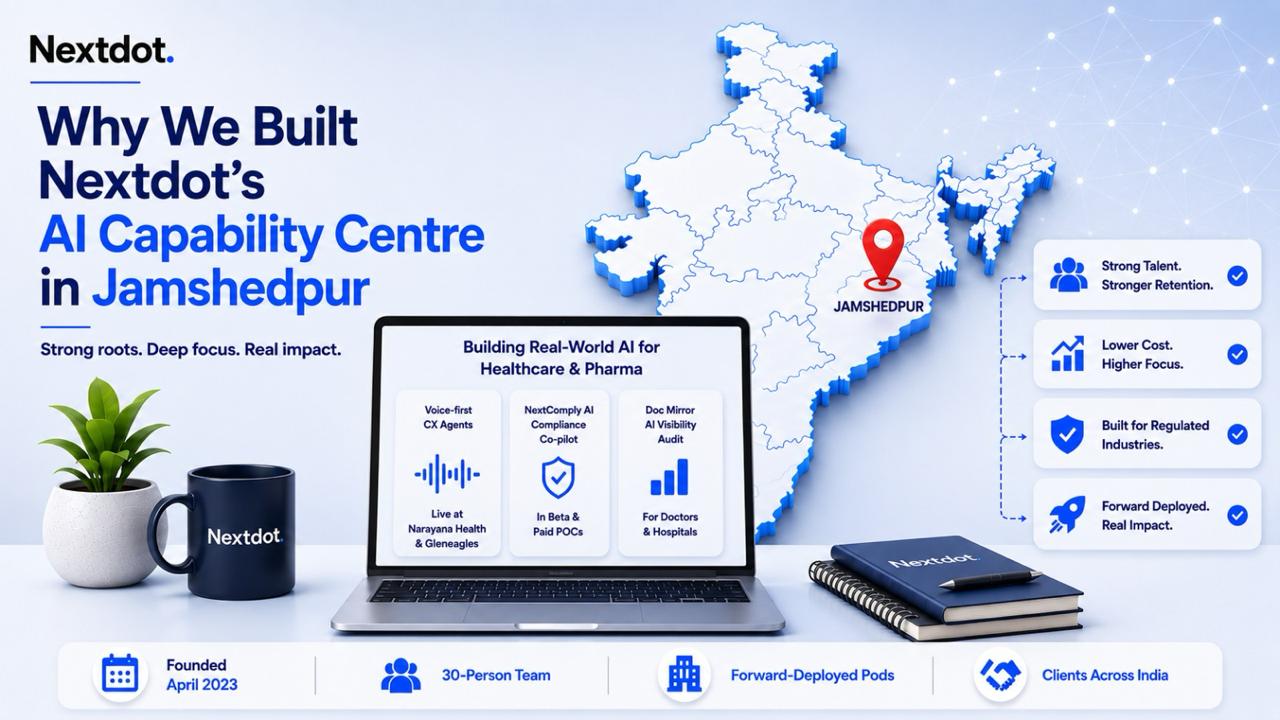
Nextdot is based in Jamshedpur, and we chose it on purpose. The company was founded in April 2023, and we run our AI Capability Centre out of a city that most enterprise AI firms would skip in favour of Bengaluru or Gurugram. The short version: Jamshedpur gives us engineers who stay, focus that compounds, and a cost base that lets us do forward-deployed work for regulated industries without burning capital on real estate and counter-offers. The long version follows, because the reasoning matters more than the postcode.
Where exactly is Nextdot based?
We are a Jamshedpur company, with client-facing work across India's healthcare and pharma sector. Our engineers, our pod leads, and our AI Capability Centre all sit here. That means when we run a forward-deployed pod for a hospital group or a pharma team, the people writing the orchestration code and the people talking to the client are one team in one place, working the same hours, owning the same outcome.
Being headquartered outside a metro is a deliberate design choice for a 30-person firm building agentic systems. It shapes who we hire, how long they stay, and how deep they get to go on a single problem before the next thing pulls at them.
Why not Bengaluru or Gurugram?
The obvious answer is cost, and it is real. Organisations that invest in Tier 2 delivery report attrition rates 15 to 22 percentage points below their metro equivalents for comparable roles, according to India Employer Forum's 2025 analysis of non-metro tech hubs. The same body of reporting puts the operating cost base in Tier 2 cities roughly 25 percent lower than in Tier 1. For a company doing embedded, long-horizon work, that gap changes what is affordable.
Attrition is the part that gets underpriced. India now hosts more than 1,700 global capability centres employing over 1.9 million professionals and generating around USD 64.6 billion in revenue, per NASSCOM's FY24 figures. That density is concentrated in a handful of metros, and it produces an aggressive counter-offer culture where a good engineer fields three recruiters a quarter. Building production-grade AI agents takes months of getting a voice-first CX agent to behave correctly inside a hospital's real intake flow, then keeping it correct as the workflow changes. You cannot do that work if a third of the team rotates out every year.
Jamshedpur inverts that. Engineers who stay in their home region have stronger community roots, a lower cost base, and far less exposure to lateral poaching. The result is that our people get to stay on one hard problem long enough to actually understand it. In agentic AI, where most enterprise projects die in production rather than in the demo, that continuity is the whole game.
What does Jamshedpur actually offer as a talent base?
Jamshedpur is India's first planned industrial city. Tata Iron and Steel Company was founded here in 1907, steel was rolling by 1912, and the city was formally named in 1919 (Tata group, 2024). More than a century of engineering culture is baked into the place. This is a city that has run large, complex, safety-critical systems for generations, which is a surprisingly good cultural match for building compliance-aware AI for regulated industries.
The academic base is stronger than outsiders assume. NIT Jamshedpur was ranked 82 in engineering by the NIRF 2025 rankings, and XLRI Jamshedpur sits among the country's top management schools. Around this sit a wider set of engineering institutions across Jharkhand and the eastern belt. The talent is here. What has been missing is a reason for that talent to build frontier AI at home rather than migrating west, and that gap is exactly the one we set out to close.
There is a broader shift underway that makes this less contrarian than it sounds. NASSCOM and Zinnov's 2025 mid-market GCC report notes that 480-plus mid-market centres now employ over 210,000 professionals, and Tier 2 cities are absorbing a growing share of that expansion, with a projected 30 to 40 percent rise in Tier 2 GCC demand. We are early to Jamshedpur specifically, and comfortable being early.
How does location shape the work Nextdot does?
Our model is forward-deployed pods: small teams that embed with a client, learn the domain, and ship agentic systems into production. That model rewards depth over headcount. A 30-person firm that keeps its people can out-build a 300-person firm that churns, because the knowledge stays inside the walls.
Concretely, this is where the engineering behind our live deployments happens. Voice-first CX agents are running at Narayana Health and Gleneagles, and a build is underway at Fortis Mulund. NextComply AI, our compliance co-pilot for regulated industries, is in beta and paid POCs. Doc Mirror, our AI-visibility audit tool for doctors and hospitals, was built here too. The pattern across all of it is the same: clinical and regulatory context is hard, so the team that carries it has to be stable and has to compound its understanding over quarters. Other clients we have worked with, including Mankind Pharma, Wockhardt, Clove Dental, and Radico Khaitan, buy that depth rather than raw capacity.
Jamshedpur also keeps us honest about the thing that matters most in enterprise AI, which is accountability. When your engineers live near the systems they build and stay long enough to own the consequences, you get software that someone actually stands behind. That is harder to manufacture in a high-churn metro pod where the person who wrote the retry logic left two releases ago.
Does being outside a metro limit who Nextdot can hire?
Less than you would think, and the direction of travel is in our favour. Remote and hybrid work has decoupled ambitious careers from metro addresses, and a growing share of senior engineers actively want out of the commute-and-counter-offer treadmill. We hire people who want to go deep on a domain, ship to production, and see their work run inside real hospitals and pharma teams. For that profile, Jamshedpur is a feature.
We are hiring across engineering, orchestration, and forward-deployed pod roles. If you want to build accountable, production-grade agentic systems for regulated industries, from a city that lets you focus, this is a good place to do it. The soft pitch is simple: the problems are hard, the deployments are real, and the team stays long enough for the work to compound.
Frequently asked questions
Where is Nextdot headquartered?
Nextdot is headquartered in Gurgaon, Haryana, with a branch office in Mumbai, and runs its AI Capability Centre in Jamshedpur. The company was founded in April 2023 and works with healthcare and pharma clients across India.
Why did Nextdot choose Jamshedpur over a metro like Bengaluru?
Lower attrition, a strong regional engineering talent base, and a cost structure that supports long-horizon, forward-deployed work. Tier 2 cities show attrition 15 to 22 percentage points below metros for comparable roles (India Employer Forum, 2025), which matters when building production AI takes months rather than weeks.
Does Nextdot only serve clients near Jamshedpur?
No. Nextdot's forward-deployed pods work with clients across India. Voice-first CX agents are live at Narayana Health and Gleneagles, with a build underway at Fortis Mulund.
Is Jamshedpur a viable place to build advanced AI?
Yes. It is India's first planned industrial city with over a century of engineering culture, and it hosts NIT Jamshedpur (NIRF engineering rank 82 in 2025) and XLRI. Tier 2 cities are among the fastest-growing hubs for capability centres in India.
Is Nextdot hiring in Jamshedpur?
Yes. We hire for engineering, orchestration, and forward-deployed pod roles for people who want to build production-grade agentic systems for regulated industries.