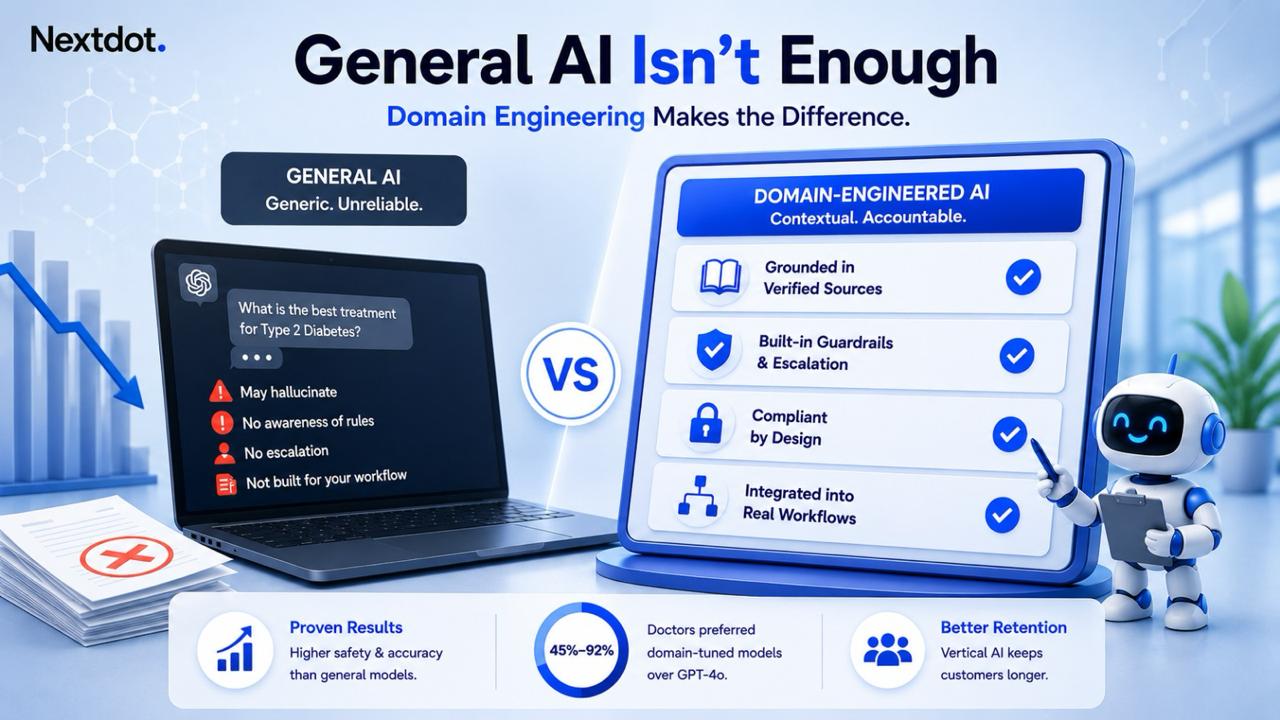
Domain-specific AI is a system where the model, the data, the guardrails, and the workflow are all engineered around one industry's rules and one job. Vertical AI beats horizontal AI when the cost of a wrong answer is high, because the accuracy gap shows up exactly where it hurts. In a 2025 npj Digital Medicine benchmark, a domain-tuned medical model scored 19.8% higher than the best general model on the safety dimension, and doctors preferred a small medical model over GPT-4o between 45% and 92% more often on factuality and clinical relevance. A foundation model on its own does not carry your specialty, your consent rules, or your escalation path. Someone has to build that.
What is domain-specific AI, actually?
A general foundation model is trained on a wide slice of the internet to be broadly capable. It writes email, summarises documents, and answers trivia across every field at roughly the same competence. This is horizontal AI, useful across many scenarios and calibrated to none of them.
Domain-specific AI, sometimes called vertical AI, is the opposite bet. You take a strong base model and wrap it in the context of a single industry: the terminology, the regulations, the reference data, the failure modes that matter, and the exact workflow a practitioner runs every day. The model is one component. The engineering around it is where the domain lives.
The distinction is easy to blur, because a general model will happily produce a confident paragraph about diabetes management or drug interactions. It sounds domain-aware. Under load, in a real clinic, on a real edge case, the difference between sounding right and being accountable becomes the whole story.
Why does pointing a foundation model at healthcare fail?
Three reasons, in the order they bite you.
First, hallucination has a cost that scales with the domain. A wrong movie recommendation is a shrug. A wrong dosage, a missed drug interaction, or a fabricated diagnostic criterion can delay care or cause harm. A 2025 MIT-led study on medical hallucinations in foundation models found that a substantial share of clinicians surveyed had already encountered plausible-but-wrong medical outputs in tasks central to their work. The base model does not know which of its confident answers is the dangerous one. It has no built-in sense of clinical consequence.
Second, a general model has no memory of your rules. Indian healthcare runs on specific constraints: the DPDP Act 2023, whose Rules were notified on 13 November 2025 with a full-compliance deadline of 13 May 2027, ABDM data-handling requirements, and NMC guidance on how doctors may present clinical information. A foundation model was not trained on your consent flow or your escalation policy. It will generate an answer that is fluent and non-compliant at the same time, and it will do so in plain, believable language.
Third, the model is the easy 20%. The hard 80% is retrieval over verified sources, structured handoff to a human when confidence drops, logging that an auditor can read, and integration into the system the practitioner already uses. None of that arrives with the model. A raw API call is a demo. A deployment is everything around the call.
This is why "we plugged in GPT" projects stall after the pilot. The demo answers the happy path. Production is made of edge cases, and edge cases are exactly where a general model has no ground to stand on.
Is vertical AI better than horizontal AI?
For regulated, high-stakes work, the evidence points one way. Beyond the safety numbers above, health-care-specific models can outperform much larger general models on tasks that require real clinical context, which means a smaller, cheaper, domain-engineered system can beat a frontier model at the specific job you care about.
The market has noticed. Venture money flowed heavily into vertical AI through 2025, with healthcare and financial services standing out as the largest categories by both capital and deal count, and vertical AI companies with strong workflow integration hold on to their customers better than horizontal competitors, per Beacon Venture Capital. Retention is the honest signal here. It means the thing kept working after the novelty wore off.
Horizontal AI still wins for broad, low-consequence, cross-functional work: drafting, brainstorming, general search inside a company. The right way to read this is by consequence and context, rather than by model size. When the answer feeds a decision that a regulator, a clinician, or a patient depends on, the domain engineering is the product. When it does not, a general model is fine and cheaper to run.
What does "domain-engineered" look like in practice?
At Nextdot, a healthcare deployment has four moving parts working together, and the model is one of them.
The base model handles language. We route to the right model for each step rather than forcing one model to do everything, which keeps cost and latency in check.
A retrieval layer grounds every clinical or compliance answer in verified source material, so the system quotes something real instead of improvising. This is what turns a confident guess into a citable answer.
A guardrail and escalation layer decides when the system may answer on its own and when it must hand off to a person. The DPDP Act expects meaningful human oversight for consequential automated decisions, so the human handoff is a design requirement, rather than a nice-to-have.
An audit layer records what was asked, what was retrieved, and what was returned, in a form a compliance reviewer can actually read.
You can see the shape of this in what is already running. Our voice-first CX agents are live at Narayana Health and Gleneagles, and in build at Fortis Mulund, handling patient conversations where the wrong answer has real consequences. NextComply AI, our compliance co-pilot for regulated industries, is in beta and paid POCs precisely because compliance is the part a general model cannot fake. Doc Mirror audits how doctors and hospitals appear to AI systems. In every case the domain rules are engineered in rather than assumed.
What should a CXO take away before buying?
Ask the vendor what happens on the edge case. Ask where the answer's sources come from. Ask when the system escalates to a human, and how that is logged. If the answers are vague, you are being sold a wrapper around a general model, and the domain work has been left for you to discover in production.
The model is a commodity that gets better and cheaper every quarter. The engineering that makes it accountable in your specific industry does not arrive on its own, and it is the part that determines whether the project survives contact with real patients, real regulators, and real edge cases. Buy the engineering. The model comes with it.
Frequently asked questions
What is the difference between vertical AI and horizontal AI?
Horizontal AI is a general-purpose system that works across many domains at similar competence, like a foundation model used for drafting and search. Vertical AI is engineered around one industry's data, rules, and workflow, so it performs better on that industry's specific, high-stakes tasks.
Can I just fine-tune a foundation model and call it domain-specific?
Fine-tuning helps, and it is one input. Domain-specific AI also needs grounded retrieval over verified sources, guardrails, a human escalation path, and audit logging. The model is roughly 20% of the work; the surrounding engineering is the rest.
Is a smaller specialised model really better than a large general one?
For domain tasks, often yes. 2025 benchmarks show health-care-specific models outperforming much larger general models on clinically contextual tasks, while costing less to run. The advantage is largest where safety and accuracy carry real consequences.
How does the DPDP Act affect healthcare AI in India?
The DPDP Act 2023 requires explicit consent, and it expects meaningful human oversight for consequential automated decisions. That makes explainability, retrieval from verified sources, and human handoff design requirements for any healthcare AI deployment, rather than optional extras.
When is a general model good enough?
For broad, low-consequence work such as internal drafting, brainstorming, or general document summarisation, a horizontal model is fine and cheaper. Reach for domain engineering when a wrong answer reaches a regulator, a clinician, or a patient.