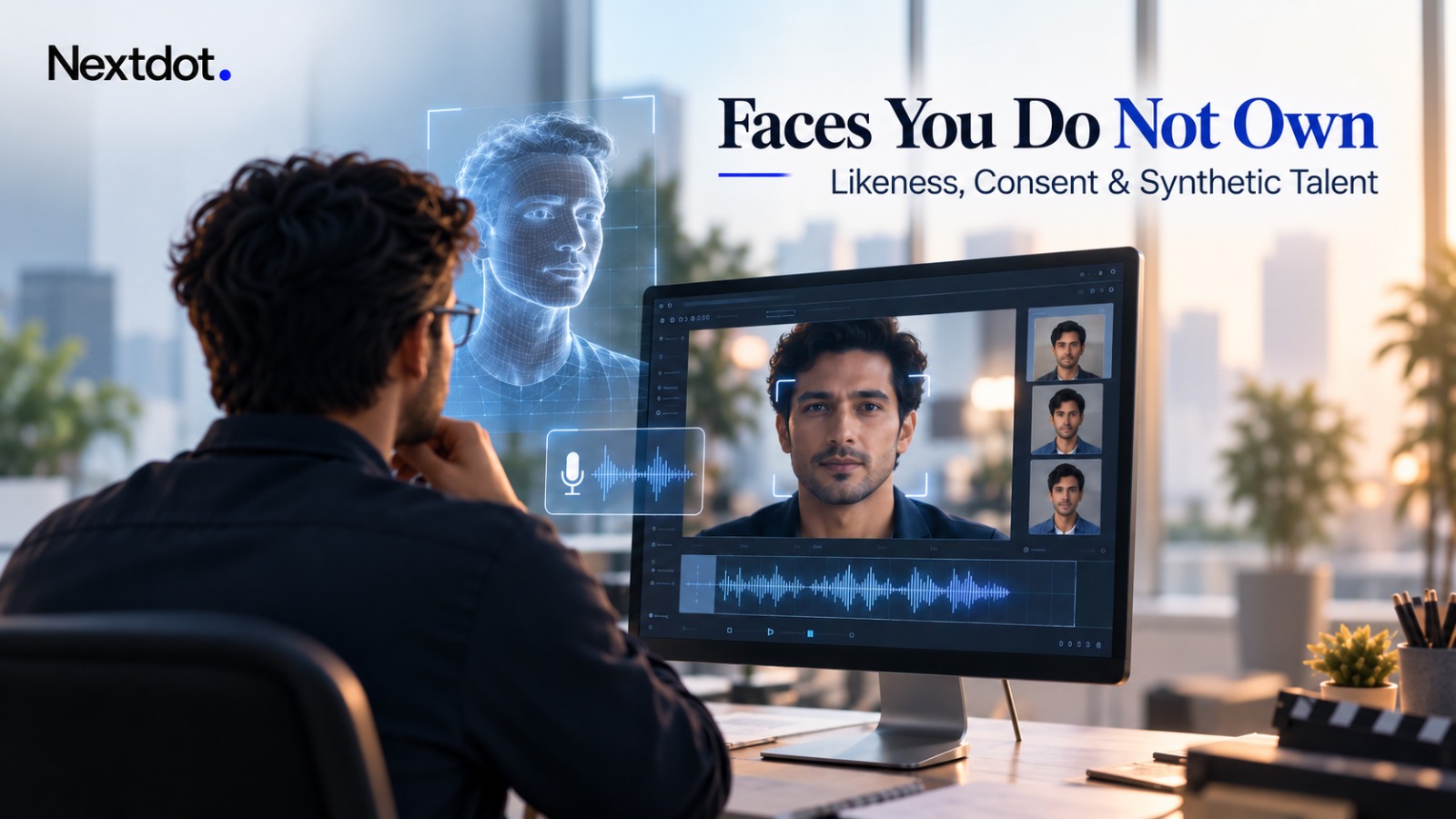
A brand in India should use AI to recreate a real person's face or voice in an ad only with that person's written, specific consent, and we advise that the consent cover the AI use, the media, the term and any re-use. India has no personality rights statute, yet courts in Delhi and Mumbai have repeatedly restrained unauthorised AI use of a person's name, face and voice, and a recognisable face or voice is likely to count as personal data under the Digital Personal Data Protection Act 2023. For a doctor, a second layer applies: medical conduct rules that restrict public endorsement, which consent alone may not answer.
This piece sets out the questions a CMO should take to counsel before a synthetic face or voice enters a brand film. It is a working brief, and your lawyer still has to sign off.
The law a CMO is working with in 2026
Indian judges build personality protection case by case, from privacy, passing off and the right to control commercial use of one's identity.
Those judges have moved fast on AI. On 20 September 2023, the Delhi High Court restrained sixteen defendants from using the actor Anil Kapoor's name, image, voice and likeness without consent, and the order named AI, deepfakes and face morphing specifically (Source: Anil Kapoor v Simply Life India & Ors, Delhi High Court, 20 September 2023, reported by LiveLaw). On 26 July 2024, the Bombay High Court restrained AI platforms from cloning the singer Arijit Singh's voice, covering voice models, voice conversion, synthesised voices and digital avatars (Source: Arijit Singh v Codible Ventures LLP, Bombay High Court, 26 July 2024, Indian Kanoon).
From 30 September 2026 the Delhi High Court is hearing three celebrity personality rights suits together, with two amici curiae appointed, to settle the scope and limits of the right, including where it meets satire and defamation (Source: MediaNama and LiveLaw, September 2026). Expect the boundaries to shift within the life of a single campaign.
The second layer is data protection. The DPDP Act 2023 defines personal data as any data about an individual who is identifiable by or in relation to that data (Section 2(t)). Ask counsel whether a face that viewers recognise, or a voice a listener can place, meets that test for your campaign. If it does, processing it needs consent that is free, specific, informed, unconditional and unambiguous, limited to the stated purpose, and withdrawable (Section 6). The DPDP Rules 2025 were notified on 13 November 2025 with an eighteen-month phase-in, so the full consent obligations bite by May 2027 (Source: PIB, DPDP Rules 2025 notification, November 2025). Section 3 carves out data a person has made publicly available themselves. Whether a public figure's published face falls inside that carve-out for a commercial synthetic use is a question for counsel, and nobody should assume the answer.
The third layer is performers' rights. The Copyright Act 1957, as amended in 2012, gives performers rights over recordings of their performance and moral rights against distortion (Sections 38 to 38B). Two questions go to counsel here. Does using an actor's filmed performance to train or drive a synthetic version of that actor engage those rights, including the film consent provision in Section 38A(2)? And did the original talent contract contemplate that use at all?
Voice is the easiest thing to take and the hardest to give back
A voice clone needs little source audio, and a brand usually holds plenty: last year's TVC, a doctor's webinar. That makes voice the likeliest place for quiet overreach, such as an editor patching a line with a cloned voice without checking the contract.
The Arijit Singh order is the one to put in front of your team. The court treated the voice itself, including vocal style and technique, as a protected attribute of the person. Ask counsel whether a clone that sounds like someone would be treated as using that person, even if you never name them.
Voice also creates a practical problem that faces do not. Once a voice model exists, it can say anything. Consent that covers "the Diwali campaign" does not stop a model from being reused for a product launch eight months later, so we advise that the contract control the model itself: where it is stored, who can run it, and when it is destroyed.
Doctors carry a second rulebook
A doctor's face on a hospital film carries clinical authority, and that authority is exactly what the conduct rules protect.
The Indian Medical Council (Professional Conduct, Etiquette and Ethics) Regulations 2002 state that a medical practitioner shall not publicly endorse any drug or product of the industry (clause 6.8.1(h)). The National Medical Commission held its 2023 conduct regulations in abeyance on 23 August 2023 and restored the 2002 code (Source: NMC notification, 23 August 2023, reported by Medical Dialogues). "What healthcare brands need from creative in a regulated market" covers the wider advertising rulebook. The point here is narrower: ask counsel whether a doctor's written consent to appear is enough, because the conduct code binds the doctor, and the brand's contract may not change that. A synthetic version of that doctor saying words they never recorded raises the risk further, because the doctor has not even delivered the line.
In November 2024 the Delhi High Court restrained fake videos that misused Dr Devi Prasad Shetty's name, voice and likeness, and in January 2025 it ordered deepfakes of Dr Naresh Trehan endorsing remedies taken down within 24 hours (Source: Dr Devi Prasad Shetty v Medicine Me, CS(COMM) 1053/2024; Global Health Limited v John Doe, CS(COMM) 6/2025; both reported by World Trademark Review). Those were bad actors. A legitimate hospital brand that produces a synthetic doctor without complete paperwork can look identical to them in a screenshot.
Synthetic presenters: the face nobody owns
A fully generated presenter, a face that belongs to no one, avoids the consent question. It raises three others.
The first is resemblance. A generated face can land close to a real person, and a brand should not count on a court accepting that the resemblance was accidental. Run a resemblance check before a synthetic presenter goes on air, and keep the record.
The second is provenance. Keep the prompts, the reference images and the model outputs that produced the presenter. If a claim arrives, the defence is a paper trail showing the face was built and never copied.
The third is disclosure. A synthetic presenter in a health ad invites the viewer to trust a person who does not exist. Labelling rules for synthetic content are covered in "Labelling AI-generated ads: what India and the EU now expect". Nextdot ships labelling as a standard option on AI-generated creative and recommends it. The client decides, and Nextdot records that choice.
What the talent contract has to say
Most talent agreements assume the performance ends when the camera stops. Our advice is that a contract fit for AI production cover at least these points, drafted by your counsel:
- Scope of synthetic use. Whether the face, voice or both may be generated, altered or extended, and for which named deliverables.
- Media and territory. Where the synthetic output may run. Ask counsel whether a clause written for Indian digital covers an export market under the EU AI Act.
- Term and re-use. How long the likeness may be used, and whether any new deliverable needs fresh written consent. Default to fresh consent.
- Model custody. Who holds any voice model or face model, where it is stored, who may run it, and a destruction date with written confirmation.
- Approval rights. Whether the talent approves each synthetic line or frame before release.
- Withdrawal. What happens when consent is withdrawn under DPDP Section 6, including takedown of live media and the cost of recutting.
- Compensation. Whether synthetic re-use carries a separate fee from the original shoot.
- For doctors. A compliance review against the medical conduct code before the doctor agrees, and a record that the review happened.
How Nextdot handles likeness on a production
The position is fixed. Nextdot never generates or clones a real person's face or voice without that person's written consent and a re-use clause. Doctors who appear in creative need explicit consent plus a compliance check before production starts.
In practice this changes the order of work. Consent is settled before any synthetic shot of a real person is made, so it belongs in pre-production next to the shot list. We recommend brands go one step further and keep each consent record with the asset it covers, so anyone reusing a clip can see what the talent agreed to.
The questions to take to counsel this quarter
Get written answers to five questions. Which talent contracts permit AI alteration, and which are silent? Which voice or face models do we hold, and who controls them? Has every doctor in our creative had a conduct review? How do we handle a consent withdrawal mid-campaign? Who updates our contract template when the Delhi High Court sets a framework?
A brand that cannot answer those risks a takedown order the first time a screenshot circulates.
Frequently asked questions
Is it legal to use an AI-generated face in an ad in India?
A fully synthetic face that belongs to no real person raises a smaller consent question, though the brand should check it does not resemble a real individual and keep a record of how it was generated. For a real person's face, get their written, specific consent and have counsel confirm it covers the use. Indian courts, including the Delhi High Court in Anil Kapoor v Simply Life India (20 September 2023), have restrained unauthorised AI use of a person's likeness.
Do you need consent to clone someone's voice?
Plan as if you do, and confirm with counsel. The Bombay High Court in Arijit Singh v Codible Ventures (26 July 2024) treated a person's voice and vocal style as protected, and restrained AI voice cloning without consent. A recognisable voice may also count as personal data under the DPDP Act 2023, where consent has to be specific to the purpose and can be withdrawn.
Can a doctor appear in an AI-generated healthcare ad?
Get the doctor's explicit written consent and a compliance review first. The Indian Medical Council conduct regulations of 2002 bar a medical practitioner from publicly endorsing a drug or industry product (clause 6.8.1(h)), and a brand contract may not change what the doctor's own code allows. Have counsel review any doctor appearance, synthetic or filmed, before production.
What should a talent contract say about AI re-use?
We advise that it name the synthetic uses allowed, the media, territory and term, and whether each new deliverable needs fresh consent. It should also set custody and a destruction date for any voice or face model, give the talent approval rights, and say what happens if consent is withdrawn.