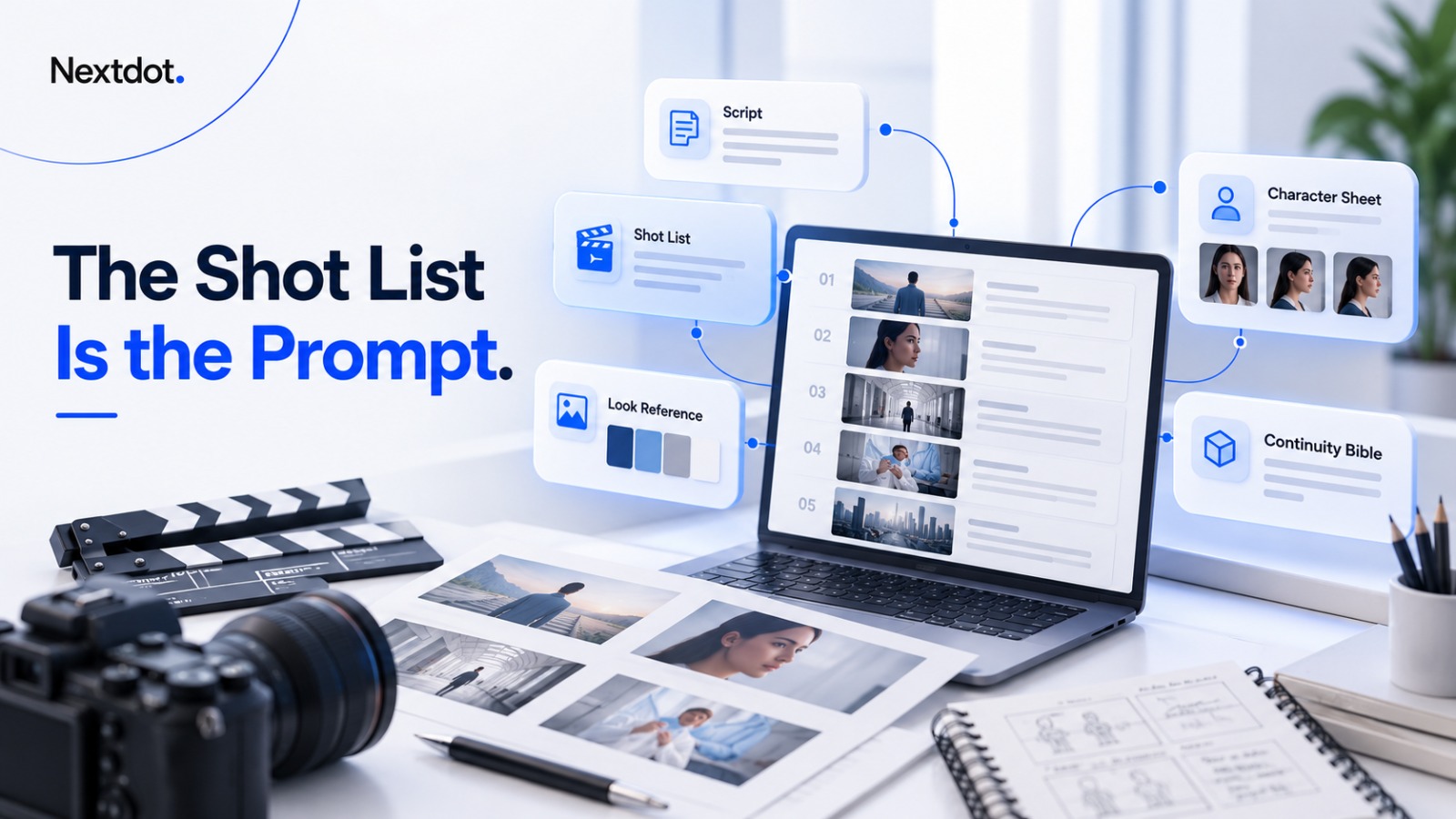
Pre-production for an AI generated film means writing five documents before the first generation: a locked script, a shot list with camera direction for every slot, a look reference, a character sheet for every recurring person or product, and a continuity bible that tracks what must stay the same. Each shot list line becomes a prompt, so the quality of the prompts is decided at the planning table. Skip that work and the edit ends up trying to rescue footage nobody directed.
Most brand teams budget for generation as the expensive part of an AI film. The real cost arrives the week after, when an editor sits with hundreds of clips that each look fine and cannot be cut into a film, because nobody decided what the film was before the clips were made.
Generic AI film is a pre-production failure
Our earlier piece, "AI filmmaking: what separates cinematic from generic", set out the craft: shot grammar, motivated light, motion with a reason, continuity held by reference discipline. This piece covers the step before any of that can happen. Craft needs a plan to execute against. Without one, a director is improvising inside a text box.
On a live shoot, skipping pre-production hurts on the day, so crews plan. AI generation removes that pressure. A new clip costs seconds, so teams generate first and think later. The model nearly always returns something plausible, which hides the missing plan until the edit, where you find a pile of competent shots with different lenses, different light, a lead character whose jawline shifts between clips, and no sequence that holds them together.
The fix is old. Pre-production turns a creative idea into decisions a crew can execute. With AI, the crew is a model that works only from what you write, so pre-production matters more, because every gap in the plan gets filled by the model's default, and the default is what generic looks like.
The five documents that come before the first generation
The script
The script locks what the film says and in what order. Lock it before any generation, with sign-off from the brand and, in healthcare, from the medical and legal reviewers who will see the final cut anyway. A script change after generation invalidates shots in bulk. A script change before generation costs a conversation.
The shot list
The shot list breaks the script into individual shots, numbered, each with a job. Shot 4 establishes the ward. Shot 5 reveals the device in the nurse's hand. Shot 6 lands the patient's reaction. Each line carries framing, lens, camera move, duration, subject, action and light. In AI production each line becomes the prompt, almost word for word. So whoever writes the shot list is directing the film, whether or not they ever touch the generation tool.
The look reference
The look reference fixes the visual identity of the whole piece in one place: colour palette, grade, contrast, lens character, grain, lighting logic, and a small set of reference frames that show the target. Without it, each generation drifts toward the model's idea of a pleasant image, and twelve pleasant images from twelve prompts rarely share a colour temperature.
The character sheet
A character sheet defines every recurring person, and in product films every recurring object, in enough detail that the model can hold them steady. For a person that means face reference images from several angles, age, build, wardrobe for each scene, hair, and the expressions the script calls for. For a product it means the exact form, colour, label and scale, taken from the real item. A character described only in words gets reinterpreted on every generation. Reference images hold it far better.
If the character is modelled on a real person, the sheet carries one more item: the consent record. Nextdot never generates or clones a real person's face or voice without that person's written consent and a re-use clause, and a doctor appearing in healthcare creative needs explicit consent plus a compliance check. Put that paperwork on the character sheet so nobody generates a frame of a real face before it exists.
The continuity bible
The continuity bible tracks everything that must stay constant across shots and everything that must change on purpose. The wristwatch on the left wrist in scenes 1 to 3. The IV line removed after scene 4. The daylight that moves from morning to afternoon across the film. The model has no memory of the shot before, so nobody holds these notes unless you assign the job. The bible is also the checklist for the review pass described in "AI filmmaking: what separates cinematic from generic".
How to write a shot list a model can execute
A human crew can ask questions on set. A model cannot, so each line has to carry everything. Four habits make the difference.
Write one shot per line, with one job. A line that asks for a reveal, a reaction and a camera move in the same four seconds will get an average of all three. Split it.
Name the camera direction in concrete terms. "Slow push in from medium to close-up, 35mm equivalent, eye level, three seconds" gives a model a target. "Cinematic shot of the doctor" gives it permission to guess. Framing, lens, height, move, speed and duration belong on every line.
Reference the fixed documents instead of re-describing them. Each line should point to the character sheet entry, the look reference and the continuity state for that moment, so the prompt inherits them. Re-typing a description from memory on every line is how drift gets in.
Mark the shots that are candidates for a live shoot. Some slots need real hands on a real product, or a performance no model will give you. Decide shoot or generate per shot, here, while the plan is still on paper.
The hardest part of this translation is camera movement. A shot list line might call for a slow dolly toward a subject with a slight rise at the end, and many generation tools treat movement as a loose suggestion, so the move comes back as a drift or a random push. Nextdot has early access to Higgsfield models, whose camera controls target this problem: a shot list line that specifies a particular camera move, lens feel and framing that has to arrive as written rather than approximately. The shot list still carries the direction. The model's job is to execute the move the list describes without inventing its own.
Do you need a storyboard for an AI film
For anything longer than a single clip, yes, though it can be rougher than a traditional board. A storyboard shows the sequence as pictures: composition, where the subject sits, which way they face, how one shot hands off to the next. Eyeline and screen direction errors only show up when you see the frames in order.
In AI production a team can generate rough frames straight from the shot list and lay them out as the board, which turns the storyboard into a cheap first test of the shot list. If a frame comes back wrong at board stage, the fault usually sits in the shot list line, and fixing the line then costs far less than fixing it after full generation. Treat the board as a draft of the film you can still change.
How much of an AI film is planning versus generating
The split varies with the film, so the ratio matters less than the direction of the trade. Time moved into pre-production comes back in selection and edit, because the team generates fewer, better-aimed clips and the editor cuts a film instead of searching for one.
A useful rule for a CMO: if the first generated clips appear on the same day the brief lands, pre-production did not happen, however polished those clips look.
What a CMO should ask to see before generation starts
You need to know the documents exist and that someone owns them. Before approving the start of generation on any AI film, ask for five things.
Ask for the signed-off script, with medical and legal review done where the category needs it. Ask for the numbered shot list, and pick three lines at random to check that each carries framing, lens, move and duration. Ask for the look reference, and check that it is one page everyone works from. Ask for the character sheet, and for any real person on it, ask to see the consent record. Ask who owns the continuity bible by name.
A team that can hand all five across the table has directed the film before generating it. A team showing finished-looking clips on day one will be directing in the edit, where it costs the most.
In the Creative Intelligence Pod, the shot list, character sheets and continuity bible are client-owned creative memory, and they go with the client in usable form if the engagement ends. The planning is the asset the film was made from, and it belongs to the brand.
Frequently asked questions
Do you need a storyboard for an AI film?
For anything longer than a single clip, yes. A storyboard shows the sequence as pictures, where eyeline and screen direction errors become visible. In AI production the board can be built from rough generations of each shot list line, which makes it a cheap test of the shot list.
What is a character sheet in AI video?
A character sheet is the reference document for every recurring person or product in the film. It holds reference images and fixed details, such as wardrobe per scene or a product's exact form and label, and every generation points to it so faces and products hold steady between shots. If the character is based on a real person, the sheet should also hold that person's written consent.
How do you write a shot list for AI generation?
Write one shot per line with one job. Give every line concrete camera direction: framing, lens, height, camera move, speed and duration. Point each line to the character sheet, look reference and continuity state for that moment. Mark any shot that needs a live shoot instead of generation.
How much of an AI film is planning versus generating?
The split varies with the film. Time spent in pre-production reduces time spent in selection and edit. As a working test, if generated clips appear on the day the brief arrives, the planning step was skipped.