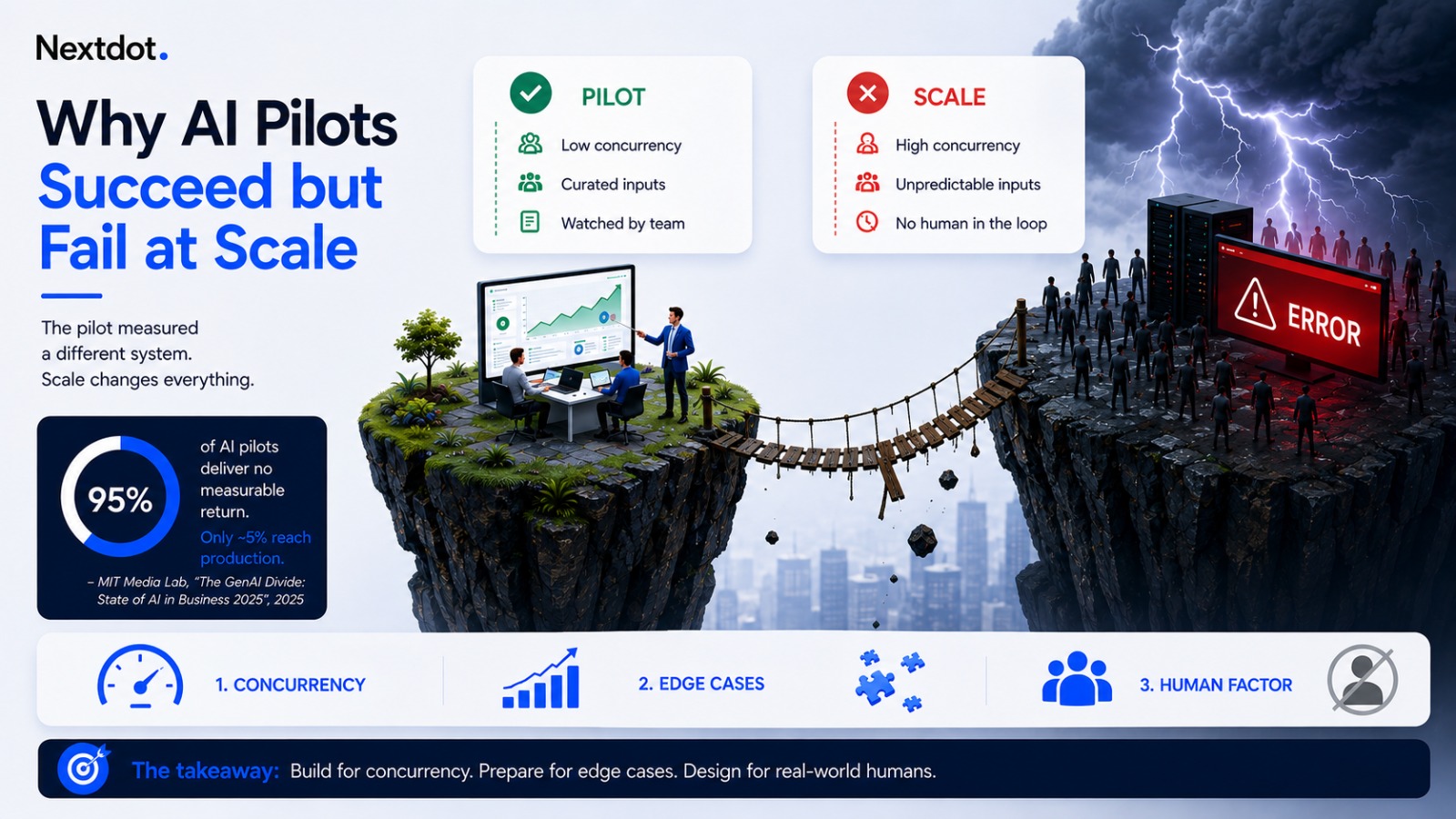
Your pilot did not lie to you. It measured a different system than the one you tried to scale. A pilot runs on low concurrency, curated inputs, and a team watching every output, and at scale all three of those conditions reverse at once. The model did not get worse. The conditions around it changed, and the engineering that survives those conditions was never built during the pilot.
This is the most expensive misread in enterprise AI, and it is common enough to be the base case. An MIT Media Lab study of enterprise deployments found that 95 percent of generative AI pilots delivered no measurable return, with only about 5 percent reaching production with real value (Source: MIT Media Lab, "The GenAI Divide: State of AI in Business 2025", 2025). The report is blunt that the models are not the problem. The gap sits in how the system meets real workflows, real load, and real users. A pilot is a controlled experiment. Scale is an adversarial one.
The scaling discontinuity is not a slope, it is a cliff
Most people picture scaling as a smooth ramp: more users, proportionally more cost, proportionally more work. The reality is discontinuous. Systems hold steady, then break past a threshold, then behave like a different system entirely. Three things change at that threshold, and each one alone can end a project.
The first is that traffic stops being sequential and becomes concurrent. The second is that input variety explodes past anything the pilot's happy-path data covered. The third is that the humans who quietly absorbed every problem during the pilot are no longer in the loop, and someone has to answer for the failures they used to catch. A pilot hides all three because a pilot is small, curated, and watched. Production is none of those.
Concurrency: the failure the demo cannot show
A pilot serves a handful of users, usually one request at a time, often with an engineer refreshing the logs. Nothing about that tells you how the system behaves when two thousand requests arrive in the same minute. Concurrency is the failure mode that is structurally invisible in a pilot, because a pilot never generates it.
What breaks under concurrency is rarely the model. It is everything the model depends on. Rate limits on the inference API that were never hit at pilot volume start returning errors. Database connections that data retrieval depends on saturate, and latency climbs because every request is now waiting behind others. A retrieval step that took 400 milliseconds when one person used it takes four seconds when four hundred people do, and a voice agent that pauses for four seconds before speaking has already lost the caller. Latency under load is one of the two failure modes we see most often in live voice deployments, and it comes precisely from data fetch and, at some sites, from scale. It does not appear until the concurrency is real.
Concurrency also changes cost in a way linear projection misses. When a system slows under load, timeouts trigger retries, retries multiply calls, and an agentic workflow that loops or chains steps can compound token spend far past the per-run number from the pilot. The unit economics that looked fine at ten users can invert at ten thousand, and the finance team finds out from the invoice rather than the forecast.
The fix is not a bigger model. It is queuing, backpressure, connection pooling, graceful degradation when a dependency is saturated, and load testing at the concurrency you actually expect rather than the concurrency you tested by accident. This is ordinary distributed-systems engineering, and it is exactly the engineering a pilot gives you no reason to build.
Edge cases: the long tail the pilot never sampled
A pilot runs on a clean slice of inputs. Someone chose the test cases, and they chose the ones that represent the workflow well. Production sends everything: the malformed record, the code-switched sentence that moves between Hindi and English mid-clause, the scanned document that is rotated ninety degrees, the patient name that collides with another encounter, the question the system was never designed to answer and confidently answers anyway.
The problem is arithmetic. If a system handles 99 percent of inputs correctly, a pilot of 200 cases might show two failures, or zero, and you ship. At 100,000 requests a month that same rate is a thousand failures a month, and in a clinical or regulated setting the content of those failures matters more than the count. An output attributed to the wrong encounter, a retrieval pulling the wrong record, a note generated outside its intended-use envelope: these are not rounding errors. They are the events that decide who is liable when something goes wrong.
That is why the intended-use statement and the mandatory human review step are not paperwork. They are the boundary that says what the system is allowed to do, so that an input outside that boundary is caught by design rather than discovered in an audit. Edge cases do not announce themselves. You find them by instrumenting for them: capturing the inputs that produced low-confidence or out-of-envelope outputs, reviewing them, and feeding them back. A pilot ends before that loop starts. A production system lives or dies on whether it exists.
None of this allocation of blame is enforceable unless you can reconstruct what happened. If a hospital asks to see the last thirty times the system overrode or was overridden, the answer has to be a log, not a shrug. Audit logs, versioned models and prompts, and human override capture are what turn an edge-case failure from an argument into a record. Build them before scale, because after an incident is too late to start.
The support burden nobody put in the budget
Here is the line item that kills projects quietly. During the pilot, support is free, because the people running the pilot are the people fixing it. An engineer sees a bad output, patches the prompt, and moves on. That labour never hits a spreadsheet, so it never enters the scale model. Then the system goes live to real users, the engineers move to the next build, and the support that was invisible becomes a staffed, recurring, growing cost.
Human handoff is the single most common failure we see in live voice deployments, and handoff is a support problem before it is a technical one. When the agent reaches the edge of what it can do, someone has to take the call, and the escalation path that routes them is specific to each organisation. There is no single model that works everywhere. Designing it, staffing it, and monitoring it is real operational cost, and it grows with volume rather than shrinking. The pilot proved the system could work. It said nothing about what keeping it working costs per month.
Gartner's read on why projects get abandoned after proof of concept names escalating costs and unclear value alongside data quality (Source: Gartner, July 2024). Read carefully, both of those are scale problems wearing a strategy costume. Costs escalate because concurrency and edge-case handling and support were never priced. Value looks unclear because the pilot measured capability and the business needed reliability, and nobody built the second one.
What to do differently before you scale
Treat the pilot as a capability test and nothing more. It answers one question: can the system do the task on a good input, once. Scaling answers three harder ones. Does it hold under concurrent load. Does it handle the long tail of inputs safely. Can you afford to support it, and can you reconstruct what it did when something breaks.
The teams that cross this gap build the operational layer during the pilot, not after it, even though it makes the pilot slower and less impressive. They load test at real concurrency. They instrument for edge cases from day one. They price the support burden as a recurring line, and they build the audit trail before they need it rather than during a regulator's visit. A demo that is engineered to survive scale is less dazzling than one that is engineered to dazzle. It is also the only kind that is still running a quarter later.
Frequently asked questions
Why does AI fail at scale after a good pilot?
Because a pilot and a production system are not the same system under load. A pilot runs on low concurrency, curated inputs, and constant human oversight. At scale all three reverse: requests arrive concurrently, inputs include the full long tail of real data, and no human is watching each output. The model is unchanged. The conditions around it change, and the operational engineering that survives those conditions is usually never built during the pilot.
What is the scaling discontinuity?
It is the fact that AI systems do not degrade smoothly as they grow. They hold steady, then break past a threshold, then behave like a different system. The break is driven by concurrency saturating shared dependencies, edge cases appearing in volume, and support costs becoming real. Linear projection from pilot numbers misses it because the thresholds sit above pilot volume.
How does concurrency break AI systems?
Concurrency rarely breaks the model. It breaks the dependencies around it: inference API rate limits get hit, database connection pools saturate, and retrieval latency climbs as requests queue. A four-second delay that never appeared with one user becomes routine with four hundred. Concurrency also inflates cost, because slowdowns trigger timeouts and retries that multiply calls. The fixes are queuing, backpressure, connection pooling, graceful degradation, and load testing at real concurrency.
What support costs appear only at scale?
The ones that were free during the pilot because engineers absorbed them. Human handoff and escalation, monitoring, edge-case triage, and ongoing correction all become staffed, recurring costs once the build team moves on and real users arrive. These costs grow with volume rather than shrinking, and because they never appeared on the pilot spreadsheet, they are the line item most often missing from the scale model and the reason many projects are quietly abandoned after proof of concept.