MLR Review Is the Bottleneck. AI Is Finally Good Enough to Touch It
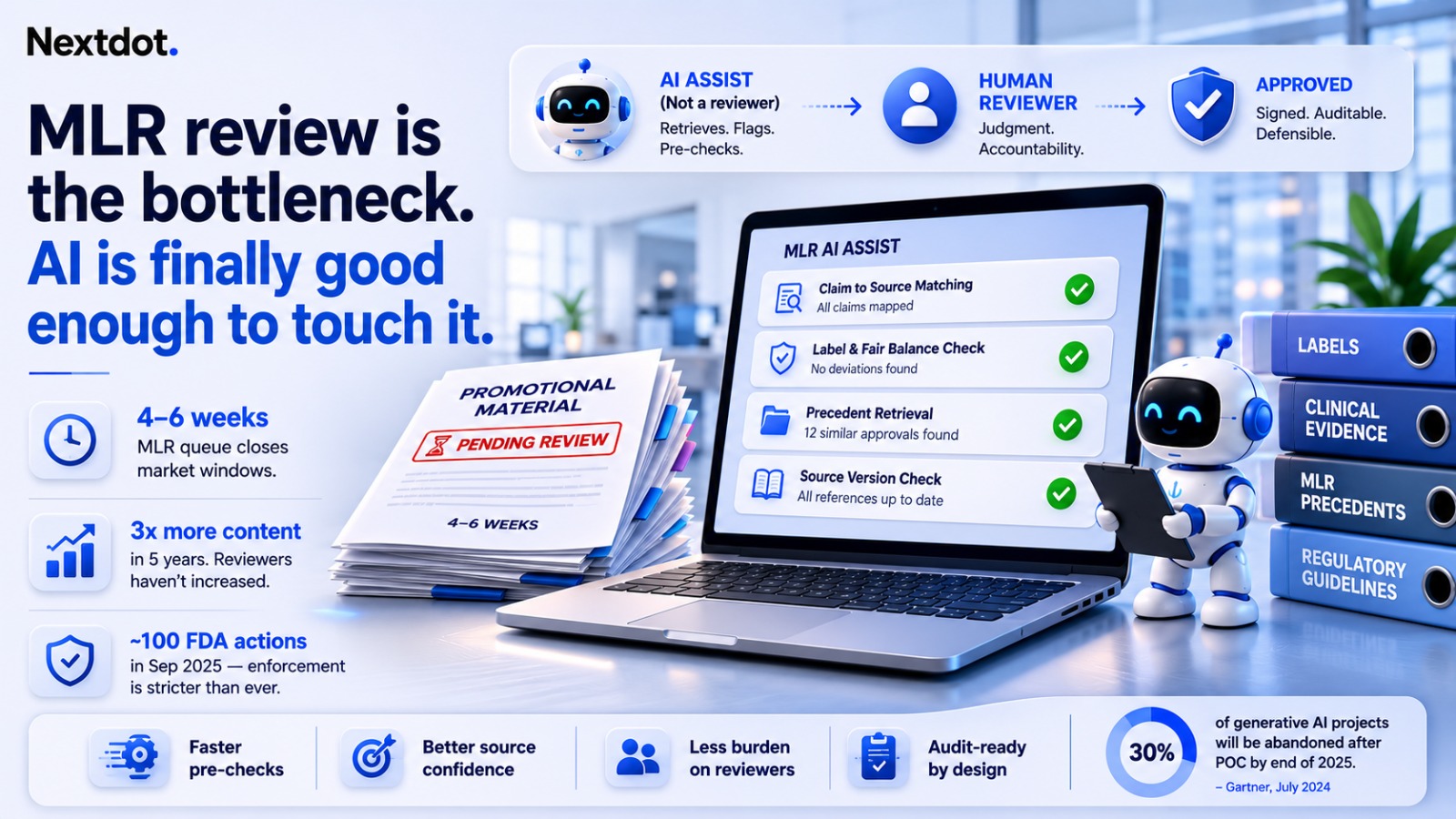
Ask a Head of Commercial Excellence where a campaign dies, and the honest answer is rarely the creative. It is the queue. A promotional piece can be briefed, designed, and ready in a week, then sit in medical, legal and regulatory review for four to six weeks [verify] while the market window it was built for closes. The content is fine. The system that clears it is the constraint.
MLR review is the checkpoint every piece of promotional and medical content passes before it reaches a physician, a patient, or a sales rep's tablet. A medical reviewer confirms every claim is supported by the label and the cited evidence. A regulatory reviewer confirms fair balance, risk disclosure, and adherence to the approved indication. Legal reviews for liability exposure. It is slow because it is meant to be slow. When it fails, the company does not get a bad review cycle. It gets a letter.
For the last decade the honest position on AI here was to stay away. Language models hallucinated citations, could not be audited, and had no place near a regulated approval. That position has changed. The models are still not trustworthy enough to review content, and they may never be. What changed is that they became reliable at the mechanical work surrounding the review. That distinction is the entire subject of this piece.
The volume is the problem, and it keeps getting worse
The reason MLR became the bottleneck is arithmetic. The volume of material moving through review has climbed far faster than any review team has grown. In 2021 alone, the FDA's Office of Prescription Drug Promotion received over 59,000 Form 2253 submissions, the filing that accompanies promotional material for prescription drugs and biologics. [Source: FDA OPDP, Gray Matters newsletter, 2021.] That is one regulator, one country, one year.
Behind that number is a content explosion nobody staffed for. A single drug launch now needs the same message adapted across a rep-triggered email, a congress deck, a web banner, a patient leaflet, an interactive visual aid, and a dozen market-specific variants, each a separate reviewable asset. Industry surveys put the growth of MLR-bound content at roughly three times its level five years ago [verify], while reviewer headcount, senior medical and regulatory professionals who are expensive and scarce, has stayed close to flat. The queue is the predictable result of those two lines diverging.
The cost of the queue is not abstract. In a launch, weeks of delay on approved materials is weeks of a sales force calling on physicians without the piece the campaign was built around, against a competitor whose content cleared first. Commercial teams feel it as lost share of voice. Medical teams feel it as reviewers working nights and weekends on redundant assets. Nobody in the chain thinks the current pace is acceptable. They just do not have a lever that does not compromise the review itself.
Why reviewers are cautious, and why that will not change
The instinct is to attack the queue by pushing reviewers to move faster. That misreads the job. A reviewer is slow because being wrong is expensive, and in 2025 it became a great deal more expensive. After years of light enforcement, roughly five FDA promotional enforcement letters across 2023 and 2024 combined [verify], the agency reversed hard. In September 2025 it issued around 100 cease-and-desist letters and thousands of warning letters targeting misleading prescription drug advertising, the largest promotional enforcement action the office had run. [Source: FDA action, September 2025; documented by Covington & Burling and Sheppard Mullin regulatory advisories.]
A reviewer who has watched that happen is not going to trust a black box, and should not. This is where most AI pitches to pharma fall apart. They present the model as a faster, cheaper reviewer, and the room goes cold, because the person in the room is the one whose name goes on the submission. Any serious approach has to start from the reviewer's liability, not from the vendor's throughput promise.
Where AI actually fits, and where it must not
The framing error is treating AI as a reviewer. It is not one, and no regulator will accept it as one. The medical judgment about whether a claim is fairly balanced for a specific patient population, in a specific therapeutic context, is exactly the kind of decision that needs an accountable human name attached. AI does not carry liability. A person signs the 2253.
What AI can do is remove the mechanical work that makes the human review slow. Most of an MLR cycle is not judgment. It is reconciliation. Reviewers spend hours confirming that every claim in a piece maps to an approved source, that a referenced study actually supports what the copy implies, that the fair-balance language matches the current label, that a claim cleared six months ago has not since been superseded by a label change. This is retrieval and cross-checking work, and it is where language models are genuinely capable now in a way they were not two years ago.
Concretely, the work AI can be trusted to do ahead of a human reviewer:
• Match each claim in a draft to its cited reference and flag any claim carrying no supporting source, before the piece reaches a person.
• Compare the fair-balance and safety language against the current approved label and surface every deviation.
• Retrieve prior MLR decisions on near-identical claims, so reviewers stop re-adjudicating questions the company already settled.
• Confirm a reference was pulled from the current version of a source document, not a superseded one.
Each of these hands the reviewer a piece that arrives already annotated, with the easy rejections filtered out and the genuine judgment calls isolated and flagged. The human still decides everything that requires deciding. They simply stop spending the majority of the cycle on clerical verification that a machine does faster and more consistently than a tired professional at 9pm.
Where AI must not go is equally specific: final approval, the medical-judgment calls on balance and clinical context, and any autonomous edit to claim language. A system that rewrites a claim and passes it downstream is no longer an assistant. It is an unsupervised regulatory actor, and no Chief Medical Officer will sign under one. The line is drawn at judgment and at authorship. Everything before the judgment is fair game. The judgment itself stays human, on purpose.
The audit trail is the whole game
For a regulated buyer the interesting question is not whether the model is capable. It is whether the system is defensible when an inspector asks how a specific claim got approved. That means treating the AI layer as validated software: computer system validation, versioned prompts and models, and a complete, immutable log of what the AI suggested, what the human accepted or overrode, and why. If the AI flags a claim and the reviewer overrides the flag, that override has to be recorded and attributable to a named person. An MLR assist tool that cannot reconstruct its own reasoning under audit is a liability dressed as a speed gain.
This is why the assistive architecture holds up in regulated settings and the autonomous one collapses. The AI does retrieval and flagging, the human holds judgment and accountability, and every handoff between them is logged. That is the same design principle behind any compliance-aware system worth deploying in a pharma environment: the machine narrows the work, the person owns the decision, and the trail between them survives inspection. It is a design stance, and it is the correct one here. A vendor that leads with autonomy rather than auditability has not understood the buyer's risk.
What this means for an Indian pharma company
Indian pharma is not a spectator in this. The large Indian manufacturers serve US, EU and emerging markets, which means their promotional content is subject to FDA, EMA and multiple local promotional regimes at once, alongside domestic CDSCO requirements and the industry's own marketing code. A single molecule's content may need to clear three regulatory frameworks, each with its own claim rules, its own risk-disclosure conventions, and its own audit expectations. That multiplies exactly the reconciliation burden AI is good at removing, and it raises the stakes on the audit trail that most tools treat as an afterthought.
The pragmatic path is narrow and worth stating plainly. Do not buy a system that promises to review your content. Buy the capability to pre-check content before it reaches review, cut the reconciliation load on scarce reviewers, and produce an audit trail an inspector will accept without argument. Keep the human signature precisely where it sits today. Measure the result in cycle-time reduction on the mechanical stages, claim-to-source matching, label reconciliation, precedent retrieval, and not in reviewer roles removed. The moment the business case is written as headcount savings, the compliance function will kill it, and they will be right to.
MLR review will stay slow where it should be slow, which is on judgment. The gain sits in everything around the judgment, the retrieval, the cross-checking, the reconciliation, the precedent lookup, and that is finally a body of work AI is good enough to carry. The bottleneck was never the reviewer's judgment. It was the hours of clerical work buried under it. That is the part worth automating, and the only part worth trusting a model with.