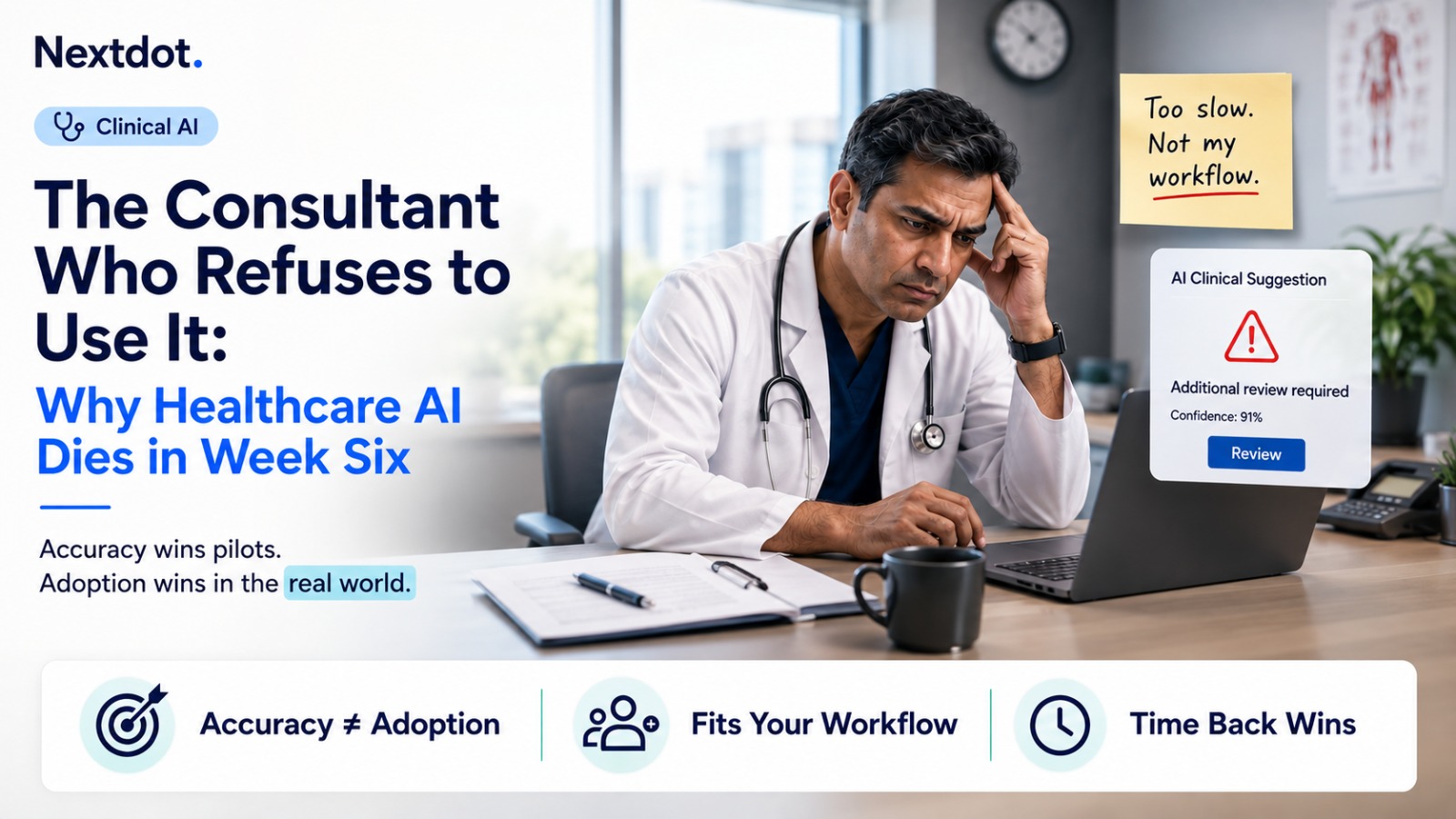
Clinical AI fails after a successful pilot because the pilot measured accuracy and the deployment lives or dies on adoption, and those are different problems. A tool can be right nine times in ten and still be abandoned by week six if using it costs the consultant thirty seconds they do not have between patients. The determinant of whether a clinical AI deployment sticks is not model quality. It is whether the tool fits the physical, timed, interrupted reality of a working clinic better than the workaround the doctor already has.
The pilot is run by the enthusiasts. Two or three engaged consultants, a clean cohort of patients, an engineer in the room, and everybody watching. Accuracy looks excellent because the conditions are excellent. Then the tool goes to the full department, the engineer leaves, the OPD runs at real volume, and the thing quietly stops being used. Nobody switches it off. It just becomes the software everyone has open in a tab and nobody touches. That is week six.
Workflow gravity is the force you are fighting
Every clinician has an existing way of getting the note written, the order placed, the diagnosis recorded. It is fast, it is muscle memory, and it was built under pressure over years. Call it workflow gravity. The moment your AI tool asks the consultant to do one thing differently, click somewhere else, wait for a response, correct an output, confirm a suggestion, it is fighting that gravity. And gravity wins by default, because the old way already works well enough to get through the list.
This is the mistake that kills pilots at scale. Teams optimise the wrong number. They spend the engagement pushing model accuracy from 91 to 94 percent, when the reason the tool will be abandoned has nothing to do with the missing 6 percent. It has to do with the fact that the consultant sees fifty patients in a morning OPD and the tool adds eight seconds per patient. Eight seconds times fifty is nearly seven minutes of a session the doctor did not have. The tool is more accurate and it is still slower than the old way, so the old way survives.
Here is the size of the surface you are working on. A 2024 study in JAMA Network Open found that primary care physicians spent an average of 36.2 minutes on the electronic health record per patient visit, against visits scheduled for 30 minutes (Source: JAMA Network Open, Rotenstein et al., 2024). The documentation burden is already larger than the consultation. A clinician carrying that load does not adopt a tool because it is clever. They adopt it because it visibly gives time back on the first day, in their own hands, on their own patients. If it does not, it is one more window competing for attention that is already fully spent.
The consultant who refuses is telling you something true
There is always one. The senior consultant who tried it twice, went back to dictating to a junior or scribbling on the pad, and will not pick it up again. The instinct is to treat this person as a change-management problem, an adoption laggard to be won over with training. That instinct is usually wrong.
The refusing consultant is running a live test of your tool against the fastest workflow in the building, and reporting the result. When they revert, they are not being difficult. They are telling you the tool loses to the workaround under real load. The correct response is not another training session. It is to sit behind them during a full OPD, count the seconds, and find the specific friction: the extra confirmation click, the output that reads slightly wrong for their specialty so they distrust all of it, the lag while the system fetches a record, the note formatted for a template that does not match how they actually document. Every one of those is fixable. None of them is fixed by persuasion.
Alerts are the standing warning here. Clinical decision support has been firing on-screen prompts at doctors for two decades, and the literature on what clinicians do with them is not kind. Override rates for medication safety alerts across studies run from roughly 46 to 96 percent (Source: BMC Medical Informatics and Decision Making, 2017). When a tool interrupts often enough with something the clinician judges low-value, the clinician learns to dismiss it reflexively, including the times it was right. An AI feature that adds friction without visibly earning its interruption trains the same reflex. Alert fatigue is workflow gravity with a decade of evidence attached.
Why the pilot lies to you
Pilots are optimistic by construction, and it helps to name exactly how.
The people are wrong. Pilots run on volunteers, the consultants curious about AI, not the median doctor and certainly not the skeptic. Volunteers tolerate friction the department will not.
The volume is wrong. A pilot cohort is a fraction of real OPD load. The eight-second cost that is invisible across twelve patients becomes a session-breaker across fifty.
The support is wrong. During the pilot an engineer is present, so problems get solved in the moment and never show up as failures. Post-handover, a small snag with nobody to fix it becomes a reason to stop.
The measurement is wrong. Pilots report accuracy and satisfaction surveys. Neither predicts sustained use. The number that predicts survival is whether usage holds four weeks after the engineers leave, at full volume, without prompting. Almost nobody instruments for that, which is why the drop-off at week six surprises the sponsor every time.
What actually makes a deployment stick
Adoption is an engineering property, not a training outcome. You design for it or you lose it.
Measure time-to-task against the current workaround, not accuracy against a benchmark. If the tool is not faster than what the consultant does today, on their patients, at their pace, it does not matter how accurate it is. Faster is the adoption threshold. Accurate is the floor beneath it.
Build for the median clinic, not the demo. The tool has to survive fifty patients, a shared workstation, a consultant who is interrupted mid-note by a nurse, a flaky network segment on the third floor. Latency is not a metric here, it is the difference between a tool that gets used and a tab that gets closed. A response that arrives after the doctor has already moved to the next patient is a response that trained them to stop waiting.
Design the human review step so it costs a glance, not a decision. Every responsible clinical AI deployment keeps a human in the loop, and it should. The trap is making that step expensive. If confirming an output means reading it as carefully as writing it from scratch, you have removed the time saving and kept the risk. The review has to be a fast scan that catches the wrong-record and out-of-envelope cases, not a second full act of documentation.
Instrument adoption from day one, per clinician, over time. You want to see who stopped and when, because the shape of the drop-off tells you where the friction is. A consultant who used it daily for two weeks and then went dark is a workflow signal you can act on. Without that instrumentation you learn about week six in week ten, when the sponsor asks why nobody is using the thing they paid for.
There is a harder truth underneath all of this, and enterprise buyers should hear it plainly. A pod that builds a clinical AI tool, ships it, and leaves needs someone on the hospital side to own the tool once it is live. Adoption is not a one-time delivery. It is a set of small frictions surfacing over weeks as the tool meets more clinicians and more edge cases, each needing a fix. With nobody on the client side to own that, even a good tool drifts toward the week-six cliff. This is why Nextdot builds embedded rather than handing software over a wall, and it is also why, on an engagement with no engineering counterpart to receive the handover, the honest recommendation is sometimes to buy a maintained product instead of commissioning a build that will have no owner.
Clinical AI does not die because the model was wrong. It dies because the deployment fought the fastest workflow in the building and lost quietly, one consultant at a time, until week six when someone finally checks the logs. Win that fight and the tool sticks. Ignore it and no amount of accuracy will save you.
Frequently asked questions
Why does AI fail after a successful pilot?
Because the pilot and the deployment measure different things. A pilot measures accuracy under favourable conditions: engaged volunteers, low patient volume, an engineer present to fix problems immediately. Deployment measures sustained adoption under real conditions: the median clinician, full OPD load, and nobody on hand when something snags. A tool can pass the first and fail the second. The usual failure point is week six, once the engineers have left and the department returns to its faster existing workaround.
How do you get doctors to adopt AI tools?
By making the tool faster than what the doctor already does, on their own patients at their own pace, and proving it on day one. Adoption is an engineering property, not a training outcome. Measure time-to-task against the current workaround rather than accuracy against a benchmark, keep latency low enough that the response arrives before the doctor moves on, and design the human review step to cost a glance rather than a second full act of documentation. Training does not overcome a tool that is slower than the old way.
What is workflow gravity in clinical AI?
Workflow gravity is the pull of the clinician's existing, practised way of getting work done. Doctors have muscle-memory routines for writing notes, placing orders and recording diagnoses, built under time pressure over years. Any AI tool that asks them to do something differently is fighting that gravity, and gravity wins by default because the old way already works well enough to clear the patient list. It is the single largest force acting against a clinical AI deployment.
What determines whether a clinical AI deployment sticks?
Whether the tool visibly saves the clinician time under real load, and whether someone owns adoption after go-live. The predictive metric is not pilot accuracy or a satisfaction survey. It is whether usage holds roughly four weeks after the engineers leave, at full patient volume, without prompting, instrumented per clinician. Deployments stick when they are engineered to beat the existing workaround on speed, keep the human review step cheap, and have an owner on the hospital side to fix the small frictions that surface week after week.