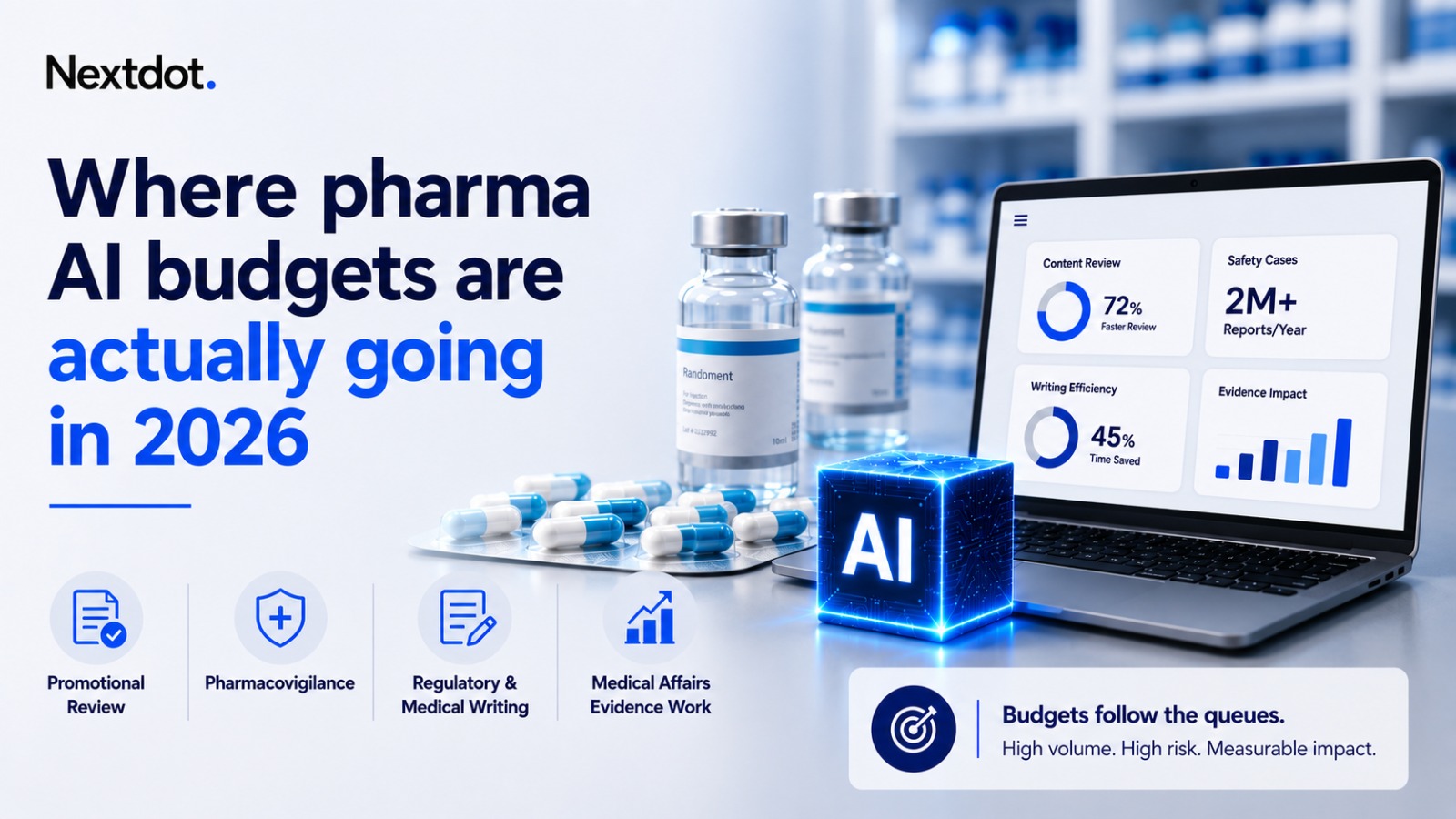
Pharma AI money in 2026 is going into the back office of regulated content, not the sales force. The four line items being funded are medical, legal and regulatory review of promotional material, pharmacovigilance case processing, regulatory and medical writing, and medical affairs evidence work. Sales enablement, the rep-facing pitch that dominated the 2019 conversation, is where the smallest cheques go, because it is the one area where the return is soft and the compliance exposure is real.
The reason is not fashion. It is where the cost and the risk actually sit. Every one of the funded areas is a high-volume, document-heavy, deadline-bound process staffed by expensive, scarce specialists whose work is auditable and legally consequential. That is the exact shape of problem where a language model earns its keep, and it is the exact shape of problem a rep-triggered email is not.
The money follows the queues, not the pitch
A useful way to read a pharma AI budget is to ask which teams are missing deadlines because the work will not fit in the hours available. Those teams get funded first, because the case writes itself: the volume is measurable, the headcount is capped, and the gap between the two is the business case.
Three of those queues dominate.
The first is promotional review. Every piece of promotional and medical content, a rep-triggered email, a congress deck, a patient leaflet, a market-specific variant, passes through medical, legal and regulatory review before it reaches a physician or a patient. The volume of reviewable content has multiplied as launches fragment into dozens of channel-specific assets, while the senior medical and regulatory reviewers who clear it stay close to flat in number. The result is a queue that runs weeks long, and the queue closes the market window a campaign was built for.
The second is pharmacovigilance. Drug safety runs on the individual case safety report, the structured record of a single adverse event. The FDA's own system receives over two million adverse event and medication error reports each year (Source: FDA, FAERS, ongoing), and a global manufacturer processes its own worldwide inflow on top of what any single regulator sees. Case processing, the intake, coding and narrative work that turns a raw report into a compliant record, consumes up to two-thirds of a typical company's pharmacovigilance resources (Source: Deloitte, Transforming Pharmacovigilance, 2024). That is the single largest cost line in drug safety, and it grows with every product on the market.
The third is regulatory and medical writing. A submission dossier, a clinical study report, a periodic safety update: each is a long, structured, source-anchored document assembled by specialists who spend more time reconciling references and reformatting for regional templates than writing anything new. The bottleneck is not the science. It is the assembly.
Why sales enablement lost the argument
The rep-facing use case reads well in a slide and funds poorly in practice. The pitch, an assistant that helps a rep tailor a message to a physician, runs straight into the review function described above. Anything a rep says or sends about a product is promotional content, and promotional content is regulated. A model that generates rep-facing claims does not remove work from the system. It adds volume to the review queue that is already the constraint.
The compliance exposure is not theoretical. In September 2025 the FDA's Office of Prescription Drug Promotion ran the largest promotional enforcement action in its history, issuing roughly 100 cease-and-desist letters and thousands of warning letters against misleading prescription drug advertising (Source: FDA OPDP enforcement action, September 2025, documented in Covington & Burling and Sheppard Mullin regulatory advisories). A Head of Commercial Excellence who has watched that is not going to fund a tool that manufactures more claims faster. They are going to fund the tool that clears claims safely.
So the budget inverts the 2019 assumption. The value is not in helping the rep say more. It is in shortening the review that governs what the rep is allowed to say at all.
What "funding AI" actually buys in these areas
The word that matters in every one of these budgets is assist, not replace. None of these processes hand judgment to a model, and no regulator would accept it if they did. The medical decision about whether a claim is fairly balanced, the safety assessment of whether an event is causally related, the regulatory call on whether a dossier meets the standard: these carry an accountable human name, and the name is the point. A model does not carry liability. A qualified person signs the submission.
What the budget buys is the removal of the mechanical work surrounding that judgment. In promotional review, that is claim-to-source reconciliation, checking that every statement maps to an approved reference and that nothing has been superseded by a label change. In pharmacovigilance, it is intake structuring, MedDRA coding suggestions, duplicate detection, and a first-draft narrative the safety physician then verifies. In writing, it is assembling the document from approved source content into the correct regional template. This is retrieval, cross-checking and drafting work, and it is where models became reliable in a way they were not two years ago.
The distinction is the whole procurement decision. A vendor selling a faster reviewer or an autonomous case processor is selling something the regulatory framework will not let the buyer use. A vendor removing the reconciliation and assembly load around a human who still signs is selling time back to a specialist who is the scarcest resource in the building.
Where medical affairs and commercial excellence sit
Medical affairs is the quieter line item, and it is growing. The work here is evidence synthesis: reading across the published literature, congress output and internal data to answer a medical question, respond to an unsolicited request for information, or build the scientific narrative behind a product. It is non-promotional, which changes the risk profile, but it is still governed and still auditable. AI budget in medical affairs funds the retrieval and summarisation that lets a medical science liaison or a medical information specialist cover more ground without cutting the review of what they produce.
Commercial excellence is where the two threads meet. The commercial leader owns the content pipeline and feels the review queue as lost share of voice. Their AI spend is not on generating more rep content. It is on the throughput of the approval system that content depends on, because a launch asset that clears in days instead of weeks is worth more than one more variant stuck in the queue.
For a company deciding where to start, the honest sequencing is: fund the queue that is already breaking a deadline. In most portfolios that is either promotional review or pharmacovigilance, because those are the two with the hardest volume curves and the clearest regulatory floor. Writing and medical affairs follow, because the same retrieval and assembly capability extends to them once it is built and validated. Sales enablement waits, not because it is impossible, but because it is the one place where the risk-adjusted return has not yet cleared the bar the others already have.
Frequently asked questions
What are pharma companies funding in AI?
The dominant 2026 spend is on regulated back-office content work: medical, legal and regulatory review of promotional material, pharmacovigilance case processing, regulatory and medical writing, and medical affairs evidence synthesis. These are high-volume, document-heavy, deadline-bound processes run by scarce specialists, which is where a language model removes measurable cost. The spend removes the mechanical work around a human decision, it does not replace the decision.
Is pharma AI going into sales enablement?
Sales enablement receives the smallest share, reversing the 2019 assumption that reps were the primary AI opportunity. Anything a rep communicates about a product is regulated promotional content, so a tool that generates rep-facing claims adds volume to the review queue that is already the bottleneck. After the FDA's September 2025 promotional enforcement action, commercial leaders are funding tools that clear claims safely rather than tools that produce more of them.
What is the biggest pharma AI use case?
By cost, pharmacovigilance case processing is the largest single target, because it consumes up to two-thirds of a company's drug safety resources (Source: Deloitte, Transforming Pharmacovigilance, 2024) against an adverse event volume that only grows. By strategic urgency, promotional review competes for the top spot, because a slow review queue directly delays launch content into the market. Both are volume problems with a hard regulatory floor, which is exactly the shape AI is funded to address.
Where do pharma AI budgets actually sit?
They sit with the functions that own the regulated queues: medical affairs, regulatory affairs, pharmacovigilance, and commercial excellence as the owner of the content pipeline. The unifying logic is that AI is funded to assist an accountable human, not to make the regulated decision, so the money flows to reconciliation, coding, drafting and assembly work rather than to the judgment that a qualified person still has to sign.