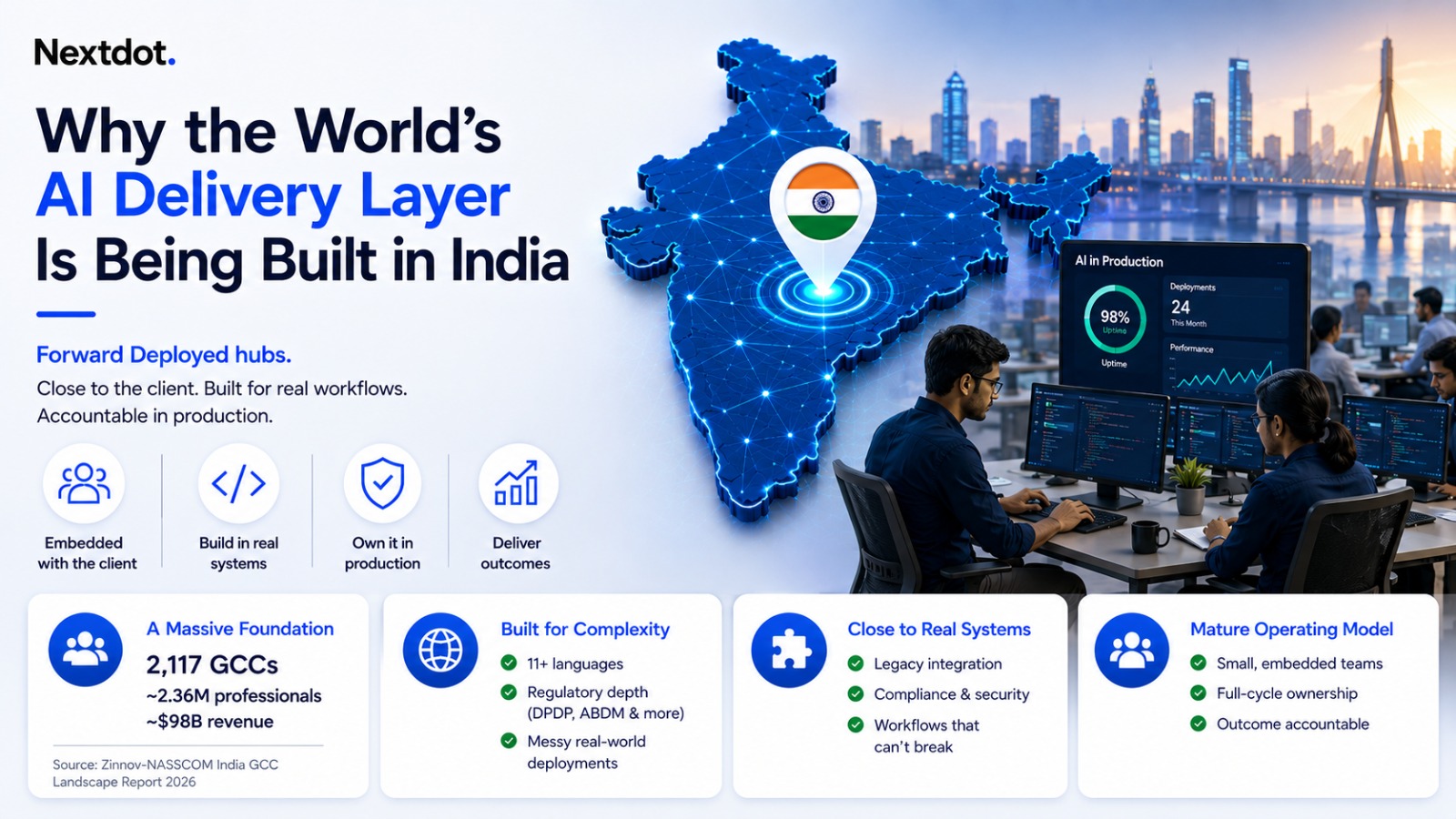
A Forward Deployed hub is a place where engineers sit close enough to a client's real workflow to build AI into it, keep it running, and stay accountable for what it does in production. Not a call centre, not a code shop taking tickets, not a consultancy that writes a recommendation and leaves. It is the delivery layer of the AI economy: the people who turn a model that works in a demo into a system that survives contact with a hospital, a bank, or a regulator. That layer is being assembled in India, and the reason is not the one most people reach for first.
The reflex answer is cost. It is the wrong answer, or at least an incomplete one that misreads what is actually happening. The work moving to India is not the cheap work. It is the hard, adjacent-to-the-client work that the last decade of AI hype quietly assumed would take care of itself.
The wave nobody has named
Everyone can see the model layer. Frontier labs raise on it, the press covers it, and every enterprise board has been briefed on it. What almost nobody names is the layer underneath the model and above the client: the work of taking a general-purpose model and making it do one specific job, inside one specific system, under one specific set of constraints, without breaking.
This is where AI projects actually live or die. A model that scores well on a benchmark tells you almost nothing about whether it will hold up against a hospital's twenty-year-old information system, a compliance officer's veto, and a workflow that three hundred staff already know by heart. Closing that gap is engineering, integration, and operations, done in contact with the client, under the client's real conditions. It looks nothing like the research that produced the model, and it demands a different kind of engineer: one who reads a legacy schema before writing a prompt, and who assumes the first version will fail in a way the demo never showed.
That is delivery work, and it does not scale the way software scales. You cannot ship it once and clone it. Each deployment is its own problem. Someone has to sit with the client, learn the workflow, build against the real system, watch what breaks, and fix it. The industry spent years pretending this layer would be thin, that a good enough model plus an API key was the whole job. The layer turned out to be most of the work, and it is where the value moves once models become a commodity anyone can rent by the token. When the intelligence is a utility, the advantage shifts to whoever can wire that utility into a live enterprise and keep it standing.
Why India, specifically
India already runs the world's delivery layer for software. The infrastructure that assembles the AI version of it is sitting right there, and it did not have to be built from scratch.
Consider the shape of it. India now hosts 2,117 global capability centres employing about 2.36 million professionals, with revenue near 98 billion US dollars (Source: Zinnov-NASSCOM India GCC Landscape Report 2026). A capability centre is the point. These are not vendors taking outsourced tickets. They are the in-house engineering, product, and operations arms of large global companies, run from India, owning real mandates. The relationship those centres institutionalised, deep engineering embedded next to the business rather than sold across a contract, is exactly the relationship AI delivery needs.
Three things compound on top of that base, and none of them is the wage bill.
The first is deployment under constraint. Indian engineers do not get to build for a clean, single-market, single-language, lightly regulated environment. They build for eleven-plus languages, patchy connectivity, and a stack of regulation, DPDP 2023 for data, ABDM for health identity, sector regulators on top, that assumes nothing works by default. An engineer who has shipped into that has learned to build for the messy real case, not the demo. That is precisely the muscle AI delivery rewards, because every enterprise deployment is a messy real case.
The second is proximity to the client's actual system. Delivery work is concrete to the point of being tedious: HL7 feeds, legacy databases, a compliance review, a workflow that cannot go down during OPD hours. The engineers who can do this are the ones who have done integration before, at volume, for demanding clients. India has more of those engineers than anywhere, and they are already organised into the centre-and-client structure the work needs. That structure matters more than any individual's skill, because delivery is a team sport played over months, not a single clever fix.
The third is a maturing operating model. The delivery unit that works for AI is small, embedded, and accountable: a team that builds inside the client's environment, ships something real, and owns it in production rather than handing over a slide deck. Nextdot runs this model out of an AI capability centre in Jamshedpur, staffed by engineers who deploy into hospitals and regulated enterprises and then stay to run what they built. The city is incidental. The structure is the point, and it is spreading across India faster than any single firm.
Why cost is the wrong lens
Read the shift as a cost story and you will predict the wrong future. A cost story says the work goes to whoever is cheapest, and it moves again the moment somewhere cheaper appears. That is the old outsourcing logic, and it does not describe what is happening.
AI delivery is not commodity labour. It is judgment work done under real constraints, and judgment does not relocate on price. The engineer who has shipped a voice agent into a live hospital contact centre and watched the human handoff fail knows something the cheaper engineer who has never deployed does not. That knowledge compounds inside the delivery hub, deployment after deployment. It is the accumulation of hard-won operational experience, and it stays where the experience was earned.
This is the difference that matters for anyone deciding where to build or buy AI capability. The model is a commodity you rent. The delivery is where the durable advantage lives, and it lives in the teams that have already been through the failures once. India is assembling that advantage not because it is cheap, but because it already had the deepest bench of engineers trained to make hard systems work in hard conditions, and AI delivery is that exact job at a new scale.
The services wave of the software era made India the place software got built and run for the world. The AI wave is doing the same thing to the delivery layer, and it is happening now, largely unnamed, while everyone watches the model layer instead.
What this means if you are buying AI
For an enterprise leader deciding how to get AI into production, the practical takeaway is to separate two questions that vendors routinely blur. The first is which model to use. That question is becoming less interesting every quarter, because the gap between the top models keeps narrowing and any of them can be rented on demand. The second is who will deliver it into your environment and stay accountable when it misbehaves. That question is where the money and the risk actually sit, and it is the one a slick model pitch is designed to skip.
A delivery hub earns its place by answering the second question with evidence rather than a benchmark. Ask what the team has deployed, into what kind of system, and what broke. Ask who owns the thing after go-live, and what happens at 2 a.m. when a voice agent starts mishandling handoffs during a hospital's night shift. The teams worth hiring have been through that failure already and can describe it in specifics. The ones selling only the model layer usually cannot, because they have never sat inside the client's constraints long enough to hit the wall.
This is why the location of the delivery layer is a strategic fact, not a procurement detail. The country that accumulates the most real deployment experience becomes the default place that hard AI work gets done, the way India became the default place hard software work got done. The advantage feeds itself: more deployments produce more engineers who have seen production fail and recover, which attracts more deployments. That flywheel is turning in India right now, and it is turning fastest inside teams built for embedded delivery rather than arms-length outsourcing.
Frequently asked questions
What is a Forward Deployed hub?
A Forward Deployed hub is a team of engineers who work close to a client's real environment to build AI into the client's actual workflow, integrate it with existing systems, and stay accountable for how it behaves in production. It is distinct from a consultancy, which recommends and leaves, and from an outsourced code shop, which builds to spec without owning the outcome. The defining feature is that the team deploys into the client's real constraints, systems, regulation, staff behaviour, and remains responsible for the system after it goes live.
Why is AI delivery work moving to India?
Because India already runs the world's delivery layer for software and has the engineering base the AI version needs. As of 2026 India hosts 2,117 global capability centres employing roughly 2.36 million professionals (Source: Zinnov-NASSCOM India GCC Landscape Report 2026), meaning global companies already run deep engineering and operations from India rather than merely outsourcing to it. Indian engineers routinely build under hard constraints, many languages, heavy regulation such as DPDP 2023 and ABDM, and unreliable infrastructure, which is exactly the skill AI delivery demands, since every enterprise deployment is a messy real-world case rather than a clean demo. The driver is accumulated deployment experience, not low cost. Cost explains where commodity work goes; it does not explain where durable engineering advantage forms.