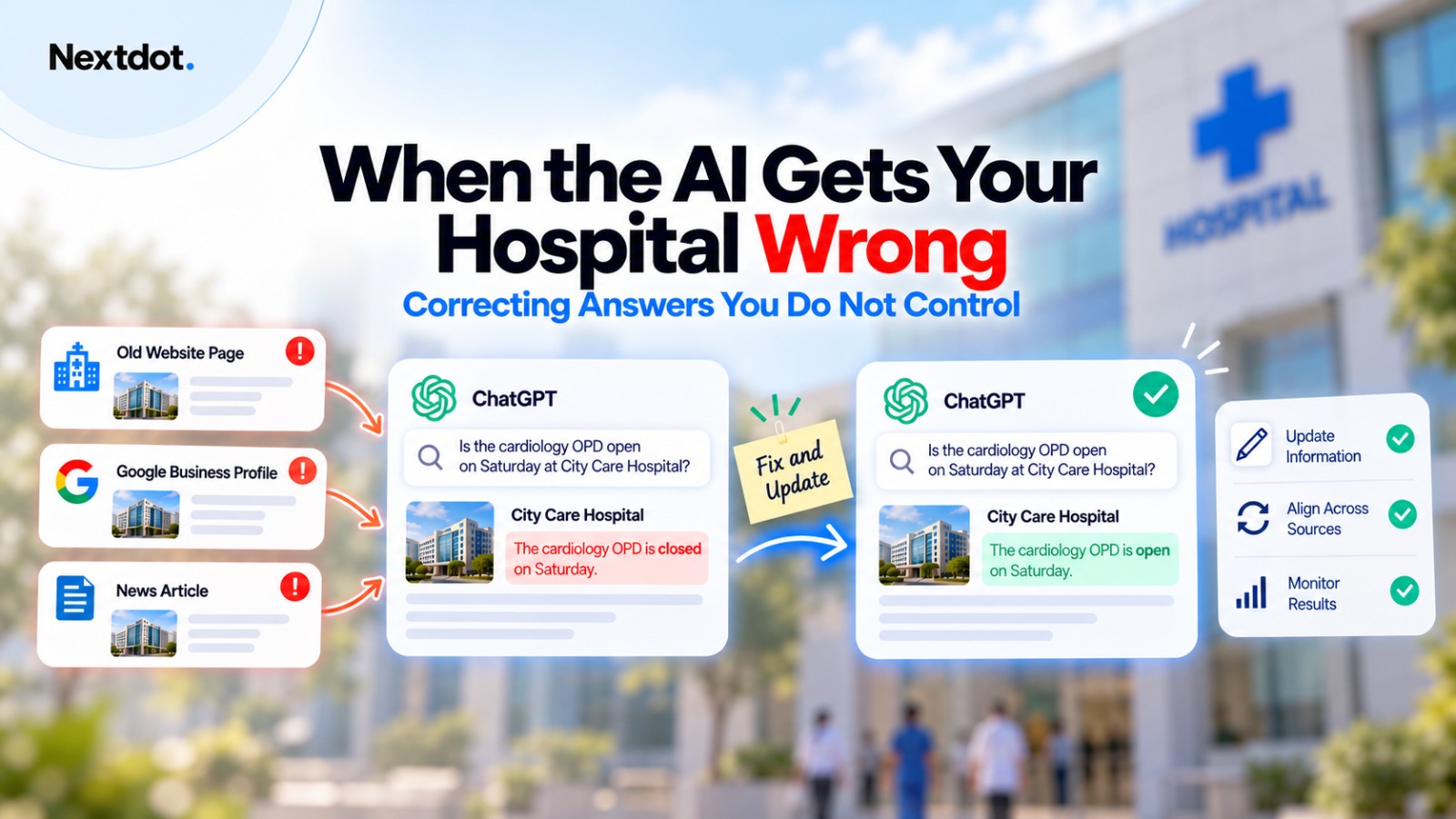
You cannot edit what ChatGPT says about your hospital, and telling it the right answer in a chat changes nothing for the next patient who asks. What you can do is find the page the answer came from, correct that page, reinforce the corrected fact across every source that repeats it, and then measure again on a fixed schedule until the answers catch up. The work is slow because the engines update on their own clocks, and it only stays fixed if someone in the hospital owns it.
The problem usually surfaces at the front desk. A patient calls to ask why the cardiology OPD is closed on Saturday when the website says it is open. A consultant who left eight months ago is still named as the knee surgeon to see at a branch. An assistant tells a family that your hospital offers a transplant programme you never ran. Your team wrote none of these errors, and your team answers for all of them.
Where the wrong answer actually comes from
An AI assistant answering a question about your hospital draws on two kinds of material. The first is what the model absorbed during training, which can be months or years old and which you cannot touch after the fact. The second is what it retrieves live when the question is asked, and this is the part you can influence.
Google says that AI Overviews and AI Mode may use a "query fan-out" technique, issuing several related searches across subtopics and sources to build one answer, and that a page must be indexed and eligible for a search snippet to appear as a supporting link (Source: Google Search Central, "AI features and your website", last updated 10 December 2025). OpenAI says ChatGPT search sometimes partners with other search providers, and that a site must not block its OAI-SearchBot crawler for its content to appear in ChatGPT summaries and snippets (Source: OpenAI Help Center, "Searching the web with ChatGPT", accessed 30 September 2026).
The practical consequence for a hospital: the wrong answer usually traces back to a page that exists somewhere on the open web. The common sources are these:
- An old page on your own site that nobody deleted, such as a 2022 press release announcing a doctor's joining, or a branch page for a clinic that closed.
- A Google Business Profile with stale timings, a wrong phone number, or a category that implies a service you do not offer.
- Third-party directories and aggregators that scraped your details once and never refreshed them.
- A news article, a forum thread or a patient review that states something inaccurate with confidence.
- A doctor's own profile on a listing platform that still names your hospital as their practice.
The model is repeating a source. Your job is to find which one.
The four errors hospitals see, and the route to fixing each
Each class of error has a different most-likely source, so the first move differs.
Wrong timings. OPD hours, emergency availability, visiting hours and pharmacy timings drift fastest. The usual culprit is the Google Business Profile or a directory listing, because those are the pages engines treat as the structured record of a location. Fix the profile first, then your own branch page, then every directory that lists the branch. If your website and your profile disagree, you have handed the engine two answers and it will pick one.
Closed branches. A closed clinic lingers because its footprint was built over years: a profile, a branch page, maps listings, directory entries, local news coverage of the opening. Mark the profile as permanently closed, remove or redirect the branch page to the nearest open facility with a clear note, and work through the directories. Leaving the old page live "for SEO" keeps the error alive.
Services not offered. This one carries the most risk. An assistant that tells a patient you run a paediatric oncology unit, or that you accept a particular insurance scheme, sends a family somewhere they cannot be treated. The source is often a loosely written service page ("we manage all cancers") or a health package listing that mentions a test you outsource. Rewrite your service pages to state precisely what is offered at which location, and remove ambiguous category tags.
Doctors who have left. Each consultant departure leaves behind a profile page, schedule listings, directory entries, video content and the doctor's own listings elsewhere. Redirect the departed doctor's page to the specialty page, remove them from booking flows, and check that the replacement consultant has a complete profile, because an empty slot invites the engine to fill it with the old name.
The correction loop: find, correct, reinforce, re-measure
Every fix above runs through the same four steps.
Find the source. Ask the assistant the question that produced the error, and look at the citations where it shows them. Perplexity and Google AI Overviews generally show links. ChatGPT shows sources when it searches. Where there is no citation, search the wrong fact word for word and see which pages carry it. The page that states the error most plainly is usually the one being read.
Correct it at the source. Fix pages you control directly. For pages you do not control, use the owner's correction route: directory edit requests, the aggregator's support desk, a correction request to a publisher. Log every request and its date.
Reinforce the correct version. One corrected page competing against five stale ones loses. Put the right fact on your website, your Google Business Profile, your top directories and your doctor pages, in the same words. Consistent sources leave an engine fewer competing versions to choose between.
Re-measure on a schedule. Run the same questions against the same engines on a fixed cadence and record what each one says. Answers vary from run to run, so a single check after a fix proves little. Track the fact across several runs until the corrected version holds.
Why the fix does not show up the same day
Three separate clocks govern how fast a correction reaches an answer, and none of them belongs to you.
The first is your own edit. Google's Business Profile help says edits usually take up to 10 minutes to review but can take up to 30 days, and that Google may also update a profile based on accuracy reports from other sources (Source: Google Business Profile Help, "Understand what happens to your Business Profile edits", accessed 30 September 2026). That second clause matters: a stale directory can feed a wrong detail back into a profile you already fixed.
The second is the crawl. A search engine or an AI crawler has to revisit the corrected page before retrieval can see the change. Link the corrected page from pages crawlers already visit, such as your homepage or the specialty hub, so it is found sooner.
The third is the model. Whatever the model learned in training stays until the provider ships a new version. When an assistant answers from memory without searching, your correction does not reach that answer at all until the retrieved material outweighs the trained belief, or the model is retrained.
Plan for a correction to take weeks. Set that expectation before the medical director asks why the error is still there on Thursday.
Can you ask ChatGPT to correct it?
You can tell ChatGPT it is wrong, and it will usually agree with you in that conversation. That agreement does not carry to any other user. OpenAI's help documentation asks users to flag an incorrect answer with the thumbs-down button (Source: OpenAI Help Center, "What is ChatGPT?", accessed 30 September 2026). That sends a signal to the provider with no stated timeline for any change. Use it, and keep source correction as the main route.
Who in the hospital should own this
Answer accuracy fails when it belongs to everyone. The website team owns the site. Operations owns the timings. HR knows which doctor left. Branch managers know which clinic closed. Marketing owns the Google Business Profiles. Nobody owns the moment when these facts diverge.
The cleanest model splits the job. Medical administration owns the doctor facts, and the Head of Digital Marketing owns publishing them everywhere, with a standing feed from HR on consultant exits and joins, from operations on timing changes, and from the branch network on openings and closures. Each feed triggers a fixed checklist of every surface that fact appears on.
Two questions belong with counsel before the process runs. Corrections should state facts only: timings, locations, services, who practises where. Ask counsel how NMC conduct rules and advertising codes apply if a correction starts to describe outcomes. Doctor information you publish or correct is personal data, so ask counsel what the DPDP Act 2023 requires of the hospital when it holds and corrects that data, and keep the correction log to what each correction needs.
Start with a map of what the engines say today
You cannot correct what you have not seen, and each engine can describe the same hospital differently. Nextdot's Doc Mirror audit queries the major AI assistants, including ChatGPT, Perplexity and Google AI Overviews, for how a hospital and its doctors are described, and audits the Google, search results, YouTube and page speed signals behind those answers. It also reads and validates the schema.org markup on hospital and doctor pages, and repeated runs track those answers over time, which gives the re-measure step a baseline. Tracing each wrong fact back to the page feeding it stays with the find step of the correction loop above.
Run the audit, fix first the errors that send patients to the wrong place, and measure again next month.
Frequently asked questions
Can you ask ChatGPT to correct information about you?
A correction inside one conversation does not change what ChatGPT tells other users. The reliable route is to correct the web pages ChatGPT search retrieves, keep the corrected fact consistent across your website, Google Business Profile and directories, and re-check answers on a schedule.
Where does AI get wrong information from?
From training data, and from pages retrieved when a question is asked. For hospitals, retrieved errors usually trace to an old page on the hospital's own site, a stale Google Business Profile, directories, or a departed doctor's listing.
How long does it take for AI answers to update?
Expect weeks, with no fixed end date. A Google Business Profile edit can take from 10 minutes to 30 days to review, according to Google's help documentation. Crawlers then have to revisit the page, and trained knowledge persists until the provider ships a new model. Re-measure on a fixed cadence.
Who in a hospital should own AI answer accuracy?
Medical administration owns the doctor facts and the Head of Digital Marketing owns publishing them, with standing inputs from HR, operations and the branch network, each triggering a checklist of every surface carrying that fact.