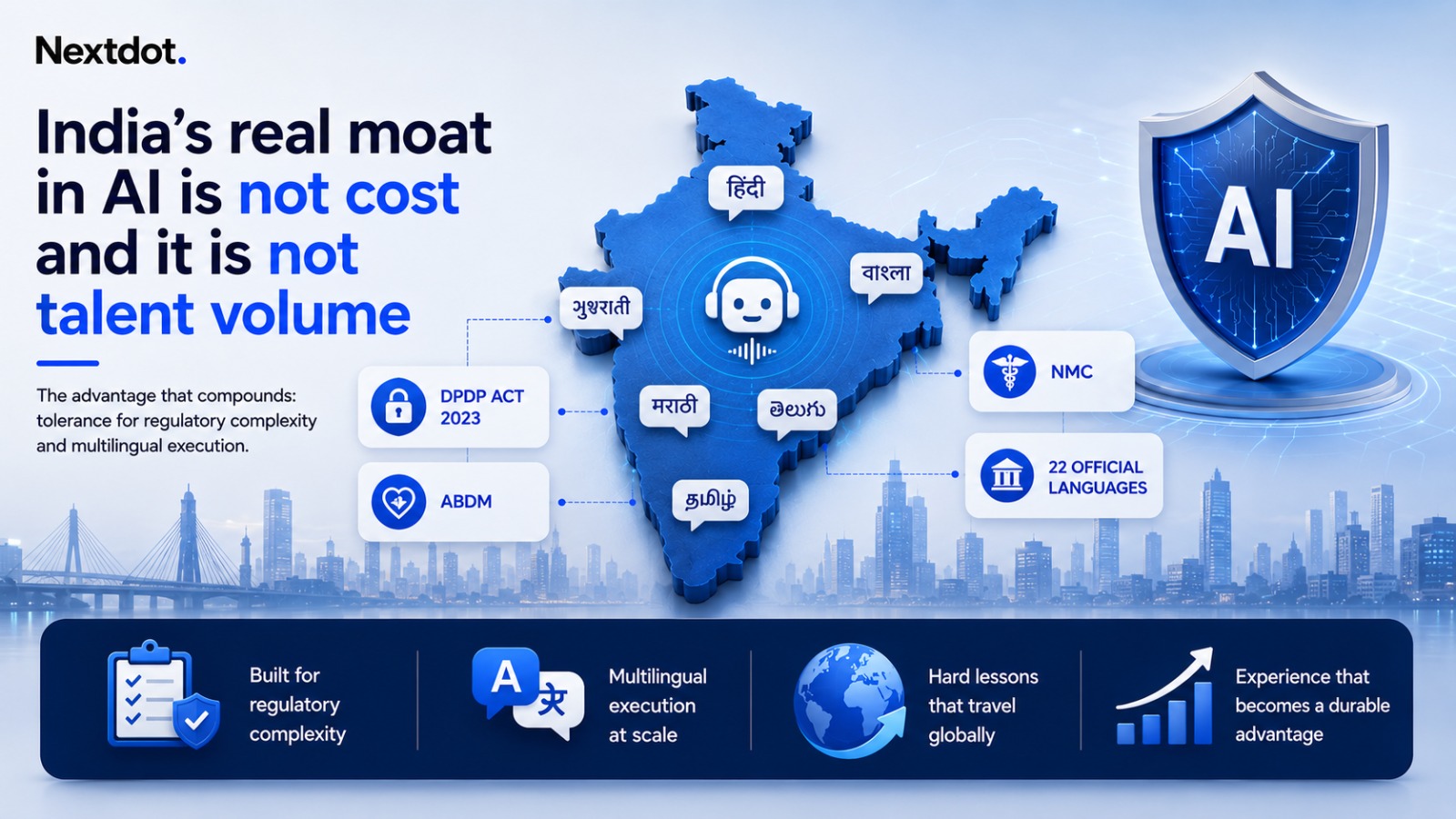
The durable advantage held by Indian AI firms is not cheap engineering and it is not the size of the talent pool. Both are real, both are temporary, and both are being copied right now by every other low-cost delivery geography. The advantage that compounds is different: tolerance for regulatory complexity and hard-won experience shipping into many languages at once. A firm that can put a working system into DPDP, ABDM, NMC oversight and eleven spoken languages has already solved the problems that stop most vendors at the border of a new market. That firm can ship almost anywhere.
Start by retiring the two explanations everyone reaches for first. Cost is a margin, not a moat. The day a competitor in another country matches the rate card, the advantage is gone, and rate cards converge fast once buyers start comparing them. Talent volume is the same story one level up. India produces a very large number of engineers, but so will several other countries within a decade, and a foundation model that writes competent code erodes the value of raw headcount every quarter. Anything a rival can replicate by hiring or by lowering a price is not a moat. It is a head start, and head starts expire.
What actually compounds
The thing that compounds is the scar tissue a firm builds shipping into a genuinely hard regulatory and linguistic environment. India is one of the hardest such environments on earth, and that is the point.
Consider what a real deployment into an Indian hospital or enterprise has to survive. It has to satisfy the Digital Personal Data Protection Act, enacted on 11 August 2023, with the DPDP Rules notified on 13 November 2025 and substantive obligations phasing in from there (Source: Press Information Bureau, 17 November 2025). It has to sit correctly alongside ABDM, the national health data architecture, without misrepresenting what it does or does not connect to. In clinical settings it has to respect the accountability lines the National Medical Commission draws around who owns a medical decision. And it has to do all of this while operating in a country whose Constitution recognises 22 official languages in its Eighth Schedule (Source: Ministry of Home Affairs, Department of Official Language), across a population that speaks many more.
None of that is a checkbox exercise. Each constraint changes the architecture. DPDP forces you to decide where data lives, who the fiduciary is, and how consent and deletion actually work in code rather than in a policy PDF. Multilingual deployment forces you to confront the fact that a voice agent good in English is often unusable in Hindi and worse in a regional language, because latency, accent handling and code-switching break in ways no English benchmark predicts. A firm that has shipped through these constraints, repeatedly, carries a set of engineering reflexes that cannot be bought and cannot be read out of a document.
There is a second-order effect worth naming. In an environment this constrained, the cost of getting the architecture wrong is high enough that firms learn to design for it from the first line rather than retrofitting later. A vendor operating in a permissive market can afford to treat governance as a later phase, because nobody forces the question early. A vendor shipping into an Indian hospital cannot. The regulator, the medical director and the data protection officer all show up before go-live, not after, and they ask for evidence rather than assurances. That pressure produces engineers who assume from the outset that every inference will one day have to be reconstructed and defended. That assumption is expensive to build and nearly impossible to acquire secondhand.
Why complexity tolerance travels
Here is the part enterprise buyers and the press both tend to miss. Regulatory complexity is not a local tax that traps Indian firms inside India. It is a training ground that produces a portable capability.
The pattern holds because hard regulated markets rhyme. A firm that has already built consent capture, audit logging, data residency controls and human-in-the-loop review to satisfy DPDP is not starting from zero when it faces the GDPR in Europe or a sectoral privacy regime in the Gulf or Southeast Asia. The specific rules differ. The engineering posture does not. You have already been forced to treat data governance as an architectural concern rather than a compliance afterthought, and that posture transfers. The muscle built lifting the Indian weight is the same muscle the next market asks for.
Multilingual experience travels the same way. Most of the world outside a handful of rich monolingual markets is linguistically messy, and a great deal of it is more like India than like the United States. A team that has already solved Hindi-first voice, code-switching between a regional language and English, and the ambient noise of a real hospital corridor has solved a general problem, not an Indian one. That capability is directly useful in markets where the dominant vendors, tuned for clean English, simply do not work.
So the moat is not that India is cheap or populous. The moat is that India is difficult in exactly the ways the rest of the emerging enterprise-AI world is difficult, and firms forged here arrive in the next market already fluent in its hardest problems.
What this means for how a firm should be built
If complexity tolerance is the moat, then a firm should be built to accumulate it deliberately rather than to escape it. That is a design choice, and most firms make the opposite one.
The tempting move is to abstract the hard parts away: buy a compliance wrapper, outsource the language work, keep the engineers focused on the model. That optimises for this quarter and dissolves the moat. The compounding move is to keep the regulatory and multilingual difficulty close to the engineering, so that every deployment adds to the institutional reflex instead of hiding it behind a vendor. Nextdot's own view is that the difficult, regulated, multilingual deployment is the asset, and the firms that treat it as a cost to minimise are trading away the only advantage that lasts.
This also reframes what an Indian AI firm is selling abroad. The pitch is not "we are cheaper." The pitch is "we have already shipped into a harder version of your problem." For an enterprise buyer in a regulated industry, that is a far stronger claim than a lower rate, because it speaks to the risk that actually keeps them awake: not whether the demo works, but whether the system survives contact with regulators, auditors and real users in a language the vendor may not speak.
Cost advantages get competed away. Talent pools get matched. The ability to ship a working, accountable, multilingual system into a dense regulatory environment, and to do it again in the next dense environment, is the rare kind of advantage that gets stronger the more it is used. That is India's real moat, and it is available only to the firms willing to keep doing the hard version of the work.
Frequently asked questions
What is India's real advantage in AI?
India's durable advantage in AI is not low cost or the size of its engineering workforce, both of which competitors can copy or price-match. The advantage that compounds is tolerance for regulatory complexity and experience deploying across many languages at once. Firms that have shipped working systems under the Digital Personal Data Protection Act, alongside ABDM, within National Medical Commission accountability lines, and across the 22 official languages recognised in the Constitution's Eighth Schedule have built engineering reflexes that cannot be bought or read out of a document. That capability is what lasts after cost and headcount advantages are competed away.
Why can Indian AI firms ship into other regulated markets?
Because hard regulated markets rhyme, and the engineering posture built for one transfers to the next. A firm that has already implemented consent capture, audit logging, data residency and human-in-the-loop review to satisfy DPDP 2023 is not starting from zero when it meets the GDPR or a sectoral privacy regime elsewhere: the specific rules differ, but the architectural discipline is the same. Multilingual deployment experience travels similarly, since most of the world outside a few rich monolingual markets is linguistically messy in ways that resemble India more than they resemble the United States. Having solved the harder version of the problem at home, these firms arrive in a new market already fluent in its most difficult requirements.