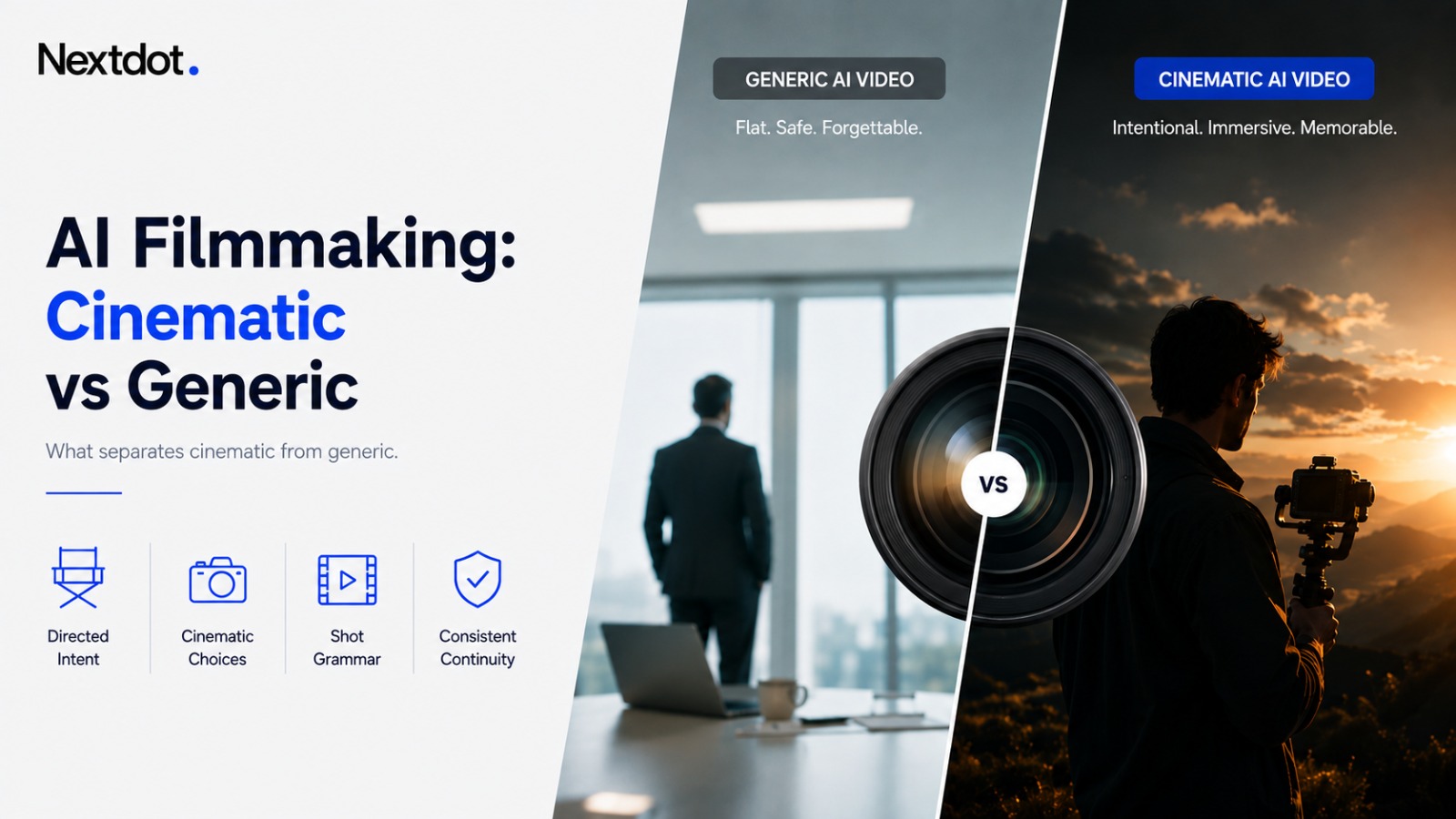
Generic AI video is a sequence of pretty frames with no point of view. Cinematic AI video is directed: someone decided where the camera sits, what the shot is telling you, and how this second connects to the last. The tools produce the frames either way. The difference is entirely in the decisions made before and around the generation, and those decisions are the same craft that has always separated a film from footage.
If your brand video looks like everyone else's brand video, the model is not the reason. The absence of direction is. A CMO evaluating AI creative should stop asking which model a shop uses and start asking who is directing it and whether they can show you the grammar behind a shot rather than the shot alone.
Why AI video looks generic
Most AI video looks generic because it is generated one prompt at a time with no controlling idea above the prompt. You type a description, the model returns a plausible clip, you take the best of a few tries, and you move on. Each clip is locally competent and globally aimless. Stack twelve of those together and you get a reel that feels like a screensaver: technically clean, emotionally flat, indistinguishable from the next brand's reel made the same way.
There are three specific tells. The first is default framing. Left to itself, a text-to-video model centers the subject, holds a mid shot, and lights everything evenly. That is the safest average of its training data, and safe averages are what generic looks like. The second is drifting identity. A product, a face, a room changes subtly from shot to shot because nothing enforced consistency. The third is dead motion. The camera either sits still or does a slow push that carries no meaning, because no one told it why it should move.
None of these are model defects. They are direction defects. The model did exactly what an undirected model does. Someone has to make choices, and most AI video is made by people making none.
The stakes here are not abstract. Short-form video is now the format most marketers use, and a majority of marketing budgets carry a dedicated short-form line item (Source: HubSpot, 45 Video Marketing Statistics for 2025). Viewers decide whether to keep watching within the first couple of seconds, with most drop-off happening before a slow, well-composed reveal ever lands [verify]. If your opening frame reads as generic, the craft in second nine never gets seen.
What makes AI film look cinematic
Cinematic is not a filter or a look-up table you apply at the end. It is a set of decisions made before a single clip is generated, then protected through the whole pipeline. Four decisions carry most of the weight.
Intent per shot. Before generation, every shot should have a job: establish the space, reveal the product, land the emotional beat, hand off to the next shot. A shot with a job is directed. A shot generated because the timeline had a gap is filler, and audiences feel filler even when they cannot name it.
Deliberate framing and lens language. Cinematic work uses framing as meaning. A low angle to make a subject feel commanding. A tight lens to compress and isolate. Negative space to create tension. These choices exist in the prompt and in the selection, which is why a director who understands lens language pulls a different result out of the same model than a prompt-typist does.
Controlled light. Even, flat light is the generic default. Motivated light, a direction, a source, a fall-off, a color temperature that carries mood, is what separates an ad from a clip. You can specify this. Most people do not, and their footage announces it.
Motion with a reason. A dolly that follows an action. A rack of focus that moves attention from one plane to another. Camera movement in cinematic work answers a question the audience is already asking. Movement for its own sake, the aimless drift, reads as a video generated rather than shot.
Tooling matters here only insofar as it gives a director more of these controls. Sustaining a coherent camera move across a longer shot, and holding a consistent look while doing it, is where many text-to-video models fall apart and where more capable models earn their place. Nextdot has early access to Seedance models, which we use where a shot needs a controlled camera move and a stable subject held across its full length rather than a series of disconnected fragments. The model does not supply the direction. It executes a directed move without dissolving the shot, which is the specific technical problem cheaper generators cannot solve.
What is shot grammar in AI film
Shot grammar is the shared visual language that lets a sequence of individual shots read as one continuous idea. It is the film equivalent of grammar in a sentence: rules the audience has internalized without ever studying, which is why breaking them feels wrong even to a viewer who cannot explain why.
The working pieces are old and stable. The establishing shot that tells you where you are before it tells you anything else. The shot-reverse-shot that lets two subjects share a scene. The eyeline match that makes it clear what a subject is looking at. The 180-degree rule that keeps spatial relationships consistent so a viewer never feels disoriented. Match-on-action that hides a cut inside a movement so the sequence flows. Pacing, how long each shot holds before it hands off, which is where rhythm and energy live.
AI generation does not know any of this by default. It generates shots, not sequences, and it has no memory of the shot before unless you build that memory into the process. So shot grammar in AI film is a human-imposed layer: the director decides the sequence, the coverage, and the cut points, then uses the tools to fill each slot. A shop that treats AI video as prompt then prompt then prompt is skipping grammar entirely, which is precisely why undirected AI reels feel like a shuffle of unrelated images.
This is the single clearest test a CMO can run. Ask a creative shop to explain the shot grammar of a piece they made: why this cut here, why this angle, why this hold. A shop doing craft can answer instantly. A shop generating clips will describe the tool.
How do you keep continuity across AI-generated shots
Continuity is the hard technical problem in AI film, and you solve it with reference discipline, not luck. A model generating each shot independently has no reason to keep a face, a product, a wardrobe, a set, or a color palette identical from one clip to the next. Left alone it will drift, and drift is the fastest way to make expensive work look amateur.
The working methods are concrete. Lock visual references for anything that must stay constant: the product, the talent, the environment, the palette, and carry those references into every generation rather than re-describing from scratch each time. Establish a look specification for the whole piece, the color grade, the lens character, the lighting logic, and hold every shot to it. Where a model supports it, seed and reference controls that anchor a subject across shots. And a human continuity pass at review, the same job a continuity supervisor has always done on set, catching the mismatched detail before the client ever sees it.
For a regulated buyer this matters beyond aesthetics. A product that changes shape between shots, or a clinical setting that looks different every cut, is not just ugly, it undermines trust in the brand making the claim. Continuity is credibility.
The honest summary: continuity does not come free from any current model, and any shop promising it as automatic is describing a capability the tools do not yet have. It comes from reference discipline, a defined look, and a human check. That is craft, applied to a new set of tools.
The through-line
Every generic AI reel and every cinematic one is made with roughly the same class of model. The gap between them is direction: intent per shot, deliberate framing, motivated light, motion with a reason, a shot grammar that makes a sequence cohere, and continuity held by reference discipline rather than hope. The tools got good enough that craft is now the entire differentiator. A CMO buying AI creative is not buying a model. They are buying whether anyone in the room can direct.
Frequently asked questions
Why does AI video look generic?
Because it is generated one prompt at a time with no controlling idea above the prompt. Undirected text-to-video defaults to centered framing, even lighting, and aimless camera motion, the safe average of its training data. It also drifts: faces, products, and sets change subtly between shots because nothing enforced consistency. The result is locally competent and globally aimless. The fix is direction, not a better model.
What makes AI film look cinematic?
Decisions made before generation and protected through the pipeline: a defined job for every shot, deliberate framing and lens language, motivated light with a source and a mood, and camera movement that answers a question the audience is already asking. Cinematic is a set of directorial choices executed with the tools, not a filter applied at the end.
What is shot grammar in AI film?
Shot grammar is the shared visual language that makes a sequence of individual shots read as one continuous idea: establishing shots, shot-reverse-shot, eyeline matches, the 180-degree rule, match-on-action, and pacing. AI models generate shots, not sequences, and hold no memory of the previous shot. So shot grammar is a human-imposed layer where the director sets the sequence, the coverage, and the cut points, then fills each slot with the tool.
How do you keep continuity across AI-generated shots?
With reference discipline rather than luck. Lock visual references for anything that must stay constant, the product, the talent, the set, the palette, and carry them into every generation. Define one look specification, color, lens character, lighting logic, for the whole piece and hold every shot to it. Use seed and reference controls where the model supports them, and run a human continuity pass at review to catch mismatches before the client sees them. No current model delivers continuity automatically.