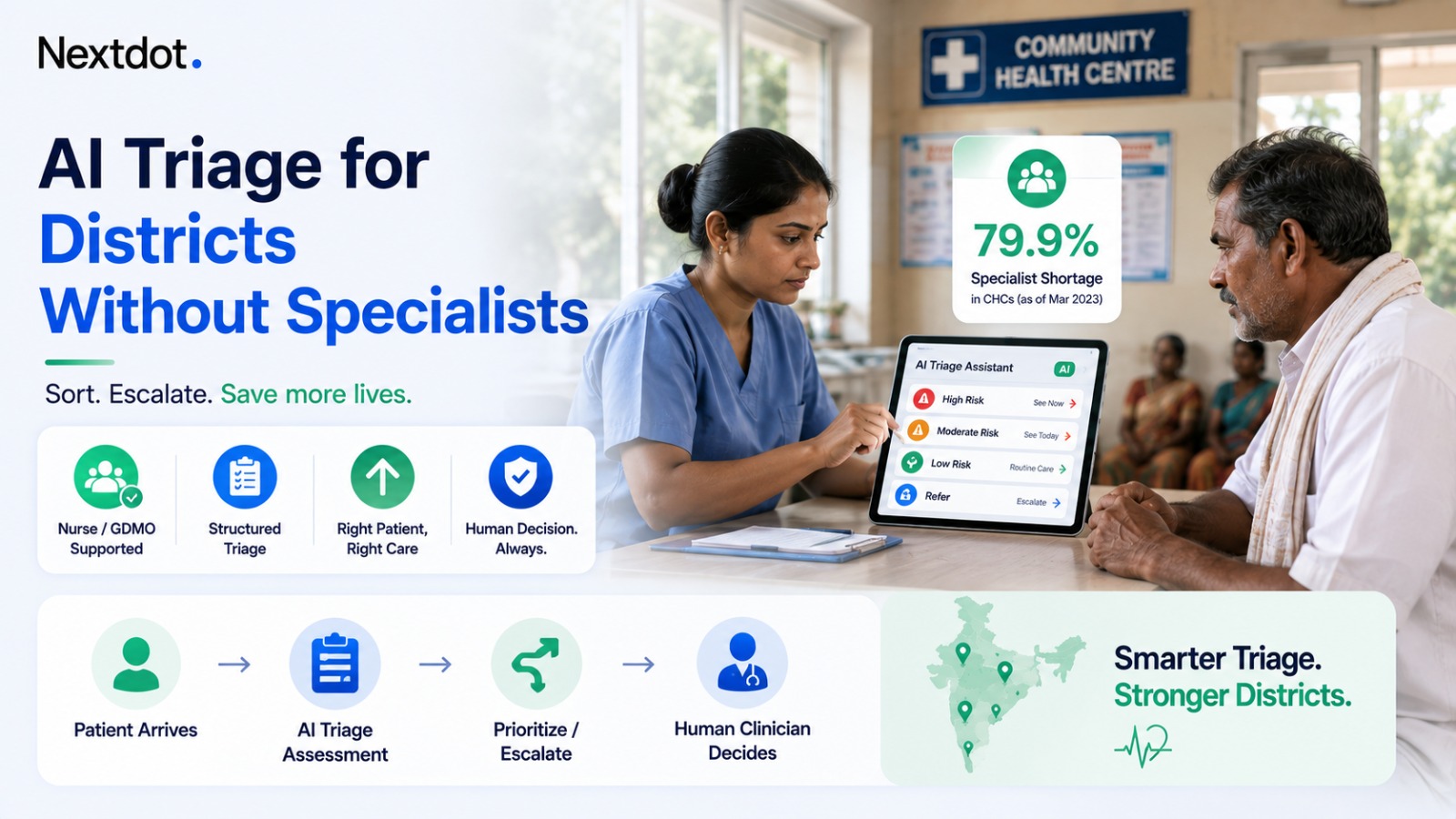
No. AI does not substitute for an absent specialist, and any district health officer who buys it as a substitute is buying a liability. What AI-assisted triage can do is sort: it can help a nurse or a general-duty medical officer decide who needs to be seen first, who can wait, and who has to be referred out today rather than next week. That sorting job, done well and kept inside strict limits, is where the technology earns its place. The diagnosis and the treatment decision stay with a human clinician, every time.
That distinction is the whole argument, so it is worth being precise about why it holds and where it breaks.
The gap is real, and it is not closing on its own
Start with the number that defines the problem. India's Community Health Centres, the second tier of the rural public system, needed 21,964 specialist doctors as of March 2023 and had 4,413 in post. That is a shortfall of 79.9 percent (Source: Health Dynamics of India 2022-23, Union Ministry of Health and Family Welfare, reported September 2024). The gap is worse for surgeons, at 83.3 percent, and physicians, at 81.9 percent. In several large states the shortfall runs past 88 percent.
These are not vacancies that get filled next quarter. A CHC in a district with a 90 percent specialist gap is a facility where a general-duty medical officer, or often a nurse, is the most qualified clinician a patient will meet before referral. The specialist the guidelines assume is not late. She was never appointed.
For context, the World Health Organization treats 44.5 doctors, nurses and midwives per 10,000 people as the density needed to deliver essential services (Source: WHO, Global Strategy on Human Resources for Health, 2016). Large parts of rural India sit well below that line. So when a vendor arrives promising that AI will "close the specialist gap," the honest response is that software does not create a cardiologist. It can only make the non-specialist in the room safer and faster at deciding what to do with the patient in front of them.
What triage actually is, and why AI fits the job
Triage is a sorting decision, not a diagnosis. It asks one question: how urgently does this person need care, and from whom. Emergency departments have run structured triage for decades using paper scales, precisely because the sorting decision can be protocolised even when the diagnosis cannot.
That protocol shape is what makes triage a defensible place for AI. A structured triage assistant takes a presenting complaint and a short set of answers, red flags, vital signs, duration, age, and maps them against an established protocol to produce an urgency band and a suggested action: see now, see today, routine, or refer. It is doing pattern-matching against a rulebook a human wrote, not forming a clinical opinion of its own.
Two things follow. First, the assistant is auditable. Every output traces back to the inputs and the protocol version that produced it, which matters when someone later asks why a patient was sent home. Second, its job is bounded. It is not deciding what is wrong with the patient. It is deciding how fast the patient needs a human who can.
Kept to that boundary, AI-assisted triage does useful work in an underserved district. It gives a nurse a consistent structure for a decision she is currently making from memory under load. It flags the red flags that get missed at the end of a twelve-hour shift. It documents the reasoning so the referral that follows carries the history the district hospital needs.
Where it works
Three settings, specifically.
High-volume OPD sorting. In a busy district OPD where one medical officer sees far more patients than the clinic was built for, a triage assistant at the registration desk can order the queue by urgency instead of arrival time. The chest-pain patient stops waiting behind the follow-up prescription. The clinician still sees everyone. The assistant only changes the order.
Nurse-led screening at the first point of contact. At a sub-centre or a health and wellness centre staffed by a nurse or a community health officer, a structured assistant supports the escalation decision: is this something the CHO manages here, or does it go up the referral chain now. The value is consistency. The assistant asks the same red-flag questions every time, which a tired human does not.
Referral preparation. When a case has to move to a higher facility, the triage record becomes the referral note: structured complaint, vitals, red flags, urgency band. The receiving hospital gets a legible handover instead of a scrawled chit, and the patient does not repeat the whole history from scratch on arrival.
In all three, notice what the AI is not doing. It is not the final decision-maker. It is preparing a decision for a human to make and own.
Where it must not be used
This is the half of the piece a responsible vendor writes and most skip.
Do not use it to rule out. A triage assistant can safely raise urgency. It must never be used to send a patient home. The failure mode that harms people is under-triage: the tool marks a serious case as routine and a non-specialist trusts it. The design rule that follows is asymmetric. The assistant is allowed to escalate freely and is never allowed to be the reason a patient is discharged. A human clinician owns every de-escalation.
Do not let it stand in for the referral that is actually needed. If the honest answer is that the patient needs a specialist the district does not have, the tool's job is to say so and route the referral, not to generate a management plan that keeps the patient local because the specialist is far away. Using triage AI to avoid an inconvenient referral is the exact misuse that turns a sorting aid into a danger.
Do not deploy it without a named clinician accountable for its outputs. Under Indian law, clinical judgment sits with the clinician and, vicariously, with the facility, and no software contract moves that accountability to a vendor. A triage assistant with no clinician signing off on its use in the workflow is not a safety tool. It is an unowned risk. The facility that deploys it has to name who is responsible for acting on, and overriding, what it produces.
Do not treat the accuracy number as a green light. Published triage accuracy for symptom-assessment tools varies widely by tool and by case mix, and the relevant question is never the average [verify]. It is the under-triage rate on the serious presentations, chest pain, stroke signs, sepsis, paediatric red flags, because that is where a wrong sort kills. A tool that is 90 percent accurate overall and misses a third of the time-critical cases is not fit for this use. Buyers should ask for the safety-relevant miss rate, not the headline figure.
How to buy it without getting burned
A district health officer or a small-hospital administrator evaluating a triage assistant should hold a short, hard line.
Ask which clinical protocol it implements and who validated it for Indian presentation patterns. A tool trained on Western case mix will misjudge what walks into an Indian district OPD. Ask for the under-triage rate on time-critical conditions specifically, in writing. Require that every output is logged with its inputs and protocol version, so an override or an adverse event can be reconstructed later. Confirm the workflow names a clinician who reviews and owns triage decisions, with the assistant positioned as input, not authority. And confirm the tool escalates on uncertainty rather than guessing, because in a low-resource setting the safe default when the model is unsure is always up the chain, never down.
Nextdot's position on this is deliberately narrow. AI-assisted triage is worth building where it makes an existing non-specialist safer and faster at sorting, inside a workflow that keeps a human clinician accountable for every decision that sends a patient home or holds them local. It is not worth building, and not worth buying, as a way to pretend a district has a specialist it does not have. The specialist gap is a workforce problem. Software can make the gap less dangerous. It cannot fill it, and a vendor who says otherwise is selling the district something it will regret.
Frequently asked questions
Can AI replace a specialist doctor?
No. AI-assisted triage sorts patients by urgency and prepares referrals; it does not diagnose or treat, and it does not substitute for a specialist's clinical judgment. In a district with an 80 percent-plus specialist shortfall, its role is to make the available non-specialist safer and faster at deciding who needs care first and who must be referred out. The clinical decision, and the legal accountability for it, stays with a human clinician.
Where is AI-assisted triage safe to use?
It is safe in bounded sorting roles: ordering a high-volume OPD queue by urgency, supporting a nurse's escalation decision at the first point of contact, and structuring a referral note for a receiving hospital. In each case the assistant maps a complaint against an established protocol to suggest an urgency band, while a human clinician still sees the patient and makes the call. It works when it is treated as input to a decision, not as the decision.
Where must AI triage not be used?
It must never be used to rule out illness or send a patient home; a triage assistant may raise urgency but must never be the reason for a discharge, because under-triage is the failure that harms patients. It must not be used to avoid a referral the patient actually needs, and it must not be deployed without a named clinician accountable for acting on and overriding its outputs. If the answer is that a specialist is needed, the tool's job is to route the referral, not to keep the patient local.
How accurate is AI triage?
Accuracy varies widely by tool, protocol, and case mix, so the headline average is the wrong measure [verify]. The number that matters is the under-triage rate on time-critical conditions such as chest pain, stroke, sepsis and paediatric red flags, because a wrong sort there is where harm happens. Buyers should demand the safety-relevant miss rate in writing, confirm the tool escalates when uncertain rather than guessing, and require that every output is logged with its inputs for later review.