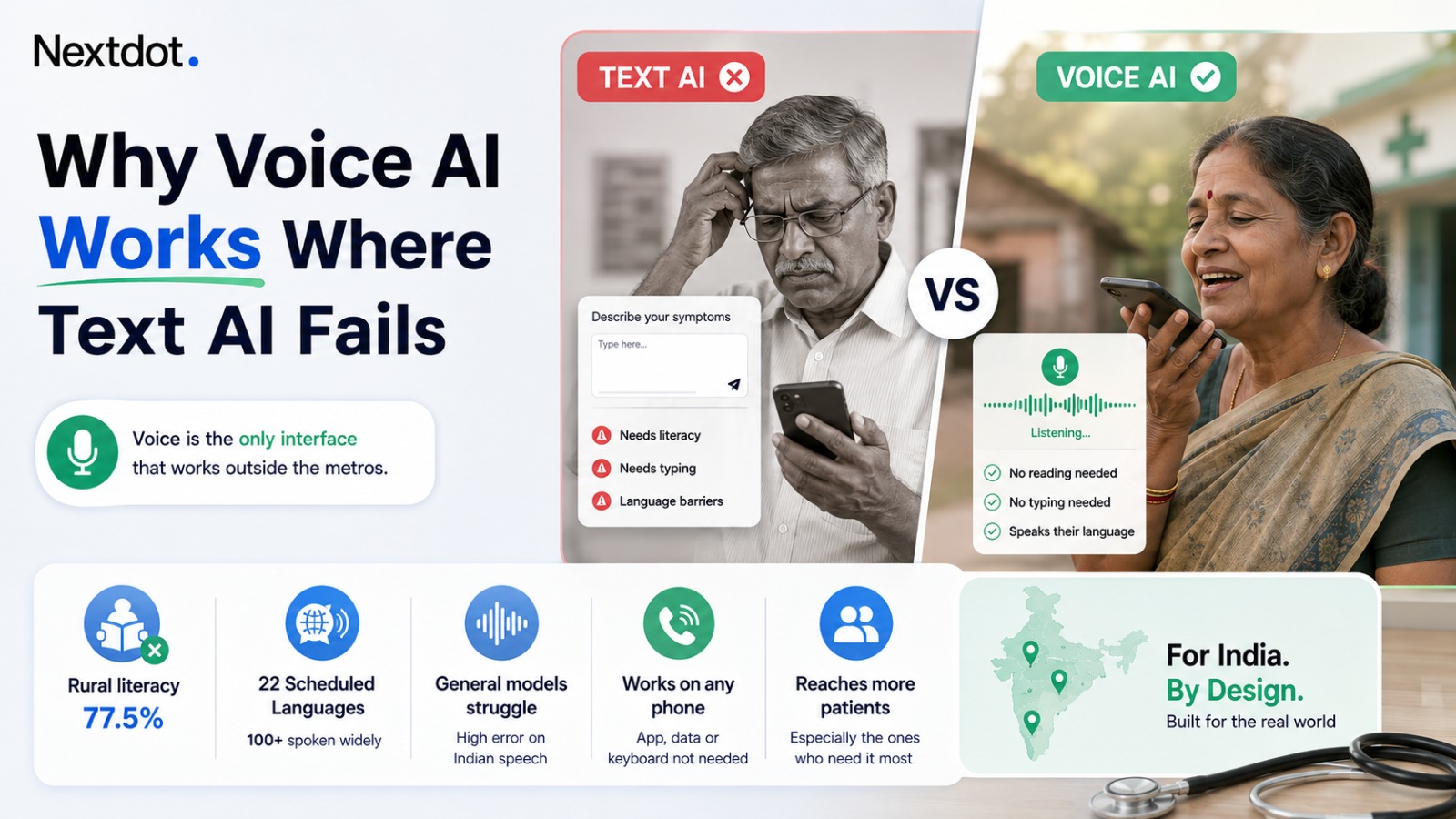
Text-first AI fails in tier-2 and rural healthcare because it assumes a patient who reads comfortably, types on a smartphone, and speaks one of the few languages your model was trained on. Outside the metros, fewer of those assumptions hold at once. Voice works because it drops the literacy requirement, drops the typing requirement, and meets the patient in the language and dialect they actually speak. The engineering problem then moves to one place: making speech recognition accurate on regional Indian inflection, which is exactly where general models fall over.
If you run a 40-bed nursing home, a district hospital, or a clinic chain across smaller towns, this is the interface decision that determines whether patients use the system at all. Get it wrong and you have built a helpdesk nobody outside your front office can operate.
The reading assumption breaks first
A chatbot, a form, a patient portal, an app: each one asks the user to read the screen and type a reply. That is a reasonable ask in a metro corporate hospital where the patient arrived with a smartphone and an email address. It is a poor ask across most of the country.
Rural literacy stood at 77.5 percent in 2023-24, and rural female literacy at 70.4 percent (Source: Periodic Labour Force Survey 2023-24, MoSPI, 2024). Literacy as the census measures it is a low bar. It does not mean a person can read a medication schedule on a phone screen, parse a consent notice, or type a symptom into a text box under stress. The number of patients who can technically read but will not comfortably transact with a text interface is far larger than the illiteracy figure alone suggests. In a waiting room in a tier-3 town, the share of patients who will happily type their complaint into an app is small, and it is smallest among exactly the patients who most need the visit: the elderly, the anxious, the first-time attender.
Voice removes the ask. The patient speaks, the system listens. There is nothing to read and nothing to type. For appointment booking, reminders, pre-visit intake, and post-discharge follow-up, that difference decides adoption. Nextdot's own WhatsApp-first booking work with small clinics reaches patients through a channel they already use, and the moment the interaction becomes spoken rather than typed, the addressable patient base widens sharply.
The device assumption breaks second
The second thing text-first design assumes is a capable device with a data connection and a keyboard the user can operate. Across smaller towns the device is often a shared phone, a feature phone, or a smartphone kept by a family member rather than the patient. Typing a chief complaint in a regional script on such a device is slow and error-prone even for a literate user.
Voice degrades to the lowest common denominator gracefully. A voice agent reachable over a plain phone call needs no app, no data plan, and no script input. The patient dials a number and speaks. That is the one interface that works on the device the patient actually holds, and it is the reason a voice channel outperforms an app in reach precisely where reach is the whole problem.
The language assumption is the one that fails hardest
Here is where most healthcare AI built for the metros quietly excludes the majority of the country. Census 2011 records 22 scheduled languages, with 96.71 percent of the population reporting one of them as their mother tongue, and 121 languages spoken by 10,000 or more people (Source: Census of India 2011, Office of the Registrar General of India). A patient in a district hospital is not choosing between English and Hindi. They are speaking Bhojpuri, Maithili, Marwari, a regional Bangla, a Tamil dialect, or Hindi carrying a strong local inflection.
A text interface handles this badly on two fronts. It forces the patient to select a language and read a script many are not fluent reading, and it collapses the dialect range into whatever the interface happens to support. Voice can meet the spoken language directly. But only if the speech recognition underneath is accurate on that speech, and this is where the general-purpose models most teams reach for first come apart.
Why general speech models degrade on Indian speech
The instinct is to take a strong general model such as Whisper, point it at Indian audio, and ship. The measured results say do not.
On native Indian-language audio, a general model's error rate is not marginally worse, it is unusable. A published evaluation put OpenAI's Whisper at a word error rate of 86.9 percent on Hindi (Source: "Evaluating OpenAI's Whisper ASR: Performance analysis across diverse accents and speaker traits," JASA Express Letters, AIP Publishing, 2024). A word error rate near 87 means the transcript is closer to noise than to signal. You cannot book an appointment, capture a symptom, or triage on a transcript like that.
Even on English, Indian inflection alone moves the number substantially. The Svarah benchmark, built specifically to test English ASR on Indian accents, found large accuracy gaps between Indian-accented English and native English across leading systems (Source: Svarah, AI4Bharat, 2023). If a strong model already stumbles on Indian-accented English, expect it to fall much further on a regional dialect it never saw enough of in training.
The reason is data. General models are trained on web-scale audio dominated by a handful of high-resource languages and accents. Indian languages, and the code-switched, dialect-heavy speech of a real consultation waiting room, are thin in that training mix. The model has not heard enough of how India actually speaks. This is a data-distribution problem, and it does not resolve by prompting harder or swapping the language flag.
This is the specific technical reason the speech layer for an Indian voice deployment cannot be a general model out of the box. It needs a recognition stack tuned for Indian languages and inflection. For this reason Nextdot uses an Indian-language speech stack rather than a general model for the recognition layer, and Nextdot is part of Sarvam's Startup Partner Program. The point is not the badge. The point is that the transcript has to be right in Bhojpuri-inflected Hindi before anything built on top of it can be trusted.
What this means for a tier-2 or tier-3 deployment
If you are specifying a patient-facing system for a smaller facility, the interface order is the decision that carries the rest.
Lead with voice for the patient-facing surface: appointment booking, reminders, intake, and follow-up over a phone call or a voice note, not a typed form. Keep text where it genuinely fits, which is your own staff on a keyboard at a desk, and the printed or messaged record the visit produces. Do not invert that and push patients onto text because text was cheaper to build.
Specify the recognition layer explicitly. Ask any vendor for the word error rate on the actual languages and dialects your catchment speaks, measured on real recordings from a setting like yours, not a clean benchmark read in a studio. A vendor who cannot produce that number is guessing, and on the evidence above, general models guess badly on Indian speech.
Design for handoff. A voice agent is a front door, not a doctor. Every clinically meaningful interaction should have a defined path to a human, and the most common live failure in voice deployments is that handoff, not the model's grasp of language. Build the escalation before you build the conversation.
Voice is not a nicer interface for rural healthcare. It is the interface that removes the three assumptions text quietly makes, reading, typing, and a narrow language set, and it is the only one that meets the patient where they are. The hard engineering is not the conversation. It is getting the speech recognition right on the way people in your district actually talk.
Frequently asked questions
Why does text-based AI fail in rural India?
Text-based AI assumes a user who reads comfortably, types on a capable device, and speaks a well-supported language. Across rural and tier-2 India fewer of those hold together. Rural literacy was 77.5 percent and rural female literacy 70.4 percent in 2023-24 (Periodic Labour Force Survey 2023-24, MoSPI), and census-level literacy does not mean a patient can read a medication schedule or type a symptom under stress. Many patients also use shared or feature phones. Text excludes exactly the patients who most need the visit.
Does voice AI support Indian regional languages?
It can, but only if the speech recognition layer is trained for them. Census 2011 records 22 scheduled languages and 121 languages spoken by 10,000 or more people (Office of the Registrar General of India). A voice system tuned for Indian languages and dialects can meet a patient in the language they actually speak. A general-purpose model pointed at Indian audio usually cannot, because it was not trained on enough of that speech.
Why does Whisper struggle with Indian speech?
Whisper and similar general models are trained on web-scale audio dominated by a few high-resource languages and accents, so Indian languages and dialects are thin in the training data. A published evaluation measured Whisper at a word error rate of 86.9 percent on Hindi (JASA Express Letters, AIP Publishing, 2024), which is close to unusable. The Svarah benchmark also found large accuracy gaps on Indian-accented English (AI4Bharat, 2023). This is a data-distribution problem, so it is fixed by a recognition stack tuned for Indian speech, not by prompting.
What interface works for low-literacy patients?
A voice interface, ideally reachable over a plain phone call so it needs no app, no data plan, and no typing. The patient speaks and the system listens. This removes the reading and typing requirements that make text-first systems unusable for low-literacy patients, and it works on the shared and feature phones common outside the metros. Voice is best used for the patient-facing surface, appointment booking, reminders, intake, and follow-up, with a clear path to a human for anything clinically meaningful.