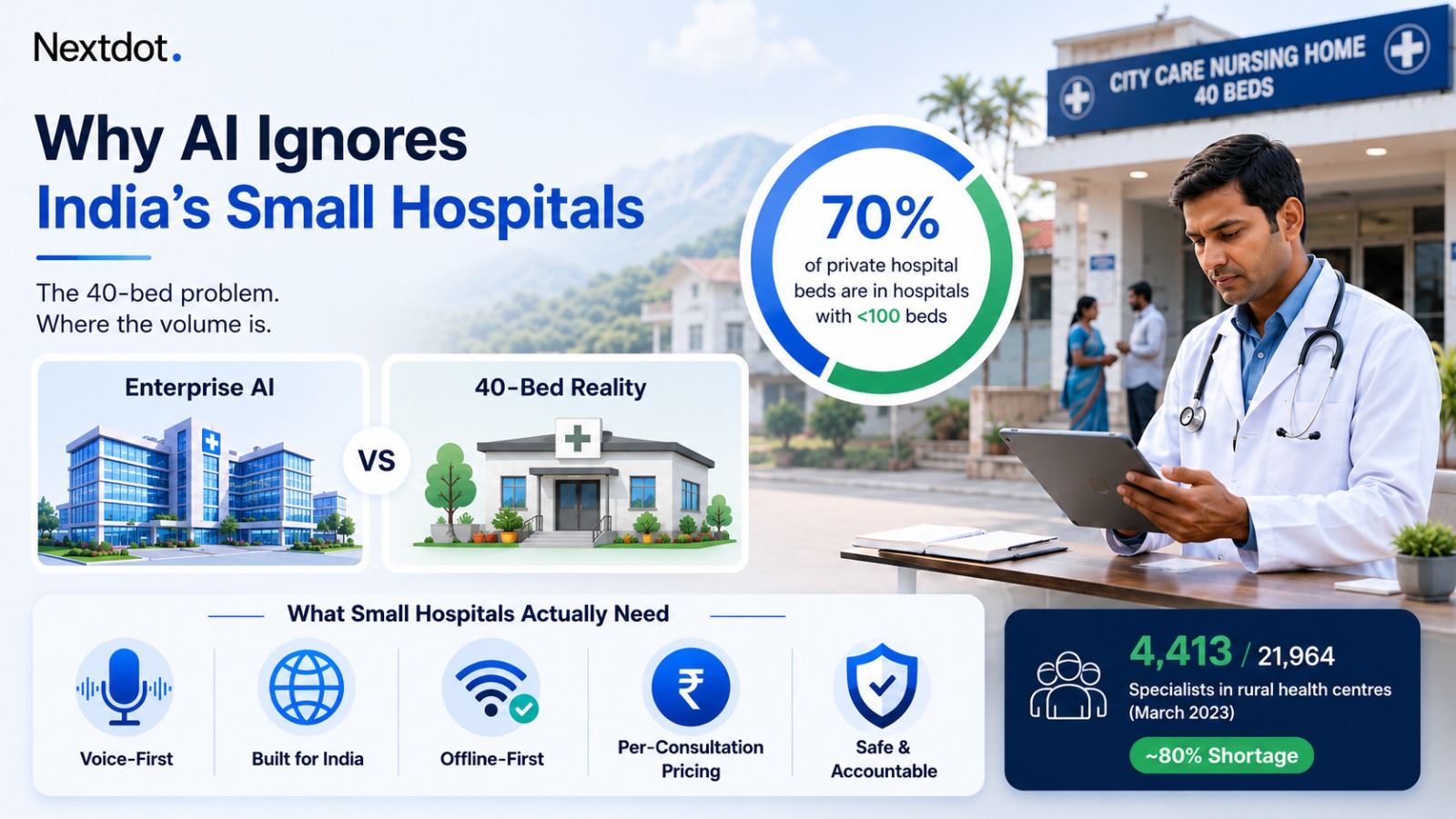
There is very little affordable AI built for a 40-bed nursing home or a tier 2 hospital in India, and the reason is commercial, not technical. Enterprise healthcare AI is priced, packaged and integration-tested for large metro hospital groups that can carry a per-seat license, run an IT team, and absorb a multi-week integration. A small facility has none of those, so it gets ignored, even though most of India is treated in exactly those facilities. Affordable AI for a small hospital is possible, but it has to be rebuilt around the small hospital's constraints rather than sold down from the enterprise version.
That is the whole problem in one line. The volume of Indian healthcare does not sit where the AI is being sold. It sits in the fragmented middle: standalone nursing homes, small chains, district hospitals, single-specialty clinics. Roughly seven in ten private hospital beds in India sit in facilities with fewer than 100 beds, spread across an estimated tens of thousands of small community hospitals and nursing homes [verify]. The corporate chains that every AI vendor demos to are a slice of the beds and a large slice of the revenue. The AI industry has followed the revenue and skipped the beds.
Why the enterprise version does not scale down
The instinct of most vendors is to take the product they sell to a 900-bed group and offer a cheaper tier of it to a 40-bed home. This does not work, and it is worth being specific about why, because each reason is a design decision, not a discount.
Pricing is the first wall. Enterprise AI is sold per seat or per site, or as an annual license in a band a small hospital cannot reach. A nursing home owner running the pharmacy, the billing counter and the front desk from four people does not have named users with dedicated logins. The staff rotate across a shared computer and a couple of phones. A per-seat model assumes a headcount and a login structure the facility does not have.
Integration is the second wall. Enterprise deployments assume an interface engine, an HL7 or FHIR feed, and someone on the client side who owns the handover. A small hospital either runs a basic HMIS with no integration surface or runs on paper and a spreadsheet. There is no counterpart engineer to receive the system. This is the disqualifier Nextdot applies to any engagement: with nobody on the client side to own the handover, a build becomes a dependency rather than a capability, and it fails within months. A small facility should buy a product, not commission a build. The catch is that almost nobody is building the product.
Support is the third wall. In a large hospital, when the AI misbehaves, an internal team files a ticket. In a nursing home, the person who notices is the owner, and his only lever is to stop using the tool. Any AI for this segment has to assume zero local technical capability, silent updates, and a fallback to paper when it fails. Enterprise support models assume the opposite.
Cost, integration, support. On each axis the enterprise product is built for a customer the small hospital is not. Cheapening the license does not touch any of the three.
Where the volume actually is
India's healthcare delivery is not a metro phenomenon with a rural tail. The distribution is closer to the reverse. The corporate super-specialty hospital is visible, marketed, and financeable, which is why it dominates the conversation. It is not where most consultations happen.
The specialist gap makes the point sharper than any bed count. In rural community health centres, only 4,413 of the 21,964 specialist doctors required were in post as of March 2023, a shortfall of 79.9 percent (Source: Health Dynamics of India / Rural Health Statistics 2022-23, Ministry of Health and Family Welfare, reported September 2024). Surgeons ran at an 83.3 percent shortfall, physicians at 81.9 percent, paediatricians at 80.5 percent. The facilities carrying the load in tier 2, tier 3 and rural India are running with a fraction of the specialist cover the metros take for granted.
This is the demand that enterprise AI walks past. Not because the need is smaller. Because the buyer does not fit the sales model. A market with the highest need and the least served software is the one worth building for on purpose.
What a 40-bed nursing home actually needs
The temptation is to answer "which AI product" before answering "which problem". For a small facility the priority list is narrow and specific, and it is not the enterprise list.
The record has to get captured without adding work. A doctor seeing a high OPD load will not stop to type structured data into forms, and a receptionist will not either. The first useful thing AI does here is take the consultation and the front-desk interaction and turn them into a clean, reviewable record, so the note gets written without the doctor writing it and without a data-entry clerk the facility cannot afford to hire.
The interface has to be voice, because the typing does not happen. In a district clinic the input is rarely clean English or clean Hindi. It is code-switched, dialect-inflected, with a drug name dropped into a regional sentence. This is a real engineering constraint: general-purpose speech models trained mostly on Western-accented English degrade on that input, and a scribe that mishears a medicine name is worse than none. The interface question and the language question are the same question in this market, and they decide whether the tool gets used or abandoned in the first week.
The system has to survive the environment it runs in. The line will drop, the power will drop, and the device is shared. A tool that treats a dead connection as an error state rather than the expected state stops the OPD dead. Local-first capture with deferred sync is not a nice-to-have here. It is the difference between a working clinic and a receptionist telling patients to come back after lunch because the software is down.
And the price has to be legible. Bill against a unit the owner already understands, the consultation, the document, the call, so he can do the math at the billing counter. A fixed monthly sum that does not care whether the OPD saw 20 patients or 200 is a number he cannot reason about, and he will not sign it. Charging per consultation forces a second design choice that happens to be correct: route routine notes to a smaller, cheaper model and reserve an expensive one for genuinely hard cases, so the unit price actually clears.
Why this is a build decision, not a charity decision
None of this argues for a stripped, worse product offered as a favour to small hospitals. It argues that the small-hospital product is a different product, engineered from the constraints up, and that whoever builds it correctly reaches the largest underserved base of clinical volume in the country.
The line that has to hold is safety. Costs get cut, clinical safety and data accountability do not. Every AI-generated clinical note is reviewed by the clinician before it enters the record, with no silent auto-filing. Every action is attributable to a person, even on a shared device, because under DPDP 2023 the facility holds personal health data it must account for regardless of its size. The law does not scale its expectations down for a 40-bed home, and neither should the design.
Everything else flexes against budget: model tier, sync frequency, feature depth. The floor is a system that stays safe when it is offline, dark and shared, which is the condition it will spend most of its life in. Build for that condition and AI reaches the facilities where most of India is actually treated. Keep building for the server room, and it stays in the metros, chasing the revenue and missing the beds.
Frequently asked questions
Is there affordable AI for small hospitals?
Very little of it is purpose-built today, and that is the gap. Most healthcare AI is priced and integration-tested for large metro hospital groups, then offered to small facilities as a cheaper tier of the same product. That does not fit a facility with no IT team, no named-user logins, and no integration engineer. Affordable AI for a small hospital is possible, but it has to be engineered around the small facility's constraints: voice-first capture, offline tolerance, per-consultation pricing, and clinician review, rather than a discounted enterprise license.
Why does healthcare AI only serve metro hospitals?
Because the sales model, not the technology, is built for them. Enterprise AI assumes a per-seat license the facility can afford, an IT team to run it, an integration layer to plug into, and internal staff to support it. Metro corporate hospital groups have all four. Small hospitals have none, so vendors follow the revenue to the metros and skip the far larger base of small-facility beds.
What AI works for a 40-bed nursing home?
AI that captures the record without adding staff work, runs voice-first because nobody will type structured data between patients, handles Indian dialect and code-switched speech accurately, survives dropped connections and power cuts through local-first capture, and prices per consultation so the owner can reason about the cost. It must keep clinician review on every note and attribute every action to a person even on a shared device. A custom build is usually wrong here because there is no engineering counterpart to own the handover; the right answer is a product designed for these constraints.
Where is most of India's healthcare actually delivered?
In the fragmented middle, not the metros. Roughly seven in ten private hospital beds in India sit in facilities with fewer than 100 beds [verify], and rural community health centres run with an 80 percent specialist shortfall, with only 4,413 of 21,964 required specialists in post as of March 2023 (Source: Health Dynamics of India / Rural Health Statistics 2022-23, Ministry of Health and Family Welfare, reported September 2024). The volume of Indian healthcare sits in tier 2, tier 3 and rural facilities that enterprise AI currently walks past.