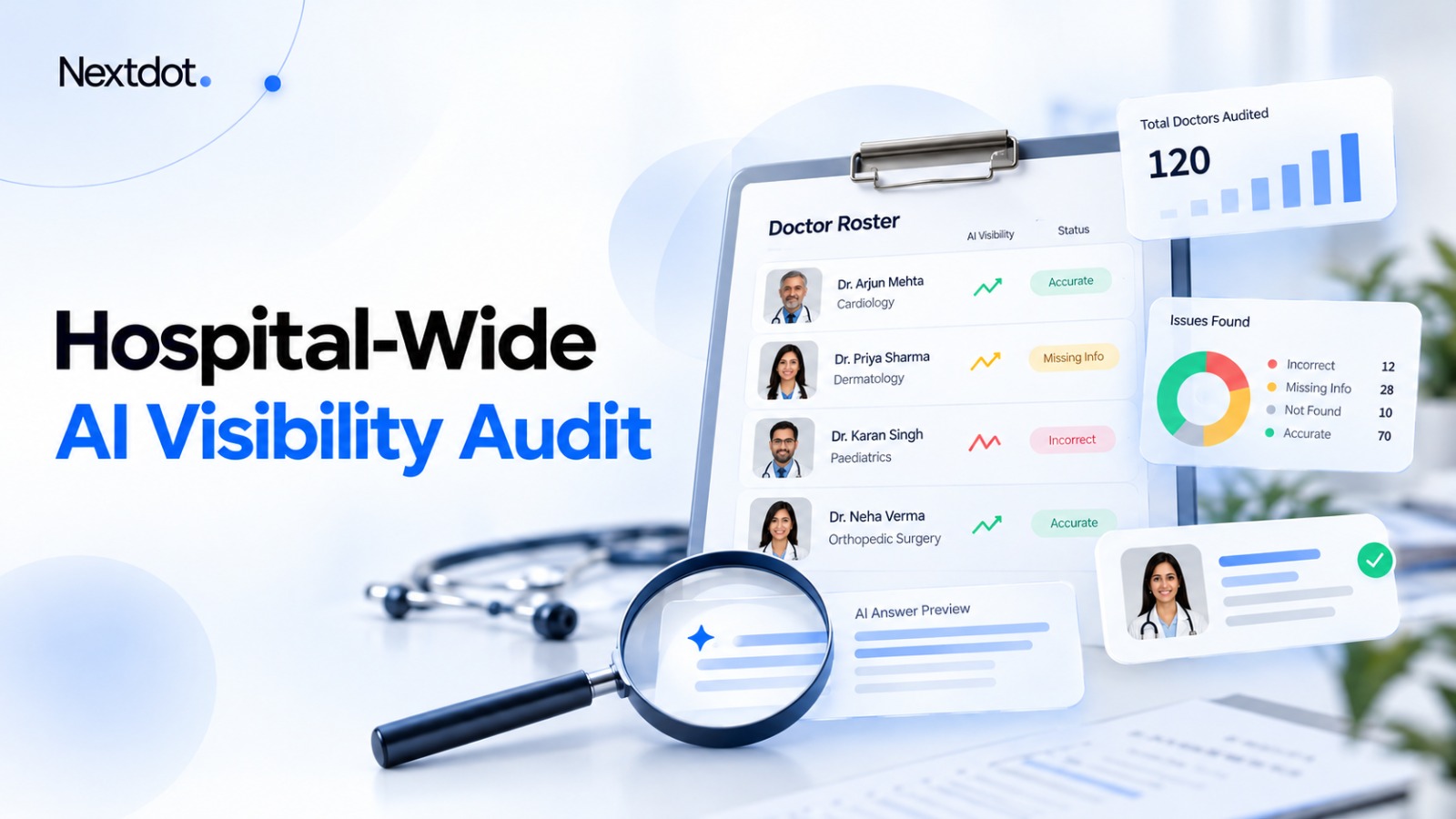
A hospital should audit how AI assistants describe its doctors by taking the full roster from medical administration, querying the major engines for every name on it, and sorting what comes back by the harm each error does to a patient. Fixes split cleanly: medical administration corrects the facts, marketing publishes them, and each doctor is told about the audit and asked to check their own record. Then the hospital re-audits on a fixed cycle, because a roster changes every month.
The star consultants are the wrong sample
Ask a hospital marketing team whether it has checked what ChatGPT says about its doctors, and where a check exists, it tends to cover a handful of senior names. Those are the records most likely to come back clean, because senior doctors have years of press, papers and directory entries behind them.
Patients ask about the rest of the roster. The pregnant woman in her second trimester asks for an obstetrician near her home who speaks Marathi. The father of a feverish toddler asks which paediatrician is open on Sunday. The answer engine has to resolve those questions to a named person, and the person it reaches for can be a junior consultant, a visiting specialist or a doctor who joined last quarter. Nobody has looked at those records.
The volume of those questions is already large. OpenAI's January 2026 report "AI as a Healthcare Ally" stated that more than 40 million people a day ask ChatGPT health questions, and that health accounts for more than 5 percent of all its messages worldwide. In Rock Health's 2025 Consumer Adoption of Digital Health Survey, published in March 2026, 32 percent of US adults said they had used AI chatbots for health information, double the 16 percent of a year earlier. Neither figure is specific to India, so read them as direction. The direction is clear enough to act on.
Scope: what a roster audit covers
The unit of the audit is the doctor. The scope is everyone a patient could reasonably be sent to by name:
- every full-time consultant, across every branch
- visiting and sessional consultants who hold OPD slots
- doctors who left in the recent past, because AI answers can keep naming them after they go
- doctors who have joined but whose pages may not be live yet
For each name, the audit asks four questions. Does the engine know this doctor exists? Does it place them at the right hospital and branch? Does it describe their specialty and the conditions they treat correctly? And when a patient asks a condition-and-city question in that specialty, does the doctor appear at all?
The prompt panel and the share of answer metric are set out in "Share of answer: how to measure whether AI recommends your hospital". What a good profile page contains is covered in "The doctor profile is the unit of hospital AEO". The roster audit sits upstream of both: it tells you where the problems are before anyone starts fixing pages.
Start from medical administration's list
Take the input list from medical administration or the credentialing team. The website's Find a Doctor page is the thing being audited, and if it is also the input, every doctor missing from the site is missing from the audit too.
Ask medical administration for the current roster with registered names, specialties and branches, plus the leavers and joiners over the period you choose to cover. Reconciling that list against the website, before any engine is queried, often produces the first findings: doctors on the site who left, and doctors on the roster who have no page.
Triage: sort by what the error costs a patient
A full-roster audit returns a lot of findings. Ranking them by how famous the doctor is repeats the star-consultant mistake. Rank them by what each error does to the person who acts on it.
First: answers that send a patient to a doctor who is gone. An engine that names a departed consultant at your hospital produces a booking you cannot fulfil, or a patient who turns up for someone who is not there. Fix these first.
Second: answers that send a patient to the wrong place or time. Wrong branch, wrong OPD days, a visiting consultant shown as full-time. The patient reaches the right doctor at the wrong door.
Third: specialty errors. A doctor described under a specialty they no longer practise, or with a sub-specialty missing, gets matched to the wrong questions and missed for the right ones.
Fourth: absent doctors in specialties patients search for most. The doctor exists, the facts are right where they appear, and the engines do not surface them for the condition-and-city question. This is a visibility gap, and it costs the hospital a patient without misleading anyone.
Fifth: thin or inconsistent records with no visible error yet. Name spelled three ways, missing schema markup, an empty directory profile. These have not caused a wrong answer yet, and they are a likely source of the next one.
The first three tiers are accuracy problems and go first whatever the doctor's seniority. Marketing's specialty priorities decide the order within tiers four and five.
Who owns which fix
Our position: medical administration owns the doctor facts, and marketing owns publishing them. In a roster audit that split becomes a work queue.
Medical administration confirms or corrects each disputed fact: is this doctor still on staff, at which branch, on which days, in which specialty. Marketing then publishes the confirmed fact to the hospital site, the Google Business Profiles it manages and the directory listings it controls. Whoever maintains the website templates owns the markup fixes. "Structured data for hospitals: what answer engines actually read" covers what that markup should say. The routes for chasing a wrong answer back through third-party sources are in "When the AI gets your hospital wrong: correcting answers you do not control".
Some records belong to the doctor. A consultant may hold a personal Google Business Profile, a profile on a booking platform, or a private clinic site. The hospital cannot edit those, and the audit can still surface them when they contradict the hospital's record. For those records, telling the doctor is the route to a fix.
Tell the doctors, and bring them into the fix
An audit of every doctor on the roster is an audit of named people. Tell them before it runs.
A short note from the medical director does the job: the hospital is checking how AI assistants describe its doctors, the audit uses publicly available information, the purpose is accuracy, and each doctor will see their own findings. Then send each doctor their own page of results, with a request to confirm the facts and to correct any profile they control. A doctor who hears about an audit of themselves after the fact can read it as surveillance. A doctor who receives their own results with a clear request is in a position to fix the listings only they control.
Whether the hospital needs anything more formal than notice is a question for counsel. Ask specifically how the Digital Personal Data Protection Act, 2023 applies when a hospital compiles publicly available information about its own doctors, what the hospital may record and keep from the audit, and whether doctor consent is needed for any part of the follow-up work. Get that answer before the audit starts, and keep the audit file to what the fixes need.
Re-audit on a cycle, and on every roster change
A roster audit goes stale as soon as a doctor joins or leaves. Two rhythms keep it current.
The first is a fixed cycle for the whole roster. Set it by how fast your roster turns over and how fast your fixes move. The engines update on their own clocks, so re-auditing faster than corrections can take effect only measures the same errors twice. A quarterly full pass is a sensible starting point, with priority specialties checked more often through the monthly share of answer panel.
The second is an event trigger. Every exit and every joining should prompt a check of that one doctor a few weeks later, once the hospital's own pages have changed and the engines have had time to see it. Add it to the joining and exit checklists medical administration already runs.
Report to leadership by tier: tier-one errors open, errors closed this cycle, and specialties that improved.
Where the Doc Mirror audit fits
Doc Mirror is the visibility audit Nextdot built, and it runs across a hospital's full roster of doctors as one hospital-paid engagement. It queries ChatGPT, Perplexity, Gemini and Google AI Overviews to see how each doctor is described, and audits Google, search results, YouTube and page speed alongside. It reads and validates the schema.org markup on hospital and doctor pages, and its repeated queries track share of answer over time against named competitors, which gives each re-audit a baseline to measure against. It uses publicly available information only.
Finding the third-party page behind a wrong answer stays with your team's correction work. Doc Mirror shows what the engines say and where your own pages and markup fall short. Start there, with every name on the roster, and give medical administration the first tier as soon as the results land.
Frequently asked questions
How does a hospital audit its doctors' visibility in AI search?
Start from medical administration's roster, including visiting consultants and recent leavers. Query ChatGPT, Perplexity, Gemini and Google AI Overviews for each doctor and for condition-and-city questions in each specialty, record what the engines say, and rank the errors by the harm they do to a patient who acts on them.
Should a hospital audit every doctor or only its senior consultants?
Every doctor. Senior consultants usually have the best-documented records. Patients ask about the whole roster, and the doctors whose details change fastest, visiting, new and departed, are the ones least likely to have been checked.
Who should fix wrong information about a doctor?
Medical administration owns the facts and confirms them. Marketing publishes the confirmed facts to the hospital site and the listings it controls. The doctor corrects any profile they own personally, such as a private clinic page or a personal Google Business Profile.
Do doctors need to agree to a hospital's visibility audit?
Whether formal consent is needed is a question for counsel, including how the DPDP Act, 2023 applies. Either way, tell doctors before the audit runs, share each doctor's own findings, and ask them to confirm their facts. Their cooperation is the practical route to fixing records they control.
How often should a hospital re-audit?
Run the full roster on a fixed cycle set by roster turnover and how quickly corrections take effect, with priority specialties checked more often. Add an event check for each doctor who joins or leaves, a few weeks after the hospital's own pages change.