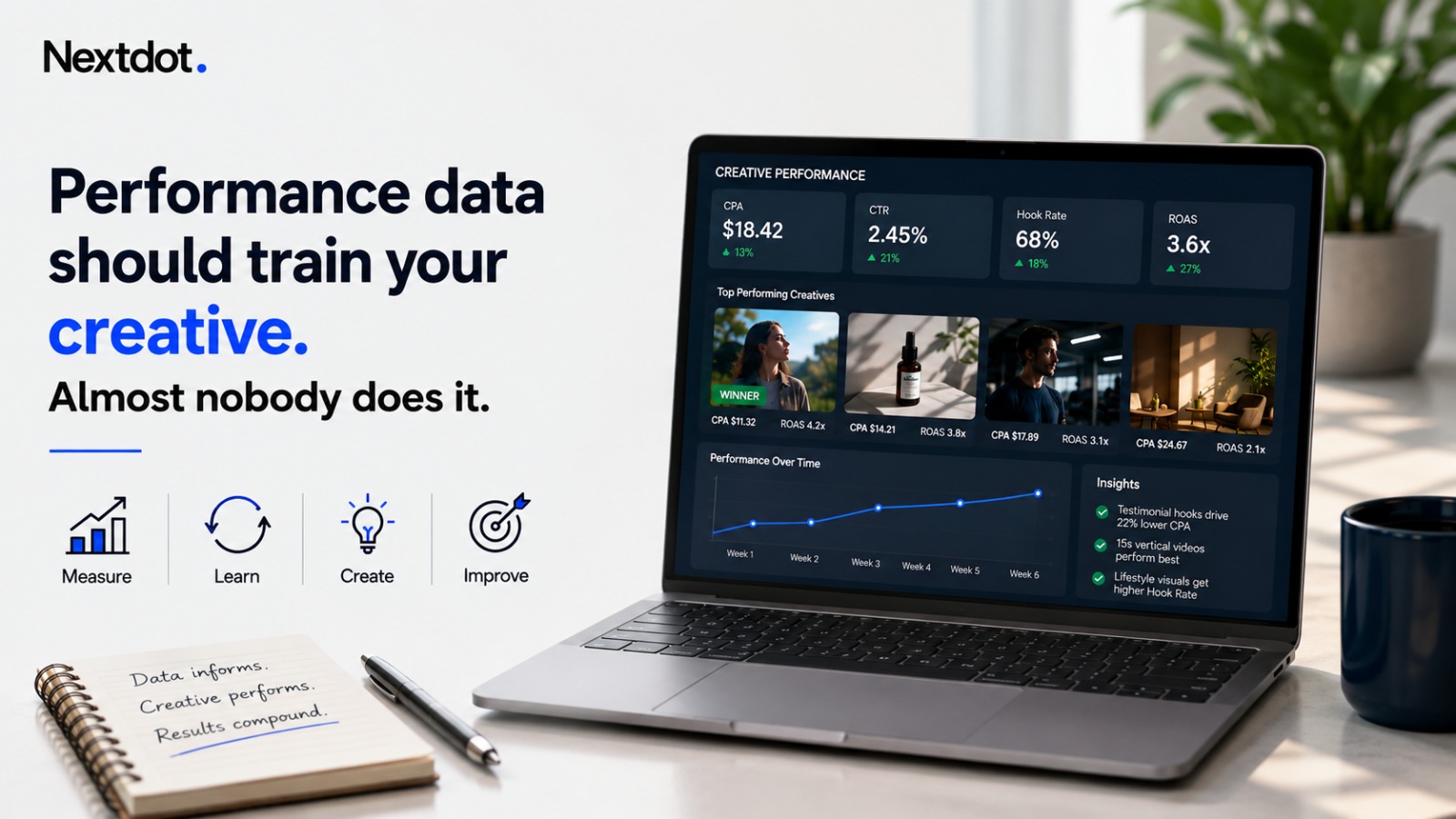
To use performance data to improve creative output, you route every campaign's actual results back into the next brief before the next round is designed, at the level of the creative variable, not the campaign average. That means knowing which hook held attention, which thumbnail earned the click, which first three seconds stopped the scroll, and then briefing the next batch to do more of what worked and less of what did not. Most marketing teams never close this loop. They read the dashboard, they nod, and then they brief the next month from taste and calendar, exactly as if the last month had not happened.
The waste is not small, because creative is not a small lever. Nielsen's meta-analysis of advertising campaigns found that creative quality is the single largest contributor to sales driven by advertising, ahead of reach, targeting, and the rest of the media plan (Source: Nielsen, cited by MarketingCharts, 2017). If the thing that moves sales most is the thing you refuse to learn from, you are spending your budget in the one place you have decided to stay ignorant.
Why the loop stays open
The reason almost nobody does this is structural, and it sits in how creative work is bought. The agency retainer produces creative. The media team runs it. The analytics team reports on it. Three functions, three vendors, three calendars, and the performance data lives in the media and analytics layer while the people making the next round of creative sit outside it. By the time a result reaches the person writing the next script, it has been averaged into a monthly deck and stripped of the detail that would change a decision.
Averages are where creative learning goes to die. A campaign that returned a mediocre blended number almost always contains one creative that overperformed badly and three that dragged it down. The blended number tells you to try harder. The variable-level number tells you to cut three formats and scale one. Only one of those is an instruction a creative team can act on.
There is also a measurement gap underneath this. Marketers increasingly claim to judge creative by business outcomes: in a 2026 survey, 75.7 percent of United States agency and marketing professionals said they measure creative effectiveness primarily by business results such as sales, conversions, and return on ad spend (Source: Statista, U.S. marketers' ways of measuring creativity, 2026). Claiming to measure by outcomes and actually feeding those outcomes back into the next brief are different things. The first is a reporting habit. The second is an operating model, and it is rare because it requires the creative team to sit close enough to the numbers to be changed by them.
What a real feedback loop reads
A creative feedback loop is worth building only if it reads the right things. For performance work, that is the metrics that map to money and attention at the unit of the creative asset: cost per acquisition, cost per lead, click-through rate, hook rate in the first three seconds, hold rate through the video, and return on ad spend by individual asset rather than by campaign. For organic and brand work, the signals are different: saves, shares, and watch-through, because those track whether the work earned distribution on its own merit rather than paid reach.
The discipline is to attribute the result to a creative decision, not a media one. If a reel underperformed, the loop has to separate a weak hook from a bad audience or a starved budget, because those lead to opposite fixes. This is where A/B testing earns its place. Not the vanity version where two nearly identical posts fight over a rounding error, but structured tests where one creative variable changes at a time: the hook, the format, the on-screen claim, the pacing of the cut. A test that changes five things at once teaches you nothing you can carry forward, because you cannot say which change moved the number.
Iteration only compounds when the learning is specific enough to reuse. "Video does better than static" is not a learning, it is a horoscope. "A patient-testimonial open outperforms a doctor-to-camera open by a clear margin for this service line, on this platform, at this budget" is a learning, and it changes the next twenty briefs.
Why month six should beat month one
Month one is guesswork dressed as strategy. You have a brand, a hypothesis about the audience, and no evidence from this account about what actually converts. Every creative you ship in month one is a bet placed with borrowed conviction. That is fine. It is the only honest starting point.
Month six should look nothing like it. By then the loop has run five times. You know which hooks hold for this brand's audience, which formats waste money, which claims the platform throttles, which thumbnail styles earn the click. The team is no longer producing volume and hoping. It is producing against a body of evidence that did not exist in month one and cannot be bought off the shelf, because it is specific to this brand, this audience, and this moment. That accumulated evidence is the real asset. The creatives are perishable. The learning is not.
This is the whole argument for keeping the creative function embedded and persistent rather than rotating through agencies and freelancers. A team that leaves takes the memory with it, and month six resets to month one every time the relationship turns over. The compounding only happens when the same team, holding the same performance history, briefs the next round. Read-only access to the client's performance data is what makes that possible, and it is the difference between a creative team that learns and one that merely produces.
There is a healthcare-specific edge here worth naming, because a hospital or a clinic brand cannot say whatever a hook rate rewards. The claim has to survive medical advertising rules before it ever gets to survive the algorithm. A feedback loop in a regulated market has to optimise inside that boundary, which narrows the creative space and makes learning from real outcomes more valuable, not less, because there is less room to guess.
What it takes to actually run it
The mechanics are unglamorous, which is why they get skipped. Someone has to pull performance at the asset level on a fixed cadence. Someone has to tag each creative so results can be traced to specific decisions, hook type, format, claim, length. Someone has to translate the numbers into a brief the next round can act on, and someone has to hold the discipline of changing one variable at a time so the next set of numbers means something. None of this is exotic. It is operational rigor applied to a function that has historically run on taste and deadline.
Where agentic tooling helps is in the tagging, retrieval, and pattern-surfacing: remembering every brief, tracking which variables were tested, and flagging that a format is decaying before a human notices it in a monthly deck. The creative judgment stays human. The institutional memory does not have to be, and a team that offloads the memory to a system that remembers everything can spend its attention on the work instead of on reconstructing what it already learned three months ago.
The teams that win at creative in 2026 will not be the ones with the best taste in month one. They will be the ones whose month six is trained on five months of what actually worked.
Frequently asked questions
How does performance data improve creative?
Performance data improves creative by telling you which specific creative decisions earned results and which wasted budget, then feeding that back into the next brief. Read at the level of the individual asset rather than the campaign average, it shows which hook held attention, which format converted, and which claim earned the click. The next round is briefed to repeat what worked and drop what did not, so output gets smarter with each cycle instead of restarting from taste every month.
What is a creative feedback loop?
A creative feedback loop is a repeating cycle in which a campaign's real performance results are routed back into the design of the next round of creative. The team ships work, measures results at the asset level, attributes each result to a creative decision, and briefs the next batch from that evidence. Run monthly, the loop turns each round of production into training data for the one after it, so the work compounds rather than resets.
Why should month six beat month one?
Month one is placed on hypotheses about the audience with no evidence from the account, so it is educated guesswork. By month six the loop has run several times and the team knows which hooks, formats, and claims actually convert for this specific brand and audience. That accumulated evidence cannot be bought off the shelf and does not exist at the start. Month six should beat month one because it is built on real outcomes rather than assumptions, provided the same team holds the performance history throughout.
Which metrics should train creative?
For performance creative, train on metrics tied to money and attention at the asset level: cost per acquisition, cost per lead, click-through rate, hook rate in the first three seconds, hold rate through the video, and return on ad spend by individual asset. For organic and brand work, use saves, shares, and watch-through, because those show whether the work earned distribution on merit. Attribute each result to a creative decision rather than a media one, and change one variable at a time through A/B testing so the learning is specific enough to reuse.