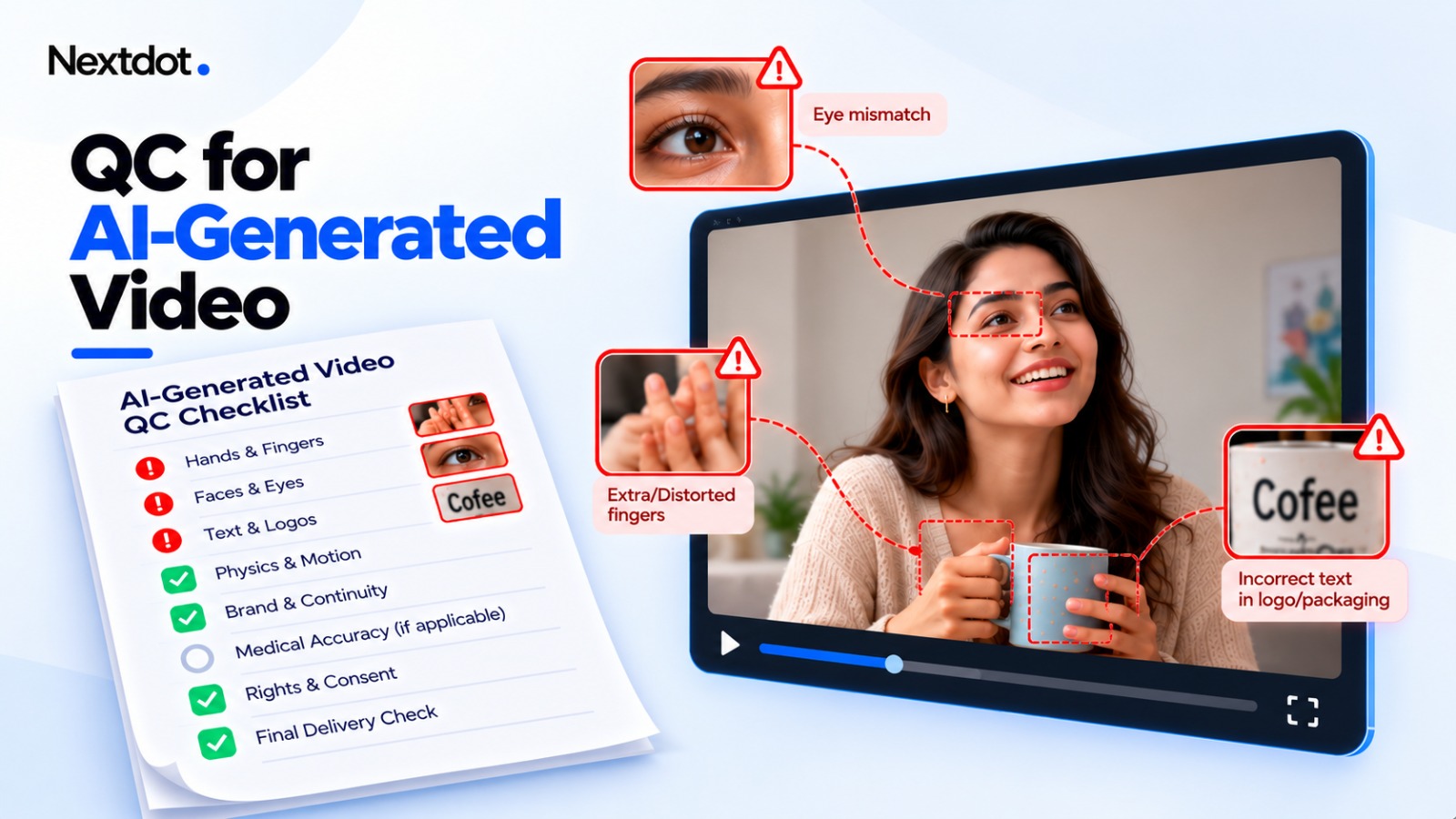
You quality-check AI-generated video in four passes, in a fixed order: generated artefacts first, then brand and continuity, then medical accuracy where the film makes a health claim, then rights, consent and the delivery record. Each pass runs against a written checklist, on the delivered file, at full speed and frame by frame. One named person, independent of the editor, signs a log that says which version was checked, what was found and what changed.
Generated footage fails differently from shot footage. A live-action film fails where a person made a mistake, so reviewers look for mistakes. A generated film fails anywhere, including in frames nobody chose to create, so reviewers have to look everywhere. "The AI video pipeline, stage by stage" names QC as one stage of the pipeline. This piece is the checklist that stage runs on.
Run the passes in order, cheapest failure first
Order matters because each pass can send a shot back, and some sends cost more than others. An artefact found in pass one means regenerating one shot. A consent gap found after the grade and mix means the film may lose a scene it has already paid to finish. So the checks that kill shots outright run first, and the checks that depend on a finished film run last.
Pass 1: Generated artefacts
This pass asks one question: is there anything in the frame that could not exist? Watch at full speed, then frame by frame.
Hands and fingers. Count them. Watch every moment a hand grips, releases or touches another surface.
Faces and eyes. Check that the eyeline holds, that both eyes track together, that teeth stay stable when the mouth moves, and that the face at the end of the shot is the same face as at the start.
On-screen text. Read every sign, label, screen and packaging surface in the shot. Generated text often looks like text from a distance and turns into near-letters up close. Readable text must be correct, or it gets blurred, replaced in the edit or cut.
Physics. Watch liquids, cloth, hair, shadows, reflections and anything that falls, pours or breaks. Researchers built the Physics-IQ benchmark to test exactly this and found physical understanding "severely limited" across the video models they tested, with visual realism no guide to whether a model got the physics right (Source: Motamed et al., arXiv, 14 January 2025).
Objects that appear or vanish. A cup on the table in frame 40 and gone in frame 60.
Lip-sync drift. On any shot with speech, watch the mouth against the audio through the whole line, including the end of a longer line. Check again after a language version is dropped in.
Temporal flicker. Texture that crawls on skin, walls or fabric from frame to frame.
Pass 2: Brand drift and continuity
Artefacts are errors the model makes inside a shot. Brand drift and continuity breaks are errors that appear between shots, because each generation starts fresh.
Logo and marks. The logo appears at the approved size, colour and clear space, and it is the real file composited in the edit. A generated logo is a lookalike, and a lookalike is a brand failure.
Product. The pack, device or label on screen matches the product on the shelf in shape, proportion, colour and printed text, in every shot where it appears.
Colour and grade. Takes generated in different sessions arrive with different colour temperatures and grain. The graded film should read as one film. Check the brand colours against their reference values.
Character identity. The same person across every shot: face, build, age, hairline, wardrobe, jewellery. The character sheet from pre-production is the reference.
Light and screen direction. Light comes from the same side across a scene. A character exiting frame left enters the next shot from the right.
Tone. The last check in this pass is the hardest to write down: does the film still sound and feel like the brand? "AI filmmaking: what separates cinematic from generic", and the continuity bible described in "The shot list is the prompt", set the reference this check is made against.
Pass 3: Medical accuracy, where the film makes a health claim
Any shot that shows anatomy, a device, a procedure or a clinical setting goes to a qualified medical reviewer. "Medical accuracy in AI video" covers that review in full: the locked reference pack, the shot check during generation and the frame review of the final cut. The QC point is narrower. The medical reviewer's signed log is an input to QC, and QC does not pass a health film until that log exists for the version being delivered. A brand reviewer cannot stand in for a clinician on this pass.
Pass 4: Rights, consent and the delivery record
This pass checks paper, and it checks it against the final cut, because the edit may have changed which faces and voices made it in.
Likeness and voice. For every real person whose face or voice appears, generated or altered, a written consent with a re-use clause is on file and covers this use. Nextdot does not generate or clone a real person's face or voice without it. A doctor who appears in the creative also needs explicit consent plus a compliance check.
Mandatory elements. Disclaimers, statutory text and end cards are present, legible at the delivered size and on screen long enough to read.
Labelling. Nextdot ships labelling of AI-generated creative as a standard option, recommends it, and records the client's choice. QC confirms that the recorded choice has been applied to every version it covers, and that any provenance metadata the brand intends to keep has survived export. "Labelling AI-generated ads" covers the rules.
How to watch: the viewing conditions
Many QC misses happen because the film was reviewed in conditions nobody will watch it in.
Review the delivered file, at the delivered compression, and skip the edit timeline preview. Watch on the device the audience uses, which for most performance video is a phone, and then once on a large screen, where flicker and texture problems show. Watch once with sound and once muted, because many viewers watch muted and the captions have to carry the film. Step frame by frame through every shot with a hand, a face, text or a product. Check audio loudness against the target for each platform.
Every version gets this treatment, because a 9:16 crop can bring an edge artefact into frame.
The named person who signs off
QC works when one person owns the result. That person should be senior enough to kill a shot without negotiation and independent of the editor who cut the film, because the editor has already watched it fifty times and stopped seeing it.
The sign-off takes the form of a log. It records the file name and version, the date, which passes ran and who ran them, every issue found with its timecode, what was done about each issue, and the final pass or fail. The medical review and the consent file attach to it. When a regulator, a KOL or your own legal team asks how a film was checked, the log is the answer.
Client-side approval comes after this sign-off, and it is a different job. QC answers whether the film is correct. Approval answers whether the brand wants it. "Where the approval loop breaks in AI video" covers how to keep that loop from becoming the bottleneck.
What automation can do, and where it stops
Parts of QC automate well. Format checks, duration, frame rate, resolution, loudness, caption timing and spelling in burned-in text are mechanical, and software checks them more consistently than a tired reviewer does. VBench, a benchmark suite for video generation models, scores output across 16 dimensions including subject consistency, motion smoothness and temporal flickering, and its authors validated those scores against human preference annotations (Source: Huang et al., arXiv, 29 November 2023). Measures like these can flag shots for a human to look at.
These scores have limits. A consistency score cannot tell you that the product label is last year's pack, that a gesture reads as rude in one market, or that the anatomy is wrong in a way only a clinician would notice. Use automation to widen the net. Keep the judgment and the signature with a person.
What a CMO should ask to see
Ask whoever makes your AI video for the QC log on the last film they delivered. Look for four things: the checklist it ran against, the name of the person who signed it, the issues found with timecodes, and proof that each delivered version was checked, including the crops. A team that cannot produce it quickly is probably relying on the editor's eye.
In the Creative Intelligence Pod, a named QC owner signs off every film, separate from the editor. Every healthcare video also gets a medical accuracy review before it ships.
Frequently asked questions
What are common errors in AI-generated video?
The common errors are malformed hands and fingers, unstable faces and eyelines, garbled on-screen text, physically impossible motion in liquids, cloth and falling objects, objects that appear or vanish between frames, lip-sync that drifts over a line, and texture flicker. Between shots, the film drifts on character identity, product labels, colour and light direction.
How do you QC AI video?
Run four passes in order: generated artefacts, brand and continuity, medical accuracy where the film makes a health claim, and rights, consent and delivery record. Review the delivered file on the target device, at full speed and then frame by frame, with and without sound. Record the findings in a signed QC log.
Who should sign off on AI video?
One named person who is senior enough to reject a shot and who did not edit the film. That person signs a QC log recording the version, the checks run, the issues found and how each was resolved. For health content, a qualified medical reviewer signs a separate accuracy log that the QC sign-off depends on. Client approval follows QC as a separate step.
Can QC be automated for AI video?
Partly. Format, duration, resolution, loudness, caption timing and text spelling can be checked by software, and research benchmarks such as VBench score qualities like motion smoothness and flicker. Those scores can flag shots for review. They cannot judge brand fit, product accuracy, medical correctness or consent, so a human still makes the final call and signs for it.