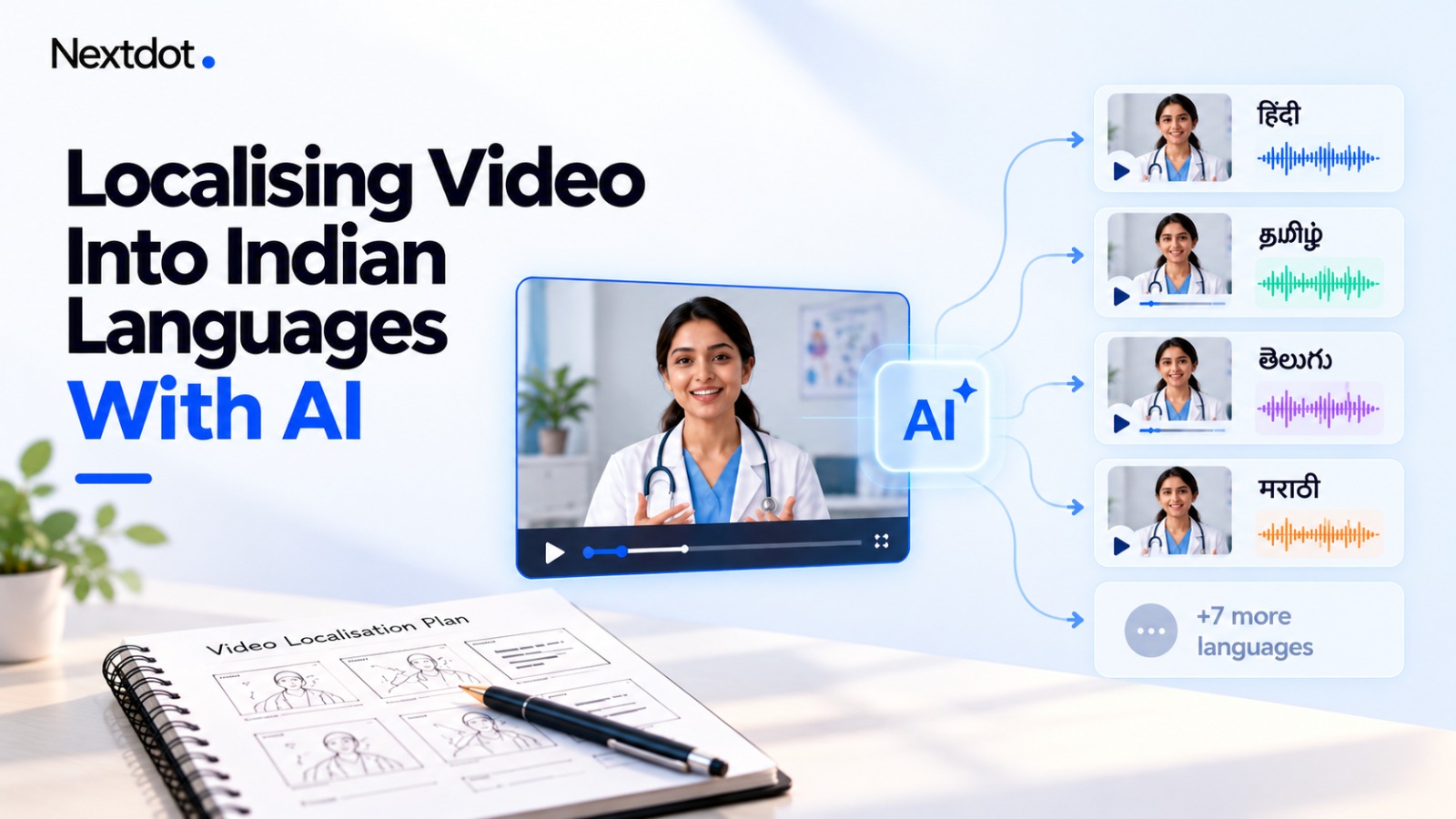
To localise brand video into Indian languages with AI, decide per language whether the film needs a dub, a fresh voice performance or a cultural re-cut, then build the master so each of those is cheap to produce. AI makes the voice and the sync fast. It does not decide what a Tamil viewer finds funny or which claim a Marathi supers line gets wrong, so every language version needs a named native speaker who signs it off before it ships.
Many localisation budgets go wrong at the first step. A brand team asks for "all the major languages", a vendor quotes eleven, and the media plan funds real spend behind only some of them. Start with the plan, and the count follows.
Pick languages from the media plan, then from the census
The IAMAI and Kantar Internet in India Report 2024, released in January 2025, counted 886 million active internet users in 2024 and found that 98 percent of them engage with content in Indic languages. The same report found that 57 percent of urban users prefer regional-language content. So the working decision is which languages earn a full version and which earn a subtitle.
The Census of India 2011, whose language tables were released in 2018, records 43.63 percent of Indians reporting Hindi as their mother tongue and 96.71 percent reporting one of the 22 scheduled languages. Your film needs the numbers for your catchment. A hospital network with most of its beds in Karnataka and Andhra Pradesh needs Kannada and Telugu at full quality before it needs anything else.
Sort the list into three tiers before production starts:
- Hero languages. Full voice performance, cultural review, custom supers and a separate edit where needed. These carry most of the spend.
- Supporting languages. A dub with native QC, localised supers, and no re-cut unless a scene fails review.
- Reach languages. Burned-in subtitles on the hero master. Cheap, fast and honest about the investment.
Without this sort, the brief becomes eleven dubs, the weakest version of the job.
Dub, re-voice or re-cut: three different jobs
These three words get used as synonyms. They fail in different ways.
Dubbing replaces the dialogue track with a translated one, timed to the existing picture. AI dubbing can keep the original speaker's voice character across languages, which is what makes it fast. It suits voiceover-led films, explainers and anything where the speaker is off screen or seen from a distance.
Re-voicing means a new performance in the target language. A native voice artist, or a consented synthetic voice directed by a native speaker, reads a script written in that language from the start. This is what a hero language needs, because the performance is where a film lands or dies.
Re-cutting changes the picture. A scene is swapped, a shot extended to fit a longer line, a supers card rebuilt, a character's name or a festival changed. AI generation makes re-cuts affordable in a way live action rarely did, because a replacement shot no longer needs a crew. It still needs the same direction and continuity discipline as the master, which "The Shot List Is the Prompt" covers.
A hero-language version often uses all three. The dub gets you a fast draft. The re-voice fixes the lines that fell flat. The re-cut fixes the scenes that do not travel.
Where lip-sync holds and where it breaks
AI lip-sync regenerates the mouth region of a face to match new audio. It is most forgiving on a medium shot with a clear, front-facing speaker. The limits show up in four places.
Line length. The same sentence runs to different durations in different languages, and the gap depends on the script and the register. When the translated line overruns the shot, lip-sync cannot fix it. The script has to be rewritten to length, or the shot extended.
Close-ups. The tighter the shot, the more the audience reads the mouth, teeth and jaw. Test every close-up line in every language on the final render, with a native speaker watching the mouth, before you trust it.
Profile and movement. Speakers turning away, eating, laughing or partly covered by a hand or a mask confuse the model.
Real faces. A generated face can take new mouth movement freely. A real doctor or ambassador is a different matter. Whether their existing consent covers altered speech in a new language is a question for your counsel before it is a craft one.
The practical answer is to design the master for localisation. Keep the lines that carry the message in voiceover. Put on-camera dialogue on mid shots. Deliver text-free plates so every supers card can be rebuilt in its own script. A master built this way localises quickly. A master full of close-up dialogue and baked-in English text localises into eleven compromises.
The voice belongs to a person
Nextdot never generates or clones a real person's face or voice without that person's written consent and a re-use clause. Doctors who appear in creative need explicit consent plus a compliance check. For localisation, our advice is to make the consent name what it covers: which languages, which films, which channels and for how long. Ask your counsel whether a doctor's consent to a Hindi explainer extends to a Tamil one, and whether a voice artist paid for one campaign has licensed a clone for the next. Write the answer into the contract before generation starts.
Nextdot works closely with ElevenLabs on voice agents and creative solutions, and one reason that matters for a regulated brand is that its professional voice cloning asks the voice owner to verify their own voice before a clone trains (Source: ElevenLabs documentation, Professional Voice Cloning, accessed 30 September 2026). The contract carries the consent. Platform verification gives it something to rest on when a regulator, a doctor or a journalist asks whose voice that is.
Synthetic voice also carries a labelling question. India's IT Amendment Rules 2026, in force from 20 February 2026, address labelling of synthetically generated audio and video on platforms. How they apply to your ads is a question for counsel, and "Labelling AI-Generated Ads" sets out what to ask. Nextdot ships labelling as a standard option on AI-generated creative, recommends it, and records the client's choice. Settle it per language version, because a cloned voice in one version and a human artist in another makes each file a separate labelling decision.
Translation is the smallest part of the job
Idiom and humour rarely survive translation. A line built on an English pun has no equivalent in Bengali, and the literal version reads as a mistake. Festivals, food, clothing, family structure and forms of address change what a scene means. A mother serving a particular breakfast reads as warm in one state and as a stranger's kitchen in another. Names on screen, the doctor's, the patient's and the street sign's, signal where a story is set.
On-screen text is its own discipline. Indic scripts use conjunct characters that some fonts and some motion templates render incorrectly, and a broken conjunct in a supers card looks careless to every native reader.
For healthcare brands, a claim translated is a claim made again. A benefit line that cleared medical and legal review in English has to clear it in every language, because a small shift in meaning can turn a supported statement into an unsupported one. "Medical Accuracy in AI Video" covers medical review for picture. The same named reviewer should see the translated claims.
Native-speaker QC, named and signed
Every language version should get a native speaker with no role in writing it, who signs a log. The check covers five things:
- Meaning. Does the version say what the master says, including every claim?
- Register. Does it sound like the brand speaking this language, or like a translation of it? Is the mix of English and the target language natural for this audience?
- Pronunciation. Brand names, drug names, doctor names and place names, spoken correctly.
- Text. Every supers card, subtitle and end frame, read on the final render in the delivered aspect ratios.
- Sync and sound. Lip-sync on every on-camera line, and loudness matched to the master.
A translator reviewing their own work passes their own errors. A colleague who "speaks some Telugu" misses register. Name the person and keep the log with the file.
How to run localisation as a pipeline branch
Treat localisation as a branch of the production pipeline described in "The AI Video Pipeline, Stage by Stage", planned at the brief. Record the language tiers against the media plan in the brief. Build the master for localisation in pre-production: voiceover-led structure, mid-shot dialogue, text-free plates. Check consent for every face and voice against the language list before generation starts. Give each hero language a native scriptwriter, a re-voice pass and a cultural review. Pass every version through native-speaker QC before it joins the versioning work in "From One Master to Sixty Cuts".
Two parts of this already run at the Creative Intelligence Pod on every film. A named QC owner, separate from the editor, signs off each output, and every healthcare video gets a medical accuracy review before it ships. When you brief any partner on localisation, ask which languages they produce at hero quality today, who the native reviewers are, and to see a signed QC log.
Frequently asked questions
Can AI dub a video into Hindi and other Indian languages?
Yes. AI dubbing can translate and re-voice a film into Hindi and most major Indian languages, often keeping the original speaker's voice character. Treat that as a first draft: hero-language versions still need a native script, a directed performance and native-speaker review.
Does AI lip-sync work for Indian languages?
It is most forgiving on mid shots with a clear, front-facing speaker. It struggles on close-ups, profile shots, masked faces and lines that run longer than the shot. Design the master with dialogue on mid shots and key lines in voiceover, and lip-sync becomes a minor fix.
Is translation enough to localise a brand film?
No. Translation changes the words. Localisation also changes idiom, humour, names, settings, on-screen text and sometimes whole scenes, and for healthcare brands every claim needs review again in the new language.
Who should check a localised video?
A native speaker of that language who did not write the version, working from a checklist that covers meaning, register, pronunciation, on-screen text and sync. They sign a log kept with the file. For health claims, the brand's medical or legal reviewer also checks the translated claims.