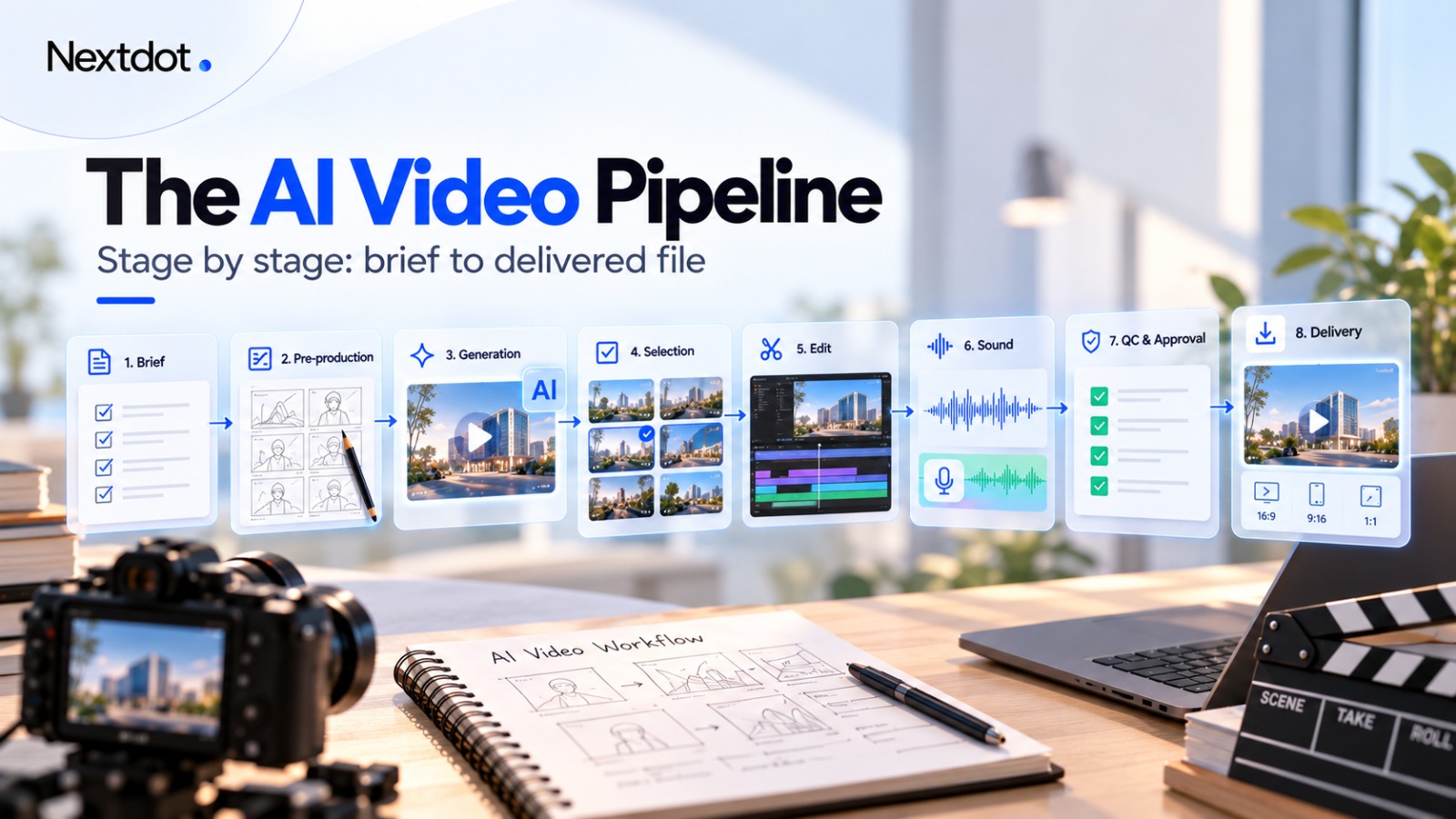
A production AI video workflow runs in eight stages: brief, pre-production, generation, selection, edit, sound, QC and approval, then versioning and delivery. Generation is one stage of eight, and it is usually the fastest. Teams that produce AI video at scale staff and schedule the other seven with the same seriousness they give the model, because that is where the hours, the errors and the rework actually sit.
Many marketing teams that adopt AI video buy access to a model and assume they have bought a pipeline. Adoption is moving fast: Wyzowl's Video Marketing Statistics 2026 report found that 63 percent of video marketers have used AI tools to create or edit marketing videos. Adoption tells you who has the tool. It says nothing about who can ship forty finished, approved, correctly versioned files a month without the brand manager losing her weekends. That second number depends on the pipeline.
Here is the pipeline as a CMO should see it: what happens at each stage, who owns it, and what breaks when it is starved.
Stage 1: The brief
The brief sets the ceiling for everything downstream. An AI video brief needs more than a traditional one, because the machine will fill every gap you leave with the most average possible answer.
A working brief names the single job of the film (awareness, lead, recall, reassurance), the audience and the platform, the duration and aspect ratios needed at delivery, the one thing the viewer must remember, and the mandatory elements: disclaimers, product shots, logo lockups. It also names what the film must avoid. In healthcare that list is long, and "What Healthcare Brands Need From Creative in a Regulated Market" covers why.
The human here is the brand owner on the client side and a creative lead who pushes back. A brief that says "make it feel premium" is an instruction to generate generic footage.
Stage 2: Pre-production
Pre-production turns the brief into decisions the model can execute: script, shot list, look reference, character sheet and continuity notes. "AI Filmmaking: What Separates Cinematic From Generic" covers shot grammar and continuity, so this piece will not repeat it. The pipeline point is simpler. Every shot that reaches generation without a decided camera position, framing and purpose will come back as a pretty frame with no intent, and the edit will spend hours trying to rescue it.
These documents are the client's creative memory. Shot lists, character sheets and continuity bibles belong to the brand and go with it if it changes production partners.
Pre-production is also where the rights questions get settled, before anything is generated. If a real person's face or voice appears, Nextdot requires that person's written consent with a re-use clause, and a doctor appearing in creative needs explicit consent plus a compliance check. That check belongs here, on paper. A pipeline that runs it after the edit has already spent the budget on footage it may not be able to use.
Stage 3: Generation
Generation gets the attention and the demos. In a well-run pipeline it is the most mechanical stage, because the decisions were made upstream.
The real work at this stage is model choice per shot. Models differ in how they handle motion, human faces, on-screen text, physical interaction and camera movement, and those strengths shift with every release. A pipeline that locks one model for every shot type accepts that model's weakest shot as its quality floor. It also means a new model version should be tested against the shot types in live briefs before a client film depends on it. Nextdot has early access to Seedance models, which is where that testing earns its value: a version change shows up in the test bench before it shows up in a client cut.
The human here is an operator who knows the models well enough to route each shot to the one most likely to hold it, and who generates enough takes per shot to give selection a real choice.
Stage 4: Selection
Selection is the stage most teams forget to budget, and it is where taste does its heaviest lifting. A generation run produces many takes of every shot. Most of them fail for reasons a viewer would feel without naming: a hand that bends wrong for a few frames, a gaze that drifts off the eyeline, light that changes direction mid-shot, a product label that mutates.
Someone has to watch every take at full resolution and full speed, reject the failures, and pick the take that serves the cut over the take that looks best in isolation. This is a creative director's job. Hand it to a junior and the film inherits the junior's eye.
When no take works, the shot goes back to generation, or back to pre-production if the shot itself was badly specified. That loop is normal. A pipeline with no path back to pre-production will keep regenerating a shot that was never going to work.
Stage 5: The edit
The edit is where selected takes become a film. It carries everything a traditional edit carries plus work specific to generated footage: matching colour and grain across takes produced in different sessions, masking small artefacts, and cutting around the moments a take falls apart.
Generated footage tends to arrive in short usable stretches, so an AI film is often cut tighter than its live-action equivalent. The editor and the scriptwriter both need to know that before the first assembly. A script that depends on a long unbroken shot is a script written for a different pipeline.
Stage 6: Sound
Sound separates a finished film from a demo, and it is the stage most visibly starved in AI video today. Viewers forgive a slightly soft frame. They do not forgive a voice that sounds processed, music that fights the cut, or a room that sounds empty.
The sound stage covers voiceover, music, sound design, mix and loudness for each platform. Voice carries the same consent rule as likeness: a real person's voice is used only with that person's written consent and a re-use clause. We recommend treating localised voiceover into Indian languages as its own pipeline branch, with a native speaker running QC on every language.
Stage 7: QC and approval
QC checks the film against the brief and against reality. It covers generated artefacts, brand consistency, continuity between shots, on-screen text accuracy, mandatory elements and disclaimers, rights and consent paperwork, and, for health content, medical accuracy reviewed by someone qualified to judge it. At Nextdot the QC pass has a named owner who signs it off, a different person from the editor who cut the film, and every healthcare video gets a medical accuracy review before it ships.
Approval then runs on the client side, and it is where calendars go to die. Generation got fast. Approval did not. "The Production Math: Throughput Without Quality Collapse" covers the review capacity a production team needs. On the client side, the fixes are structural: defined review stages, a named approver for each stage, and feedback given against a specific timecode on a specific version.
Stage 8: Versioning and delivery
A single approved master rarely ships alone. Performance campaigns need aspect ratios for each placement, duration cuts, hook variants and platform-specific end cards. The variant matrix is agreed with the client's performance team before the master locks, so versioning is planned work instead of a scramble. Each version needs a naming convention that lets someone find it in six months, and a record of which master and which approval it descends from.
Delivery is also where the labelling decision gets applied. Nextdot ships labelling of AI-generated creative as a standard option, recommends it, and records the client's choice. That choice is the client's to make and belongs in the delivery record, attached to every file it covers. It is also worth keeping consent records with each asset, so the paperwork travels with the file.
The last step makes the next film better: performance results from the delivered versions flow back into the next brief. "Performance Data Should Train Your Creative. Almost Nobody Does It" covers how that loop works.
Where humans sit, and where the hours go
Count the human judgment calls. Seven of the eight stages depend on a person making a decision. Generation is the one stage where the machine does most of the work, and even there a person picks the model and sets the number of takes.
Which stage takes longest varies by film. The pattern CMOs should expect is this: in a pipeline where generation is fast, selection, the edit and client approval absorb most of the calendar. A team that measures its AI video programme by generation speed is measuring the stage that was never the constraint.
What to ask before you scale
Before a CMO commits to AI video at volume, four questions expose whether the pipeline exists or only the tool does. Who owns selection, and what is their eye trained on? Where does consent get checked, and on what paper? Who signs QC, and are they independent of the edit? Who is the named approver at each review stage?
If those answers are clear, generation speed turns into shipped films. If they are vague, faster generation only produces a larger backlog of unreviewed footage. The Creative Intelligence Pod is built around this pipeline: every brief, approval, rejection reason and result is stored and pulled back when a new brief arrives, a named QC owner separate from the editor signs off every film, and the variant matrix is agreed before the master locks.
Frequently asked questions
What are the stages of AI video production?
Eight: brief, pre-production, generation, selection, edit, sound, QC and approval, and versioning and delivery. Generation is usually the fastest. The stages around it decide whether the output becomes a finished, approved and correctly versioned film.
Where do humans sit in an AI video pipeline?
At almost every stage. A brand owner and creative lead write the brief, a director builds the shot list and look, an operator routes each shot to a model, a creative director selects takes, an editor and sound team finish the film, and a named reviewer signs off QC before the client approves. Consent for any real face or voice is checked before anything is generated.
Which stage takes the longest?
It varies by film. Where generation is fast, selection, the edit and client-side approval usually absorb the calendar. Defined review stages and a named approver for each matter more than generation speed.
What tools does an AI video workflow need?
Generation models chosen per shot type, an edit suite, a sound workflow, a review tool with timecoded feedback, and an asset store that tracks versions and approvals. Each can be swapped. The stage structure, named owners and handoff rules are what a brand keeps.