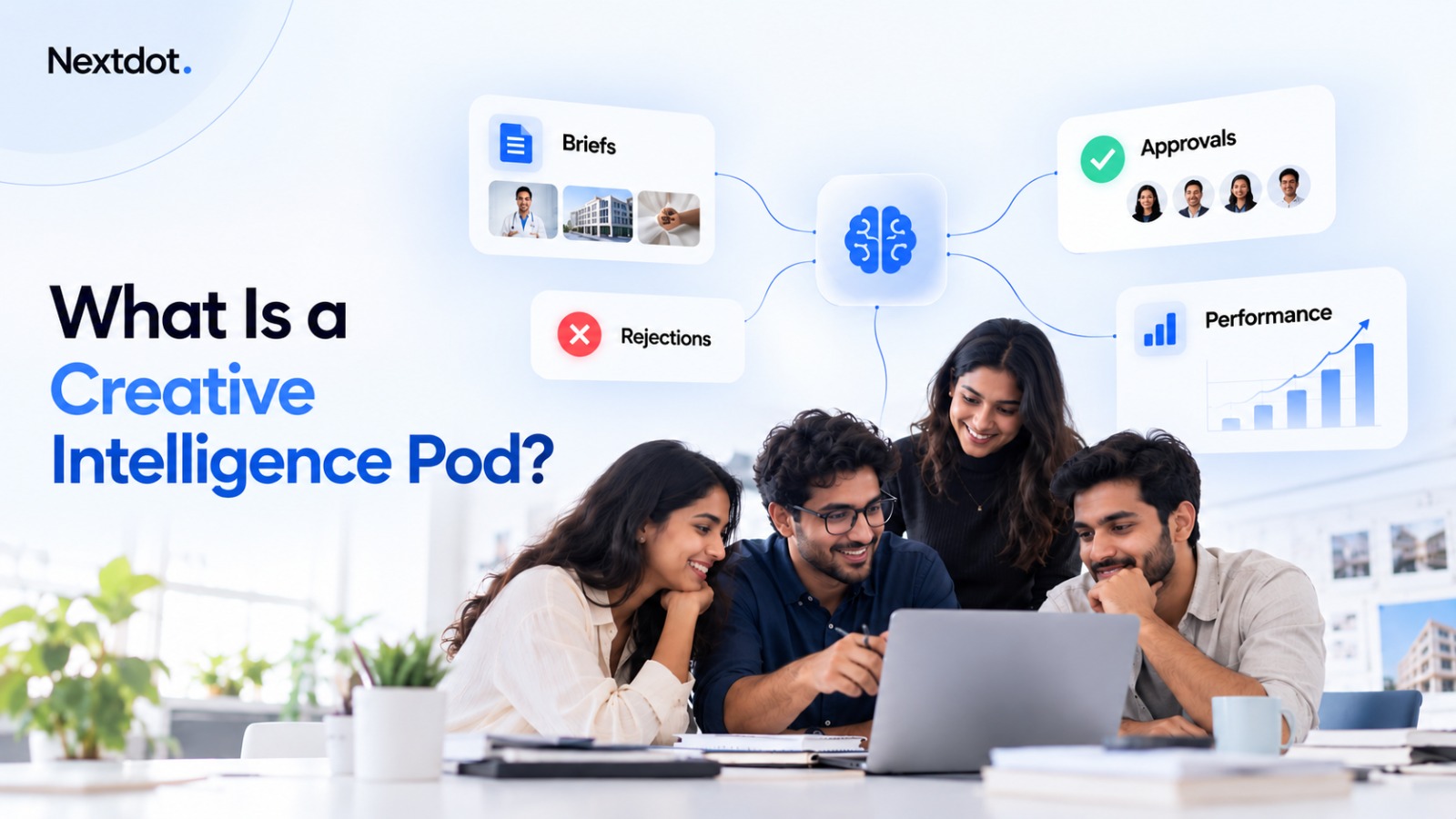
A Creative Intelligence Pod is an embedded creative team, trained people working with agentic tooling, that keeps every brief, approval, rejection and performance result your brand produces, and retrieves that record when each new brief arrives. The intelligence is memory. The pod is designed so the tenth campaign starts from what the first nine taught, drawing on read-only access to your performance data and a written history of every decision your team made about the work. That memory is the part of the pod we build toward domain superintelligence (SI).
Most creative programmes lose that history every quarter. Picture the person who knew why the doctor-to-camera open was dropped in March has moved accounts by June, and the lesson goes with them. The pod is built so the lesson stays.
Why an agency forgets
An agency account team is a rotating cast. The Institute of Practitioners in Advertising put total staff turnover in UK creative and other non-media agencies at 24.9 percent for 2024, down from 31.5 percent in 2023 (Source: IPA Agency Census 2024, published 23 January 2025). At that average, a five-person account team replaces more than one member a year.
What walks out with them is rarely written down. The brand book records what the brand wants. It does not record the eighty small decisions a marketing team made about what actually worked for its audience, which claims legal sent back, which visual the chief of cardiology refused to appear next to, or why the Hindi version of a reel outperformed the English one in one city and underperformed in another.
So every new team member relearns the account on your time, and you re-explain the rejection you already gave twice. The retainer model's pricing problem is its own argument, made in "Why the agency retainer model broke". The memory problem sits underneath it, and it survives any change in how the work is billed.
What the pod actually remembers
The intelligence in the pod is a structured record, kept for your brand alone, of four things.
Briefs. Every brief, in the form it was written, with the objective, the audience, the channel and the constraints. A new brief gets checked against the old ones before anyone makes anything, so the team sees that the same objective was tried in February with a different hook and what happened.
Approvals. Which version was approved, by whom, and at which stage. This matters more than it sounds. When the pod knows that your Head of Brand approves colour and tone, and your medical reviewer approves claims, the work reaches the right person with the right question the first time.
Rejections, with the reason. This is the part most teams never capture. A rejection without a reason teaches nothing. "Too salesy for a cardiac service line", "claim not substantiated in our approved claims list" and "this doctor has not consented to appear in paid media" are three different lessons, and each one should change a different part of the next brief. The pod stores the reason in words a person can read, and retrieves it when a new brief arrives.
Performance outcomes. What each creative did once it went live, at the level of the individual asset. The pod reads this data. It cannot change it.
Together these four records form the institutional memory of your creative programme. At the volume the pod runs for a large Indian hospital group, 250 creatives a month, each piece carries its own approval trail and results. A client interface sits on top of them, where your team sees what was briefed, what is in review, what shipped and what the numbers said, and can answer "have we tried this before?"
What the pod reads, and what it cannot touch
The pod learns from your performance data through read-only access. On the paid side that means leads, conversions, cost per acquisition and cost per thousand impressions. On the organic side it means reach, shares and saves. The detail of how a feedback loop turns those numbers into the next brief is covered in "Performance data should train your creative". The point for this piece is narrower: read-only is a design decision, and a CMO should hold any creative partner to it.
Read-only means the pod can learn from your media results and cannot move your budget, pause your campaigns or edit your audiences. It keeps the creative function and the media function accountable for their own decisions, and it keeps the pod's learning honest, because it has to learn from results it had no hand in adjusting.
Connecting that access is a setup step on your side. Before it starts, decide which ad accounts, analytics properties and organic channels the partner may read, grant view-only roles rather than shared logins, and name the person on your team who signs off the connection.
Where domain superintelligence (SI) fits
We use the term in a narrow sense. Domain superintelligence (SI) is a system built to work at expert level inside one bounded workflow, with the audit trail, integration and human accountability that a regulated enterprise needs. It says nothing about general intelligence, and nothing about taste.
In a creative programme the bounded workflow we design for is recall. Given a new brief, retrieve every prior brief, approval, rejection reason and performance result that bears on it. The pod's memory is designed to hold that full record and to put the relevant part in front of the team when a new brief arrives. That is the direction we build SI toward: one narrow task, a complete record, and named people accountable for what is done with it.
Everything else in the pod stays human. The concept, the craft call on a cut, the judgement about whether a line is right for a patient audience, and the final sign-off all sit with named people. More capable recall does not move accountability. Your brand still answers for every claim it publishes, and every asset still needs a record of how it was made and who approved it. A pod that remembers better makes that record easier to produce. It does not make it optional. One question to take to counsel before any partner touches personal data: who is the Data Fiduciary under DPDP 2023 for the data the pod reads, and what does that require of each party?
The people inside the pod
Memory with no one to act on it is an archive. The pod is a production team first.
A day-to-day operator owns the account and reads the memory before each sprint. A content coordinator turns the week's briefs into a production plan. A production team runs generation and editing, and this is where specific skill matters more than any badge. A production team of 25 people trained on Seedance and Higgsfield runs the generation stage: setting camera movement and framing against a shot list, holding a face, a product or a setting consistent across shots, and rejecting outputs that break continuity, distort hands or text, or drift off the brand's colour and lighting rules before any of it reaches your reviewer.
Two checks sit with people every time. Any real face or voice in the work needs that person's written consent with a re-use clause, and a doctor appearing in creative needs explicit consent plus a compliance check. We recommend that any creative partner store those consent records next to the asset, so a reuse request six months later can be checked against what was actually agreed. It also helps if the consent names the languages, films, channels and duration it covers. Nextdot also ships labelling of AI-generated creative as a standard option, recommends it, and records each client's choice.
Who owns the memory
You do. The briefs, the approval history, the performance learnings, the style and prompt libraries and the assets belong to the client, and they are exported in usable form when the client leaves. Nextdot keeps only anonymised process know-how.
Ask any creative partner this before signing. If the learning lives only in the vendor's system or people, you are renting your own history.
How a CMO can tell whether the intelligence is real
Four questions will separate a pod that remembers from a team that claims to.
- Show me the rejection reasons from the last quarter, in writing, by asset.
- For this new brief, show me what we tried before that is relevant, and what happened.
- Show me the access you hold to our performance data, and confirm it is read-only.
- Show me the export you would hand us if we ended the contract tomorrow.
A team that can answer all four in a meeting has built the memory. A team that promises to find out has not.
Frequently asked questions
What is a Creative Intelligence Pod?
A Creative Intelligence Pod is an embedded creative team of trained people working with agentic tooling that operates inside a brand's marketing function. Its defining feature is memory: it keeps a structured record of every brief, approval, rejection reason and performance result, and it retrieves that record when a new brief arrives. It learns from the brand's performance data through read-only access.
How is it different from an agency?
An agency account team rotates, and what it learned about your brand leaves with the people who learned it. UK creative and other non-media agencies reported 24.9 percent total staff turnover in 2024 (Source: IPA Agency Census 2024, 23 January 2025). A Creative Intelligence Pod writes the learning down as structured memory that belongs to the brand, so a change in personnel does not have to reset the account.
What is domain superintelligence (SI)?
Domain superintelligence (SI) is a system built to work at expert level inside one bounded workflow, with the audit trail, integration and human accountability that a regulated enterprise needs. In a Creative Intelligence Pod, the workflow it is designed for is recall: bringing every prior brief, approval, rejection reason and performance result to bear on a new brief. Final sign-off stays with named people, and the brand still answers for every claim it publishes.
What data does the pod learn from?
The pod learns from four records: the brand's briefs, its approval history, its rejection reasons, and the performance of each live asset. Performance data comes through read-only access, covering leads, conversions, cost per acquisition and cost per thousand impressions for paid media, and reach, shares and saves for organic content. Read-only means the pod can learn from results and cannot change budgets or campaigns.
Who owns the pod's learning?
The client owns it. Briefs, approval history, performance learnings, style and prompt libraries and assets belong to the brand and are exported in usable form when the engagement ends. Nextdot retains only anonymised process know-how.