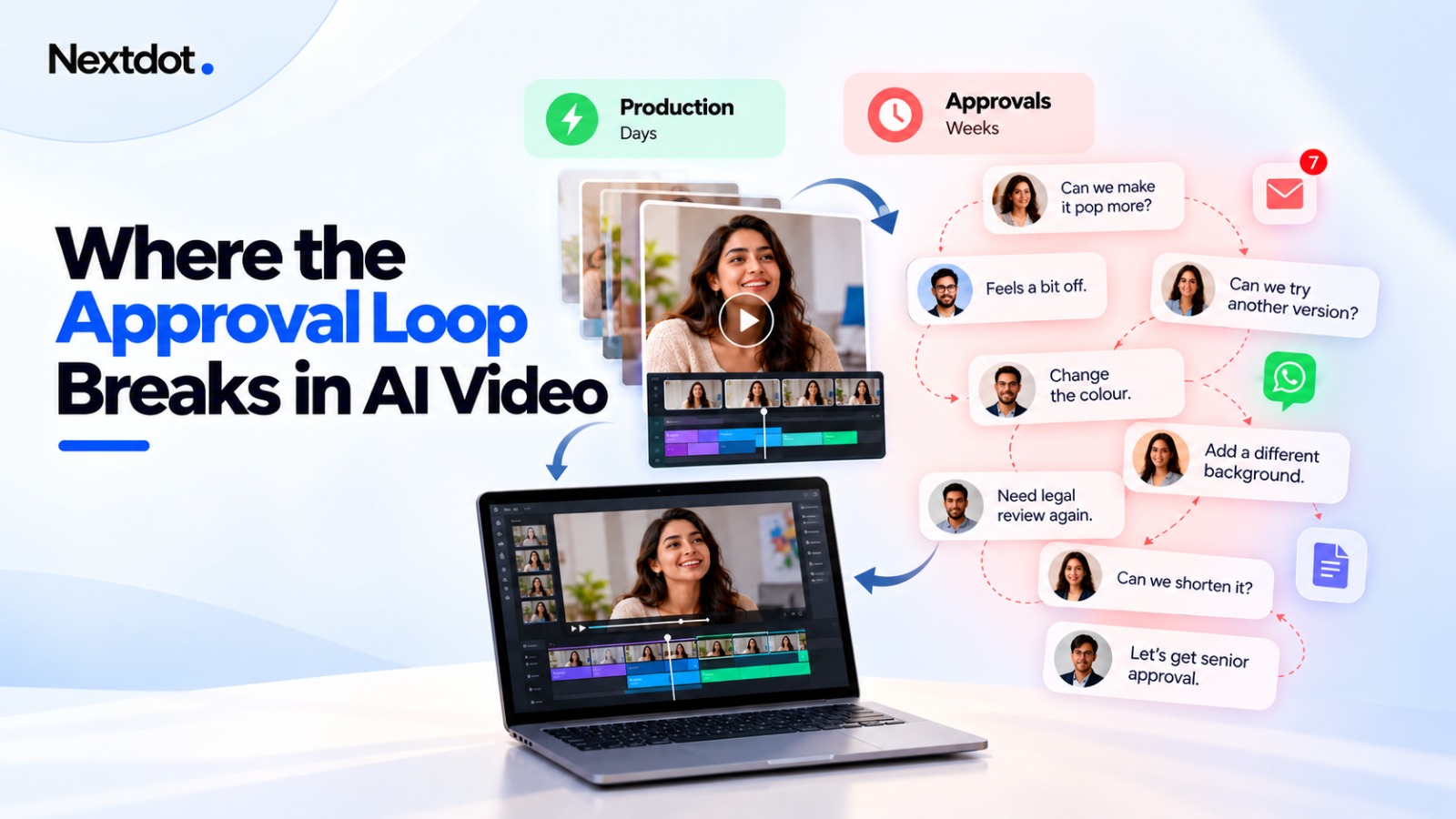
Video approvals take longer than production because generation got fast and the client-side review loop did not change. The loop breaks in four places: too many reviewers with equal authority, feedback that cannot be acted on, review of the wrong version, and no agreed limit on rounds. Fix those with defined review stages, one named approver per stage, and feedback pinned to a timecode on a specific version, and most of the avoidable delay goes with them.
A brand team can now get a rough cut of a thirty-second film in days. The same film then sits in inboxes for two weeks while seven people watch it on their phones, reply-all with "can we make it pop more", and one senior voice arrives on day twelve to reopen the concept. Production shrank. Approval did not, and it now owns most of the elapsed time.
"The Production Math: Throughput Without Quality Collapse" covers the review capacity a production team has to staff on its own side. This piece covers the other side of the table: the client's review loop, which the CMO controls and which no vendor can fix from outside.
Why the bottleneck moved to the client side
In a traditional shoot, production was slow enough to hide approval. A film took weeks to shoot and cut, and several rounds of stakeholder review fit inside that time without anyone noticing them as a separate cost. Generation removed the cover. When a first cut arrives in days, the review loop becomes the longest stage in the calendar, and it becomes visible for the first time.
AI video also changes what gets reviewed. Cheap iteration tempts teams to ask for more options, and each option multiplies the comments. And because the edit looks finished early, reviewers treat a rough cut as a final and argue about colour grade when the question on the table was structure.
The time cost is widely felt. In Ziflow's State of Creative Workflow Report 2023, run with the American Marketing Association and published in July 2023, 48 percent of respondents said they spend at least five hours a month chasing feedback. The hours go into chasing and consolidating, and very few go into the decisions themselves.
The four places the loop breaks
Too many reviewers, all with a veto. Brand, product, digital, regional marketing, the medical team, legal and a senior leader all see the cut at once. Nobody has said whose comment wins when two conflict. The editor receives contradictory notes, picks one, and the other reviewer reopens it next round. Each reviewer added without a defined role tends to add a round.
Feedback nobody can act on. "Feels a bit off." "Can it be more premium?" "The middle drags." These comments describe a reaction and leave the editor to guess the cause. With AI video the guess is expensive, because the fix might sit in the edit, the sound, the prompt or the generated shot. A vague note triggers a speculative change, which triggers a new round of reaction.
Review of the wrong version. Someone downloads the cut on Monday, watches it on Thursday and comments on a version the team replaced on Tuesday. Comments arrive by email, WhatsApp and a call, against three different files, and the producer spends a day reconciling them before any work happens.
No agreed limit on rounds. When nobody set a limit in advance, the loop ends when the last reviewer runs out of opinions. Late entrants are the worst case. A senior stakeholder who sees the film for the first time late in the loop can legitimately question the concept, and the team has no process that tells them that question belonged at the start.
How to rebuild the loop: defined review stages
The first fix is to split review into stages that each answer one question, and to agree those stages before production starts.
- Concept and script. Is this the right idea for the brief? Reviewed on paper or a storyboard, before any generation. This is where senior leaders and the medical or legal team should see the work, because changing a concept here costs a rewrite.
- Rough cut. Does the structure work? Story order, pacing, the hook, the end card. Reviewers comment on structure only. Grade, sound mix and final text are out of scope.
- Fine cut. Is the execution right? Shots, performances, on-screen text, voice-over and music. Structure is closed.
- Final and compliance. Is it accurate, on brand and ready for any legal sign-off? Claims, disclaimers, consent and medical accuracy. "QC for Generated Video: The Checks Before Anything Ships" lists the QC checks that sit behind this stage.
Each stage has an entry condition and an exit condition. A comment that belongs to a closed stage is logged, and it only reopens that stage if the named approver decides it must. That single rule cuts down late concept arguments, because it forces the conversation to happen where it is cheap.
Healthcare and pharma brands carry an extra layer. Medical and regulatory review takes the time it takes, and a CMO can control when it happens. Bringing the medical reviewer in at script stage, and again at final, costs less than showing them a finished film and discovering that the central claim needs rework.
One approver per stage
The second fix is authority. Every stage gets one named approver, a single person, who consolidates comments and makes the call when they conflict. Other stakeholders still comment. They do so as contributors, and the approver decides what goes to the production team as one set of instructions.
In practice this looks like a short table the CMO signs off at the start of a campaign:
| Stage | Approver | Contributors | Time to respond |
|---|---|---|---|
| Concept and script | Head of Brand | CMO, medical, legal | Agreed per brand |
| Rough cut | Brand manager | Digital, regional | Agreed per brand |
| Fine cut | Brand manager | Content lead | Agreed per brand |
| Final and compliance | Medical or legal owner | Brand manager | Agreed per brand |
The response windows matter as much as the names. A contributor who misses the window forfeits the round, and their comments move to the next stage or the next film.
The CMO usually belongs at concept stage and nowhere else, unless the film is a flagship brand piece. Senior review at the end of the loop is one of the most expensive habits in brand video, because it arrives when every change costs the most.
Frame-accurate feedback on a specific version
The third fix is the format of the feedback itself. Every comment should name the version, name the timecode, and describe the change wanted.
Compare two notes. "The doctor section feels rushed." Versus: "v3, 00:14 to 00:19, hold the doctor's line for a full second before the cut, the claim needs time to land." The second note goes straight to the editor with no interpretation. It also tells the producer which stage owns the fix, which matters in AI video because a wrong generated shot may need regeneration rather than a trim.
A few habits make this work:
- One review link per round, with the version number in the file name and the player. Old links expire when a new version goes up.
- Comments sit on the timeline inside a review tool, and email or chat comments do not count until someone moves them there.
- Reviewers label each comment as a must-fix or a preference. The approver decides which preferences go through.
- The production team replies to every comment with a status: done, declined with a reason, or moved to a later stage.
That last habit closes the loop. A reviewer who can see what happened to their note rarely re-raises it next round.
When a stage keeps reopening
Agree the round limit for each stage with the approvers before production starts, and keep each round small and narrow. A round that answers one question closes cleanly, and closed decisions stay closed.
If a stage keeps needing more rounds than the team agreed, the problem sits upstream. The brief did not settle the question the reviewers keep arguing about, or the wrong person is approving that stage. Fix the brief or the approver. Adding rounds treats the symptom.
AI video adds one temptation worth resisting: generating fresh options in the middle of a review round because it is cheap. Every new option resets the round. Set a rule that new generation happens between rounds, on the approver's instruction, and never as a response to one reviewer's comment.
What the CMO should measure
Track three things per film: rounds per stage, days the film spent waiting for client review, and the number of comments that reopened a closed stage. The first two show where the calendar goes. The third shows whether the stage discipline holds.
A production partner can shorten generation, the edit and QC. Only the brand can shorten its own approval loop. The teams that get real speed from AI video are the ones that redesigned review at the same time they changed production.
Frequently asked questions
Why do video approvals take so long?
Video approvals take long because several stakeholders review at once with no single decision-maker, feedback is too vague to act on, people comment on outdated versions, and nobody set a limit on rounds in advance. With AI video, production is fast enough that this client-side loop becomes the longest stage in the calendar.
How many review rounds should a video have?
Agree a round limit for each review stage (concept and script, rough cut, fine cut, final and compliance) before production starts, and keep each round narrow. A stage that keeps going past its agreed limit signals an unclear brief or the wrong approver.
Who should approve brand video?
One named person per review stage, with other stakeholders contributing comments. The Head of Brand or CMO typically approves concept and script, a brand manager approves the rough and fine cuts, and the medical or legal owner approves the final compliance stage in regulated categories such as healthcare.
How do you give feedback on AI video?
Name the version, give the timecode, and describe the specific change wanted, for example "v3, 00:14, hold the shot one second longer." Mark each comment as a must-fix or a preference, keep all comments in one review tool, and avoid requesting new generated options mid-round, because each new option restarts the review.