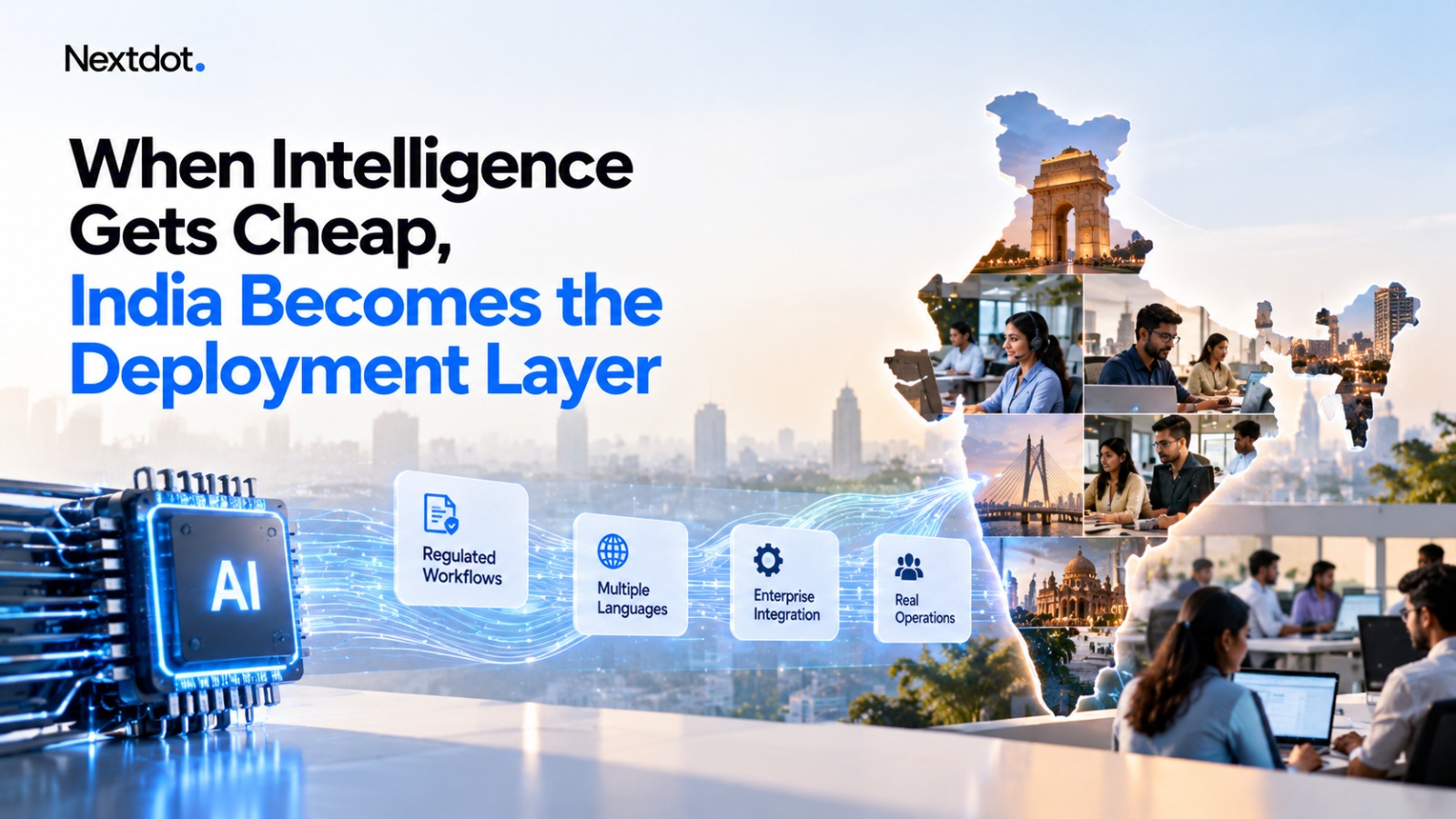
As frontier labs push the price of raw intelligence down, with some expecting it to approach the price of electricity, the scarce part of enterprise AI moves to deployment. As domain superintelligence (SI) takes shape, the hard work is getting a system built for expert-level work on one bounded task into a regulated, multilingual, legacy-bound workflow, and staying to run it. That is the layer India's delivery teams have spent a decade learning to operate. India's role in the next phase of AI is to become the place where cheap intelligence turns into accountable work.
The price of a correct answer is collapsing
Start with the number that changes the economics. Stanford's AI Index found that the cost of running a model at GPT-3.5's level of performance fell from 20 US dollars per million tokens in November 2022 to 7 cents per million tokens by October 2024, a drop of more than 280-fold in under two years (Source: Stanford HAI, AI Index Report 2025, April 2025). The labs expect the curve to keep bending. Sam Altman wrote in June 2025 that as datacenter production gets automated, "the cost of intelligence should eventually converge to near the cost of electricity" (Source: Sam Altman, "The Gentle Singularity", 10 June 2025).
The same labs now name a far larger goal. Meta set up Meta Superintelligence Labs by internal memo on 30 June 2025, and Microsoft formed its MAI Superintelligence Team on 6 November 2025. Whatever one thinks of the timelines, the direction is plain. Capability per rupee will keep rising, and the model itself is likely to become the cheapest line on an enterprise AI budget.
When the input gets cheap, value moves to whatever stays expensive. For enterprise AI, the expensive part is everything between the model and a decision a regulator will accept.
Domain superintelligence (SI) arrives first, and it arrives narrow
The useful version of this idea for a business is domain SI: a system built to work at expert level inside one bounded workflow, with the audit trail, integration and human accountability that a regulated enterprise needs. General superintelligence remains a research ambition. Domain SI is a design direction an engineering team can work toward now. A system built to review one defined set of documents, inside one team's workflow, under that team's permissions and sign-off, is the shape of it for that task and for nothing else.
That narrowness is the whole point. Domain SI only means something inside a boundary: this task, this data, this language, this workflow, this owner. Step outside the boundary and the design no longer applies. So every useful domain SI system depends on a team that drew the boundary, built the evaluation around it, and keeps checking that production still looks like what the system was designed for.
That is how we use the term. The domain SI systems we build are each designed around one workflow, one boundary and one accountable owner, and the name describes what the design is built toward.
Capability also leaves accountability where it was. More capability leaves liability, DPDP 2023 obligations and the duty to reconstruct what happened when a decision goes wrong with the enterprise and the team that runs the system. How those duties split between an enterprise and its vendors in a given deployment is a question to take to counsel before go-live. More capability raises the stakes on the layer that carries them.
What stays expensive when the model is cheap
Four costs refuse to fall with the token price, and each one tends to get heavier as models get stronger.
The first is regulation written into architecture. India's Digital Personal Data Protection Act was enacted on 11 August 2023, and the DPDP Rules were notified on 13 November 2025 (Source: Press Information Bureau). Consent, purpose limitation, retention and erasure have to live in code paths, logs and data flows. A smarter model changes none of that work. It usually adds to it, because a more capable system gets pointed at more sensitive decisions.
The second is language. The Eighth Schedule of the Constitution recognises 22 languages (Source: Ministry of Home Affairs, Department of Official Language), and real users switch between them mid-sentence. A benchmark score earned in English says little about a Hindi and English call on a noisy line. Someone has to measure performance in the language the user actually speaks.
The third is the legacy system. Most enterprises run on software older than the model team that wants to connect to it. Domain SI that cannot read the right record, write to the right field and respect the permissions already in place stays a demo. Integration through open APIs and controlled interfaces, over systems the client already owns, is slow and specific work, and a falling token price does little to compress it.
The fourth is staying. A deployed system drifts. Models get deprecated, prompts change, upstream data changes shape, and staff find ways around anything that slows them down. Somebody has to own the audit log, capture every human override, version every model and prompt, and answer the question that exposes most vendors: show me the last thirty overrides and what you changed because of them.
Add those four together and you have the deployment layer. It is where much of the cost of enterprise AI is likely to sit once intelligence is a metered utility.
Why this layer lands in India
"India's Real Moat In AI Is Not Cost And It Is Not Talent Volume" argued that India's durable edge is tolerance for regulatory and linguistic complexity. "Why the World's AI Delivery Layer Is Being Assembled in India" argued that the delivery layer is already assembling here. Cheap intelligence sharpens both arguments, and it adds one of its own.
When a frontier model costs almost nothing to call, the buyer stops paying for answers and starts paying for accountable outcomes: a system inside a boundary, checked by ongoing evaluation, with a named team responsible when it drifts. That is a delivery product. It needs engineers who read a legacy schema before writing a prompt, who expect a regulator's question before go-live, and who have watched a system fail in a live workflow and fixed it the same week. India holds a deep bench of engineers who already work this way, inside capability centres and delivery firms that have operated other people's critical systems for years.
Nextdot is one small example of the pattern. Our engineering team works out of Jamshedpur and deploys into a large hospital group and a large pharma enterprise, where observability is standard on every deployment: audit logs, versioned models and prompts, and override capture. We are also honest about what remains unfinished. Formal evaluation against clinician-labelled ground truth does not yet run on every account, and extending it is a current engineering priority. The deployment layer demands exactly this kind of plain accounting, because a domain SI system is only as trustworthy as the evaluation and observability around it.
The risk in this thesis
The same curve that makes the deployment layer valuable threatens the way Indian services firms have traditionally charged. A business built on billing hours for work a model can now do in seconds will watch its revenue shrink as the token price falls. Cheap intelligence will absorb routine code, first-draft documentation and ticket triage. Firms that sell those hours will feel it first.
The firms that grow will price and staff for outcomes inside a boundary. They will carry a bounded task, an evaluation, an accountable owner and a team that stays. That shift asks Indian delivery to move from capacity to accountability, and many firms will find it harder than it sounds. Accountability requires saying out loud what a system cannot yet do, and showing how it is checked for what it does.
What leaders should do with this
For an enterprise leader, the practical move is to split the AI budget in two. Treat model spend as a commodity line and expect it to fall. Treat deployment as the strategic line: integration, evaluation in the user's language, DPDP obligations in code, and a team that owns the system after go-live. Ask any vendor using the word superintelligence which workflow, which boundary and which named owner answers when it goes wrong. If the answer is vague, so is the system.
For the wider industry and the press, the question to ask about India's AI position is simple. How many systems does this country have in production that someone measures, runs and answers for? The labs will keep making intelligence cheaper. India's opportunity is to become the place that makes it dependable.
Frequently asked questions
What is domain superintelligence (SI)?
Domain superintelligence (SI) is a system built to work at expert level inside one bounded workflow, with the audit trail, integration and human accountability that a regulated enterprise needs. It differs from general superintelligence, which frontier labs such as OpenAI, Meta Superintelligence Labs (set up 30 June 2025) and Microsoft's MAI Superintelligence Team (formed 6 November 2025) describe as a research goal. Domain SI is defined by its boundary: the specific task, data, language and workflow it was designed for. It also leaves liability, DPDP obligations and the duty to reconstruct a decision with the enterprise and the team that runs it.
What role will India play as AI gets more capable?
India is positioned to become the deployment layer for capable AI: the place where capable systems built for narrow tasks get integrated into regulated, multilingual, legacy-bound workflows and then run under accountability. The inference cost for GPT-3.5-level performance fell more than 280-fold between November 2022 and October 2024 (Source: Stanford HAI, AI Index Report 2025), so the model is becoming the cheap part. Integration, DPDP 2023 obligations, performance across India's 22 scheduled languages and long-term operation stay expensive. India's delivery teams have years of practice at that work. The risk is that firms billing for hours of routine work will see that revenue shrink as models absorb it.
Why does deployment matter more than models?
Deployment matters more because the model is becoming a metered utility while the work around it is not getting cheaper. A capable model still needs a defined boundary, a test set, integration with the systems an enterprise already owns, data protection built into code, and a team that captures overrides and versions every change after go-live. Little of that comes free when a better model ships, and none of it moves accountability away from the enterprise that deploys the system. Once intelligence is cheap, the durable value sits with whoever can make it work reliably in a specific workflow and answer for it when it fails.