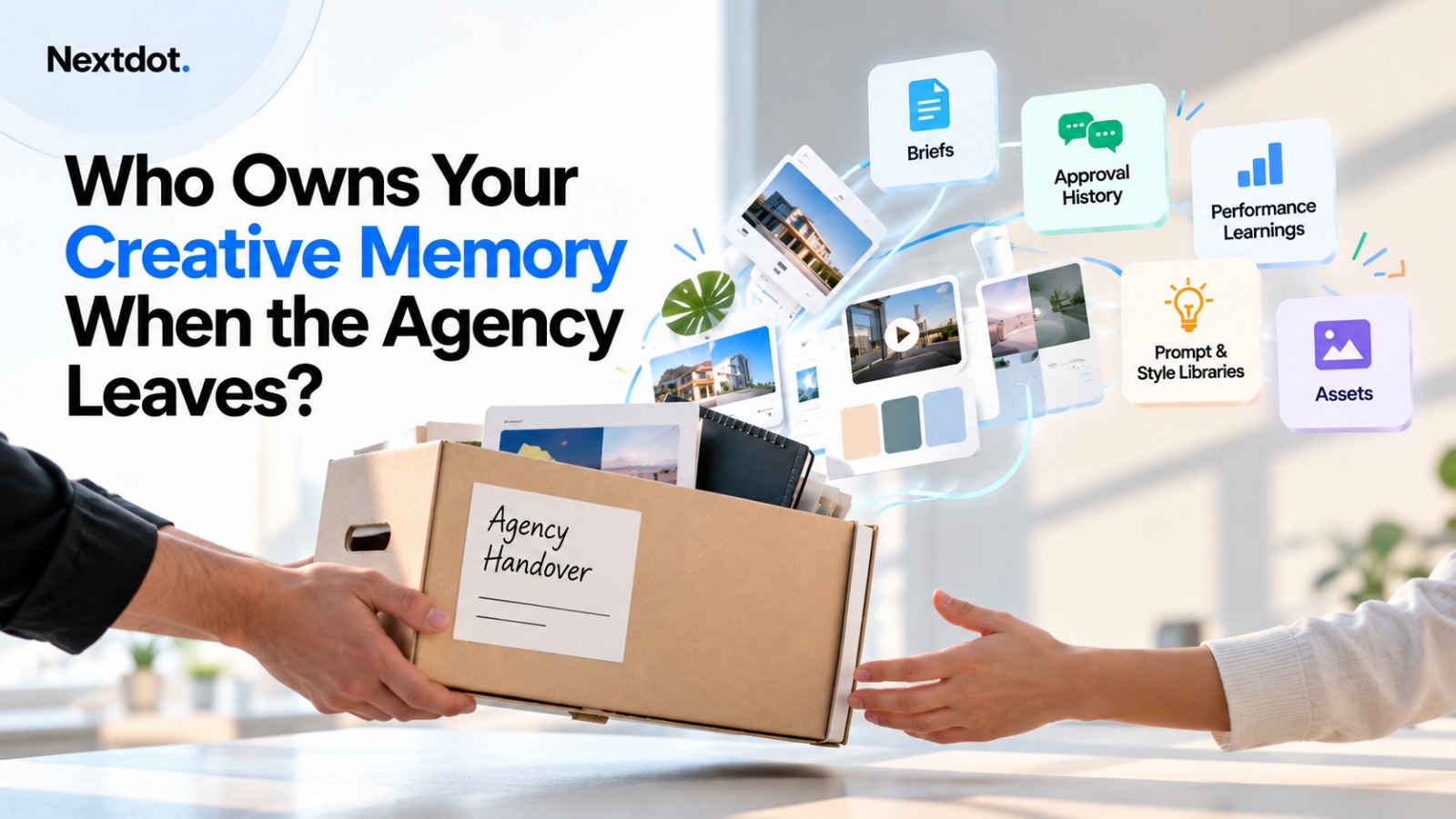
After an agency contract ends in India, the brand holds what the contract assigns to it in writing, and Indian copyright law may leave much commissioned copy, design and scripting with the agency by default. Briefs, approval history, performance learnings and prompt libraries often sit outside the assignment clause entirely, so they leave with the agency unless the contract names them. AI-generated work adds a further gap, because its copyright status in India is still unsettled.
The problem tends to surface in the last month of a relationship, when a brand asks for "everything" and receives a folder of final JPEGs.
Creative memory is five things, and most contracts cover one
When a CMO says "our creative", the contract usually hears "the finished assets", the least valuable part of the record. The real memory of a creative programme sits in five layers:
- Briefs. What was asked, for which audience, with which constraints and which claims were cleared.
- Approval history. What was rejected, by whom, and why. This is where the brand's unwritten rules live: the doctor who will not be shown in a white coat, the colour that legal flagged, the line that medical affairs struck three times.
- Performance learnings. Which hooks held attention, which formats lowered cost per lead, which messages fatigued fastest. The raw numbers sit in your ad accounts. The interpretation sits in someone's slides.
- Prompt and style libraries. In AI-assisted production, the prompts, reference boards, seeds, model settings and style guides that make output look like your brand and nobody else's.
- Assets, including raw generations. Final files, source files, project files, and the unused generations and alternates that a future campaign could reuse.
Agency contracts commonly assign layer five, sometimes only the final exports. Layers one to four get treated as the agency's working method, so the next team starts from a brand book and a folder and spends a quarter relearning what the last team knew. "Performance Data Should Train Your Creative. Almost Nobody Does It" argued that performance data should train creative. This piece covers what happens to that training at exit.
What Indian copyright law may give you by default
The Copyright Act 1957 starts from a simple rule in Section 17: the author is the first owner. The exceptions matter more than the rule.
Where a work is made by an employee under a contract of service, the employer is the first owner. An agency's staff are the agency's employees, which raises the question of whether the agency is the first owner of their work.
Section 17 also carves out a category that can favour the client. For a photograph, a painting or portrait, an engraving or a cinematograph film made for valuable consideration at the instance of another person, that person is the first owner, unless an agreement says otherwise. A commissioned brand film may therefore sit with the brand. Scripts, static copy, carousel design and jingles fall outside that list. Ask counsel who holds first ownership of each of those in your current contracts.
Section 19 sets the terms for moving ownership. An assignment has to be in writing and signed. The Act also supplies a default period and a default territory where an assignment is silent on them. Take a direct question to counsel: does a loose "all rights vest in the client" line, with no term and no territory, give you the worldwide, full-term rights you believe you hold?
Briefs, approval notes and performance analysis may not qualify as copyright works at all, which makes the contract the main place to secure them. Ask counsel what claim you would have to those layers if the contract says nothing.
The AI-generated layer: owning something the law has not classified
AI-assisted production raises a harder question. Can anyone own the output?
India's Act has a provision written for a different era. Section 2(d)(vi) says the author of a computer-generated work is "the person who causes the work to be created". It was added in 1994, long before generative models, and whether it covers them is a question to put to counsel. The SURYAST episode shows how unsettled the position is. The Copyright Office registered the image with its AI tool named as co-author, then sent a withdrawal notice on 25 November 2021 questioning the tool's legal status (Managing IP, December 2021).
The Department for Promotion of Industry and Internal Trade published Part 1 of its Working Paper on Generative AI and Copyright on 8 December 2025. It dealt with training data and deferred copyrightability and authorship of AI outputs to a Part 2 (DPIIT, 8 December 2025). Business Standard reported on 11 December 2025 that Part 2 was expected within about two months. Ask counsel whether it has appeared and what it would change for your contracts.
For brands that also run campaigns in the US, the US Copyright Office's report of 29 January 2025 states that material generated by AI alone is not protected, that prompts alone generally do not make the prompter an author, and that human selection, arrangement and modification can be protected, assessed case by case.
The practical reading for a CMO: the more human direction, editing and compositing sits on a generation, the more there is for a claim to rest on. That human work is recorded in the prompt library, the edit history and the approval trail, the same layers most contracts ignore. Losing them at exit can weaken your position on the assets you kept, and that is worth testing with counsel.
Performance learnings are the part that walks out quietly
Performance data has two halves, and they leave differently.
The raw data lives in ad platforms and analytics tools. If the agency set up the ad accounts under its own business manager, the brand may lose its own campaign history on exit. The fix belongs in week one: every ad account, pixel and analytics property sits under the brand's ownership, with the agency granted access.
The interpretation is harder to hold. A hypothetical learning such as "doctor-led Hindi Reels beat English statics for cardiac OPD leads" is worth more than the spreadsheet behind it, and it usually sits in a strategist's monthly deck or head. When they move on, so does the insight.
A contract should require a written learnings log, updated monthly, owned by the brand, and delivered in full at exit. If any of that performance data carries personal data, such as lead lists or custom audiences, ask counsel how the Digital Personal Data Protection Act 2023 allocates the brand's and the agency's roles, and make sure the exit clause covers return and deletion of that data by the agency.
The exit clause, written out
Take this list to legal before the next renewal, whatever kind of creative vendor you use.
- Scope of ownership. The brand owns briefs, approval history with reasons, performance learnings, prompt and style libraries, reference boards, pre-production material such as shot lists and continuity bibles, final and source assets, and raw generations produced for the brand.
- Assignment terms. A written, signed assignment of copyright in all deliverables, with the territory, the term and the media stated explicitly. Ask counsel to confirm the wording achieves what you intend.
- AI inputs and outputs. The vendor discloses which assets were AI-generated or AI-assisted, which tools produced them, and assigns whatever rights it holds in the outputs and the prompts that produced them.
- Format. Export in usable, open formats: layered source files, prompt libraries as structured text, approval history with dates and reasons, learnings as a readable document. A proprietary dashboard login that expires on the last day does not count.
- Timing. A handover window stated in days, with a named owner on each side.
- What the vendor keeps. Anonymised process know-how only, with nothing that identifies the brand, its customers or its unreleased work.
- Platform ownership. All ad accounts, pixels and analytics properties registered to the brand from day one.
- Personal data. Return and deletion of any personal data the vendor held, with written confirmation.
How Nextdot handles creative memory at exit
The Creative Intelligence Pod depends on memory. Every brief, approval, rejection reason and result is stored and retrieved when a new brief arrives, so each campaign starts from what the earlier ones taught. That creates an obvious question for any CMO: if the memory is the product, who owns it?
Nextdot's position is that the client owns it. Briefs, approval history, performance learnings, style and prompt libraries, and assets belong to the brand, and they are exported in usable form when the client leaves. Pre-production material, including shot lists, character sheets and continuity bibles, counts as client creative memory and goes with the client too. Nextdot keeps only anonymised process know-how, meaning how the pod works in general, without anything specific to the client.
Ask the same of any creative vendor, including us. A vague answer means the memory you are paying to build belongs to someone else.
Frequently asked questions
Who owns creative files after an agency contract ends?
It depends on the contract first. Under Section 17 of the Copyright Act 1957, the author is the first owner, and commissioned photographs and films are a category that can sit with the commissioning brand. For copy, scripts and designs, ask counsel who holds first ownership under your contract, and whether your assignment is signed and states a term and territory as Section 19 expects.
Does a brand own AI-generated creative?
The position in India is unsettled. The Copyright Act names "the person who causes the work to be created" as author of computer-generated works, and whether that covers generative AI is a question for counsel. The DPIIT deferred AI outputs to a Part 2 of its December 2025 working paper. A brand's practical protection is a contract that assigns all vendor rights in the outputs and prompts, backed by a record of the human direction and editing involved.
What happens to performance learnings when you switch agency?
Raw data stays in the ad and analytics accounts if the brand owns them. The interpretation, meaning what worked and why, usually leaves with the agency's strategists unless the contract requires a written learnings log owned by the brand and handed over at exit.
What should a creative contract say about data?
It should name every layer the brand owns: briefs, approval history, performance learnings, prompt and style libraries, pre-production material, source files and raw generations. It should set export formats and a handover window, keep all ad and analytics accounts under brand ownership, limit the vendor to anonymised process know-how, and require return and deletion of any personal data, with counsel confirming the DPDP Act 2023 position.