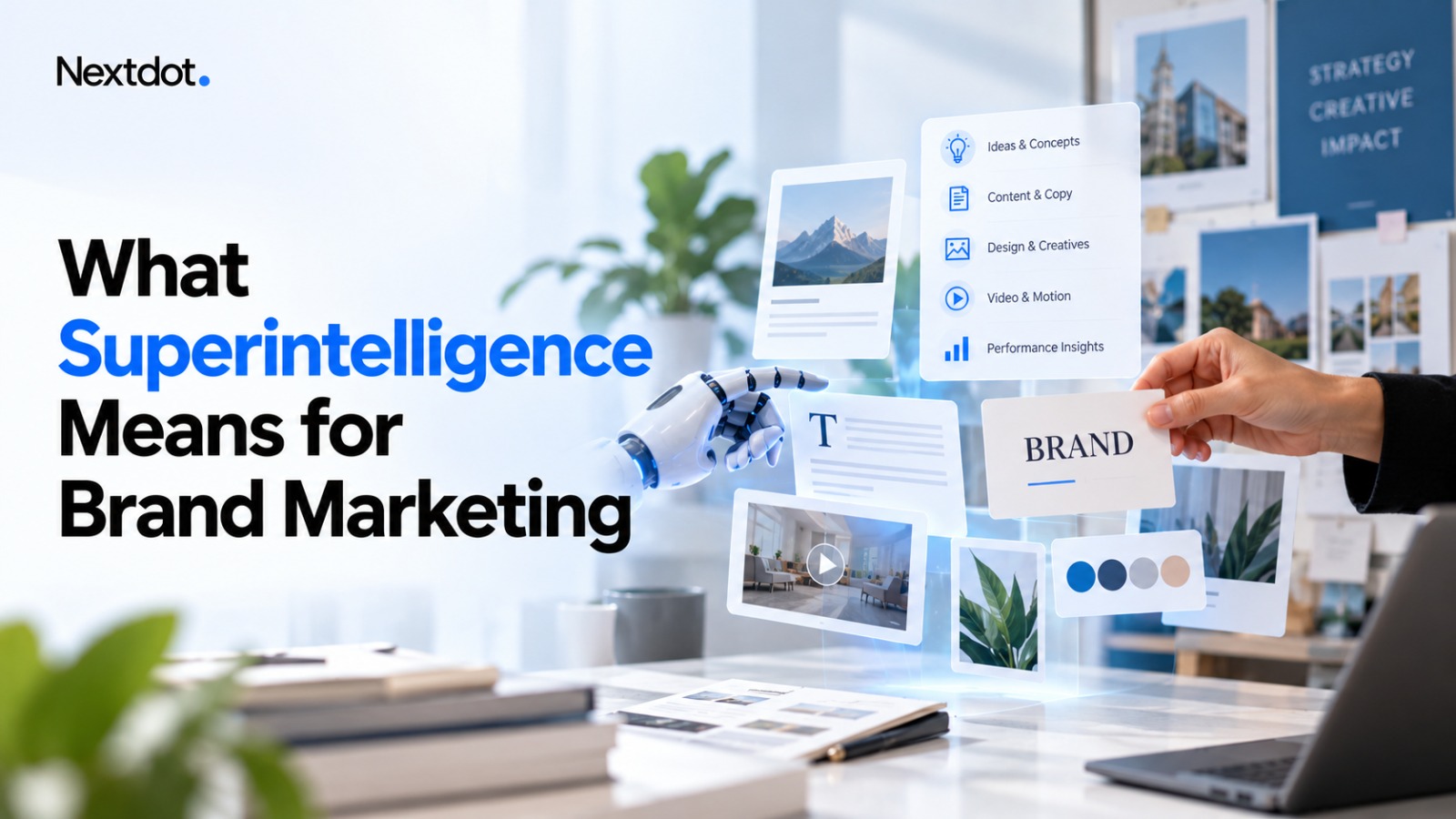
Superintelligence will reach marketing one bounded task at a time, as domain superintelligence (SI): systems built to work at expert level inside one bounded workflow. As those tasks get fast and cheap, four things stay with the CMO: what the brand promises, what it refuses to say, the record of where every asset came from, and the performance learning that tells the machine what worked. All four are forms of accountability, and accountability does not transfer to a model.
Brands that write those four down now will direct more capable systems. Brands that do not will find their marketing directed by whatever the systems default to.
Why a lab's research goal belongs on a CMO's desk
The companies building frontier models now name superintelligence as their objective. Sam Altman wrote in June 2025 that OpenAI is, "before anything else", a superintelligence research company (Source: Sam Altman, "The Gentle Singularity", 10 June 2025). Meta created Meta Superintelligence Labs on 30 June 2025 (Source: CNBC, 30 June 2025). Microsoft formed an MAI Superintelligence Team in November 2025 (Source: CNBC, 6 November 2025).
Three terms need to stay separate. AI, in this piece, means the tools marketing teams use today to write, design, edit and generate video, with people directing and approving the work. General superintelligence means a system that outperforms the best human experts across most cognitive work, strategy and creative judgment included. The labs say they are building it. Nobody has shipped it, and nobody can responsibly promise a date. Domain SI is narrower and more useful to a buyer: a system built to work at expert level inside one bounded workflow, with the audit trail, integration and human accountability that a regulated enterprise needs. The design holds inside that boundary and nowhere else.
Marketing will meet domain SI long before it meets anything general. Creative production is cognitive work with fast, measurable feedback, the kind each model generation gets better at. The likely early candidates are narrow: cutting one master into every format a media plan needs, drafting copy variants against a written brief, retrieving what the brand has already tried. Each task that crosses the expert line gets cheap. Cheap production made taste scarce. Domain SI goes one step further. As task after task crosses that line, parts of judgment get cheap as well, and the scarce thing becomes accountability: a named person who answers for what the brand said, showed and claimed.
The four things that stay with the CMO
1. The promise. Every claim a brand makes is a promise that a regulator, a court or a customer can hold it to. A model can draft the claim. The brand answers for it. In India, Chapter I of the ASCI Code says factual claims should be capable of substantiation, and advertisers and agencies must produce that substantiation when asked (Source: ASCI Code, Chapter I, ascionline.in, checked September 2026). Who else carries exposure in healthcare, pharma or financial services, and whether it changes when a model drafted the line, are questions to take to counsel. As generation gets more fluent, claims get more persuasive and more numerous, and the CMO's sign-off carries more weight for each one.
2. The refusals. A more capable system produces more options. The brand's identity lives increasingly in what it rules out: claims, tropes, subjects and the tone it will never take with a patient or a customer. Most brands keep their refusals in a few senior heads and a PDF brand book. A system cannot follow a rule nobody wrote down. The refusal list is now the most important brand document a marketing team does not have.
3. Provenance. As generated work becomes hard to tell from shot work, the record of where each asset came from becomes a liability question. Which parts were generated, with what tools, from which source material, and with whose consent for any face or voice that appears? India's amended IT Rules, in force since 20 February 2026, bring synthetically generated information into the due-diligence obligations of the platforms brands publish on, including prominent labels and provenance metadata on synthetic audio and video (Source: Khaitan & Co., "MeitY notifies the IT Amendment Rules 2026", February 2026). For brands selling into Europe, Article 50 of the EU AI Act has required disclosure of deep fakes since 2 August 2026. How either regime reaches a brand's own assets is a question for counsel, and counsel will start by asking for the provenance record.
4. The learning. The most valuable asset a performance marketing program produces is the record of what worked: which hooks, formats, faces, offers and messages moved which audience. That record is the brand's training signal, and it is also the ground truth any domain SI system in your programme should be built on. Left inside a vendor's system or a platform's model, it stops being the brand's edge. The CMO needs to own it, carry it across agencies and tools, and decide who gets to learn from it.
What changes inside the marketing function
The brief becomes a specification. A very capable system will execute a brief literally and at volume. An ambiguous brief used to produce one weak concept that a senior creative would catch. It will now produce a hundred confident variations of the wrong idea. The brief turns into a specification, and writing it becomes senior work.
Review changes its question. "Is this good?" gets easier as baseline quality rises. The harder questions are "Is this ours?", "Is this allowed?" and "Can we prove where it came from?" Review teams need to be built around those three questions.
Approval becomes the bottleneck. Production time keeps falling while approval chains stay the same length. The organisations that gain most will name one approver per asset class, define what each review stage is for, and stop routing every asset past every stakeholder.
The team changes shape. Fewer hours go into making and more go into directing, setting standards and reviewing. The people who matter most can say precisely what the brand wants and what it will not accept.
What a CMO can do this quarter
None of this waits on a new model.
- Write down the refusals. Build a working list of claims, visual tropes, topics and tones the brand will not use, with examples of each. Review it quarterly.
- Put a provenance record on every asset. Record whether it was shot or generated, which tools were used, what source material went in and what consent covers any person shown or heard.
- Contract for the learning. Make sure every agency and vendor agreement states that performance learnings, briefs and approval history belong to the brand and move with it at exit.
- Name the approver. Give each asset class one accountable approver, and define what their review checks for.
- Measure first-pass approval. Track how often work is approved at first review. It shows whether your briefs and standards are specific enough for a capable system to follow.
- Ask for the boundary. When any vendor, us included, describes a system as SI, ask in writing which workflow it is built for, where its boundary sits, what audit trail it keeps and who signs off its output.
Where domain superintelligence (SI) sits in our work
We use domain SI as the name for what we build: systems designed to work at expert level inside one bounded workflow, with the record and sign-off a regulated brand needs. General superintelligence is where the frontier labs say they are heading, and it stays their research goal.
Inside the Creative Intelligence Pod, the workflow we are building toward domain SI is recall. The pod's memory stores every brief, approval, rejection reason and result, and retrieves what bears on a new brief when it arrives. The account lead starts each brief with that history in front of them. That is the direction: one bounded workflow, a complete record, and a named person who decides what to do with what the memory returns.
Everything else the pod does, from scripts to generated video, is AI work that people direct, review and sign off. No capability claim moves consent: we never generate or clone a real person's face or voice without their written consent and a re-use clause, and doctors also need a compliance check.
A more capable system moves none of the four things above either. However well the memory recalls, the pod still hands the promise, the refusals, the provenance record and the learning back to the brand. The client owns its briefs, approval history, performance learnings and assets, and takes them in usable form at exit. Nextdot keeps only anonymised process know-how.
Machines will take on more of the work, one bounded task at a time. The brand will still need a person whose name is on the promise.
Frequently asked questions
What is domain superintelligence (SI)?
Domain superintelligence (SI) is a system built to work at expert level inside one bounded workflow, with the audit trail, integration and human accountability that a regulated enterprise needs. In marketing it arrives first in narrow workflows such as creative memory, and it leaves the promise, the refusals, provenance and the learning with the brand. General superintelligence, the broad capability OpenAI, Meta and Microsoft name as a research goal, has not shipped.
Will superintelligence replace marketing teams?
It will change what they do more than whether they exist. Domain SI will make specific tasks fast and cheap, one at a time. Accountability for promises, refusals, provenance and performance learning stays with people, so teams will spend less time making and more time directing and approving.
What should a CMO own when AI makes the creative?
Four things: the claims the brand makes and answers for, the written list of what the brand refuses to say or show, a provenance record for every asset covering what was generated and with whose consent, and the performance data that shows what worked. A model can contribute to all four and answer for none.
Do AI-generated ads need to be labelled in India?
India's IT Amendment Rules 2026, in force since 20 February 2026, bring synthetically generated information into the due-diligence obligations of platforms, including prominent labels on synthetic audio and video (Source: Khaitan & Co., February 2026). Article 50 of the EU AI Act has required disclosure of deep fakes since 2 August 2026. Whether a specific campaign needs a label, and who applies it, is a question to take to counsel.
Who owns what an AI learns from a brand's performance data?
It depends on the contract, which is why the contract should say so. Every agency and vendor agreement should state that performance learnings, briefs and approval history belong to the brand, export in usable form and move with it at exit.