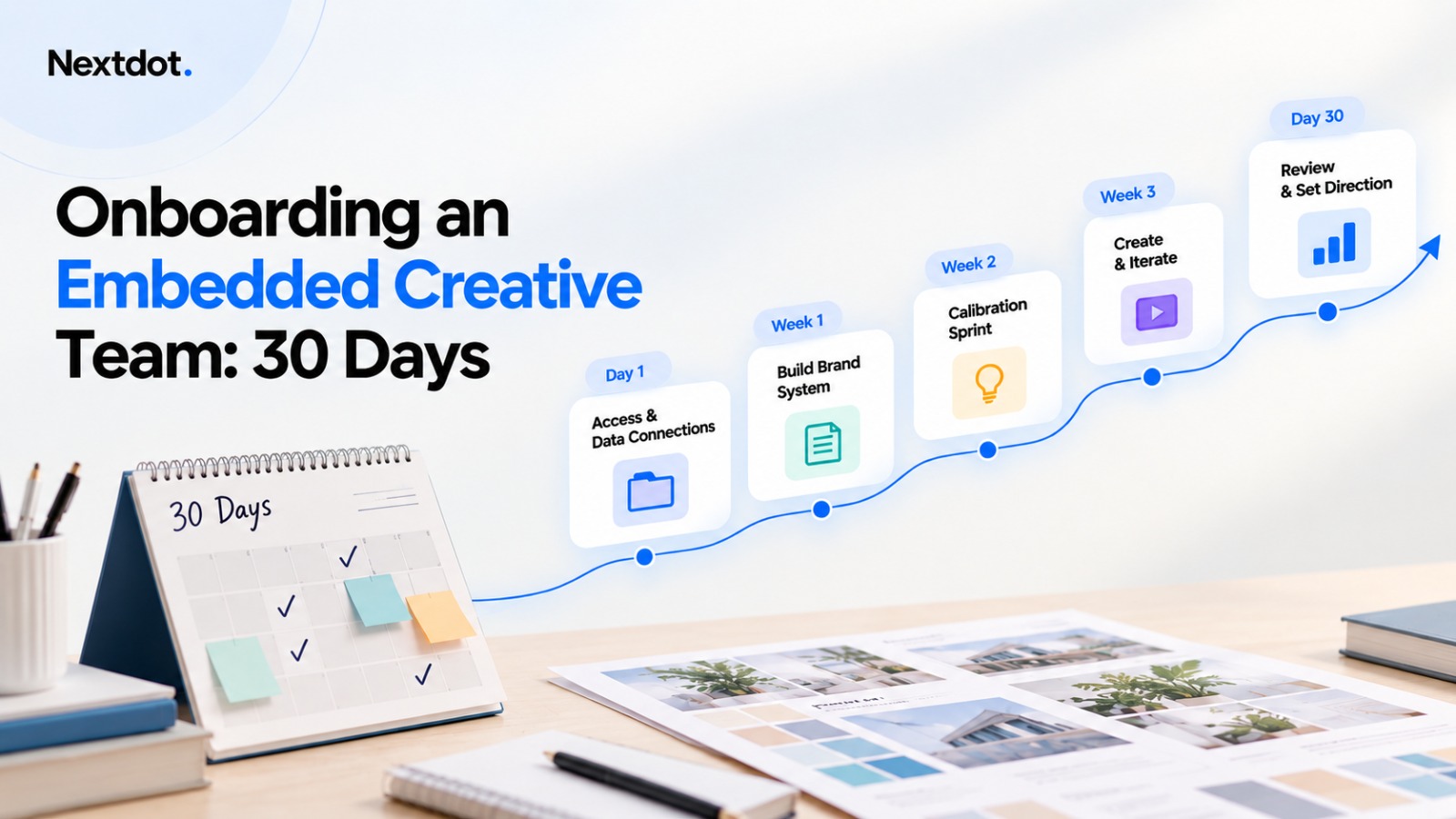
To onboard an embedded creative team, a brand grants access and data connections first, builds a working brand system with the pod, runs one real brief as a calibration sprint, and reviews the result against agreed numbers at day thirty. The pod does most of the work. The brand controls the pace, because the usual causes of a stall sit on the brand side: an access request, a missing approver, or a claims question nobody owns.
It is tempting to treat the first month with a new creative partner as a warm-up. An embedded pod cannot afford one. The first thirty days build the memory every later month draws on, so a slow start costs twice: once in lost output, and again in a weaker base for everything that compounds after it.
What the brand has to provide before day one
Five inputs only the brand can supply, and they decide how fast the first month moves.
A named owner on the brand side. One person who can approve access, route questions, and make a call when two stakeholders disagree. Without this person, every question goes to the CMO and waits.
The approval chain, written down. Who reviews a static, who reviews a film, who signs off on a medical or regulatory claim, and who holds the final yes. "Where the approval loop breaks in AI video, and how to rebuild it" covers how to design this loop. At onboarding, the current version is enough, even if it is imperfect.
The brand material as it exists today. The brand book, recent campaigns that worked, recent campaigns that were killed, and the reasons they were killed. A rejection with a reason is the most useful single input a pod receives in its first week.
The claims position. For a hospital or pharma brand, the pod needs the list of claims the brand has already substantiated, the claims legal has refused, and the person who clears a new one. "What healthcare brands need from creative in a regulated market" sets out why. At onboarding, this becomes the first draft of the claims library.
The consent register. Any doctor, patient or staff member who appears in creative needs a record of consent. Nextdot never generates or clones a real person's face or voice without that person's written consent and a re-use clause, and a doctor appearing in creative needs explicit consent plus a compliance check. The pod needs to see which faces and voices it may use before it plans a single shot. Our advice is that each consent names the languages, films, channels and duration it covers, so nobody has to guess later.
Access and data connections
The pod needs three kinds of access, and each has a different risk profile.
Asset access. The brand's asset library, fonts, logo files, photography and past creative. This is low risk and should be granted on day one.
Channel access. The ad accounts and social handles where creative ships. Grant upload and view rights. Keep publishing rights with the brand unless the CMO decides otherwise, and record that decision.
Performance data access. This is the access that makes an embedded pod worth having. The pod reads performance results, read-only: leads, conversions, cost per acquisition and cost per thousand impressions on the paid side, and reach, shares and saves on the organic side. "Performance data should train your creative. Almost nobody does it" explains why this loop matters, and onboarding is where it gets wired.
Two decisions belong to the brand here. The first is scope. Aggregated campaign metrics carry little personal data. Lead-level records from a hospital CRM carry names, phone numbers and sometimes a condition. Our recommendation is to start with aggregates and add lead-level records only when a specific question needs them, such as which creative produced leads that converted to appointments. Grant the narrowest access that lets the pod learn what worked.
The second is paperwork. Under the Digital Personal Data Protection Act, 2023, Section 8(2) allows a Data Fiduciary to engage a Data Processor only under a valid contract. The DPDP Rules, 2025, notified by the Ministry of Electronics and Information Technology on 13 November 2025, bring the Section 8 obligations into force on 13 May 2027. Take three questions to counsel before kickoff: does the pod act as a Data Processor for this data, what must the contract contain, and should it be signed now even though the obligation commences later.
A useful test once access is live: can the pod pull last month's results for the brand's top ten creatives without asking anyone for help. If not, the feedback loop is still open, and the first sprint will run on judgment alone.
The brand system build
Nextdot builds a working brand system before the first campaign. "Your brand guidelines are a PDF. AI cannot work inside a PDF" covers what goes into it: tone rules with examples, visual references, the claims library, a do-not-say list, and approved and rejected work side by side. The onboarding question is narrower. Who on the brand side has to show up, and for how long.
The answer is less time than it sounds, and more attention. The pod drafts the system from the material the brand supplied. The brand owner then holds a few focused review sessions to correct it. The corrections carry the value. "This colour is right but we never use it on a white background" is a rule no brand book states and every designer on the account needs.
Two outputs close this stage: a versioned brand system the pod works inside, and a first set of labelling and likeness defaults. Nextdot ships labelling as a standard option on AI-generated creative, recommends it, and records the client's choice. That choice gets recorded here, once, so no individual creative has to reopen it.
The first brief
Make the first brief a real one. A brief written only to test the pod produces test output and teaches the pod little.
Pick a campaign that is live or due within the month, with a clear audience, a defined channel and a known performance baseline. A recurring performance campaign works well, because the brand already knows what good looks like in numbers. Avoid a flagship brand film for the first brief. Its approval chain is the longest in the building, and it will hide the problems onboarding should surface.
The brief itself follows the brand's normal format. The pod adds one thing: a written note of which past creative it is drawing on and why. That note is the first entry in the memory "What the intelligence in a Creative Intelligence Pod is" describes. From here on, every brief, approval, rejection reason and result is stored and retrieved when a new brief arrives. The note also lets the brand check whether the pod read the history correctly before a single asset is made.
The first sprint
The first sprint is a calibration run. The pod produces a working batch against the brief, the brand reviews through the approval chain it wrote down before day one, and every round of feedback goes into the brand system as a rule, a reference, or a rejection with a reason.
The volume in the first sprint is lower than steady state. A pod committed to a fixed monthly output reaches that rate once the brand system and the approval chain are both proven, and the first sprint is where they get proven. Production time sits with the pod. Review time sits with the brand, so the approval chain decides when the first creative goes live.
Watch two things during the sprint. First, how many rounds each asset needs before approval, and why. Feedback that repeats across assets is a missing rule in the brand system. Second, which reviewer's comments reverse another reviewer's. That is an approval chain problem, and it will not fix itself in month two.
What day thirty should look like
At day thirty, the CMO should hold a short review with four questions.
Is the brand system written, versioned and in use? Is the performance data connection live and read-only, with counsel's answer on the contract in hand? Has at least one campaign shipped through the full approval chain? And do both sides agree on the numbers the pod will be held to from month two?
"The five numbers a CMO should hold a creative team to" sets out throughput, first-pass approval rate, time from brief to live, refresh rate against creative fatigue, and performance contribution. Day thirty is when those baselines get recorded. Without a baseline, month six has nothing to beat.
One more item belongs in the day-thirty review, and it is the easiest to skip. The brand owns what the pod builds during onboarding: the briefs, the approval history, the performance learnings, the style and prompt libraries, and the assets. Nextdot exports them in usable form if the client leaves and keeps only anonymised process know-how. "Who owns your creative memory when the agency leaves?" covers the contract terms. At day thirty, confirm where that memory lives and how the brand would retrieve it.
Frequently asked questions
How long does it take to onboard a creative pod?
Plan on a month to reach a proven working rhythm: access and data connections first, the brand system next, and a calibration sprint on a real brief after that. The brand's own approvals and access requests set the actual pace more than the pod does.
What does a brand need to provide?
A brand needs to provide five things: a named owner who can approve access and settle disagreements, a written approval chain, its current brand material including killed campaigns and the reasons they were killed, its substantiated and refused claims, and a consent register for any doctor, patient or staff member who appears in creative.
When does the first creative ship?
The first creative ships from the first sprint, which runs on a real live campaign after the brand system is drafted and reviewed. The brand's review cycle decides the date, so a short, written approval chain is the fastest lever a CMO has.
What access does an embedded pod need?
An embedded pod needs three kinds of access: the brand's asset library, upload and view rights on the channels where creative ships, and read-only access to performance data such as leads, conversions, cost per acquisition and reach. Publishing rights stay with the brand unless it decides otherwise. Where performance data includes personal data, ask counsel how Section 8(2) of the Digital Personal Data Protection Act, 2023 applies, given that the DPDP Rules, 2025 bring Section 8 obligations into force on 13 May 2027, and settle the contract question before access begins.