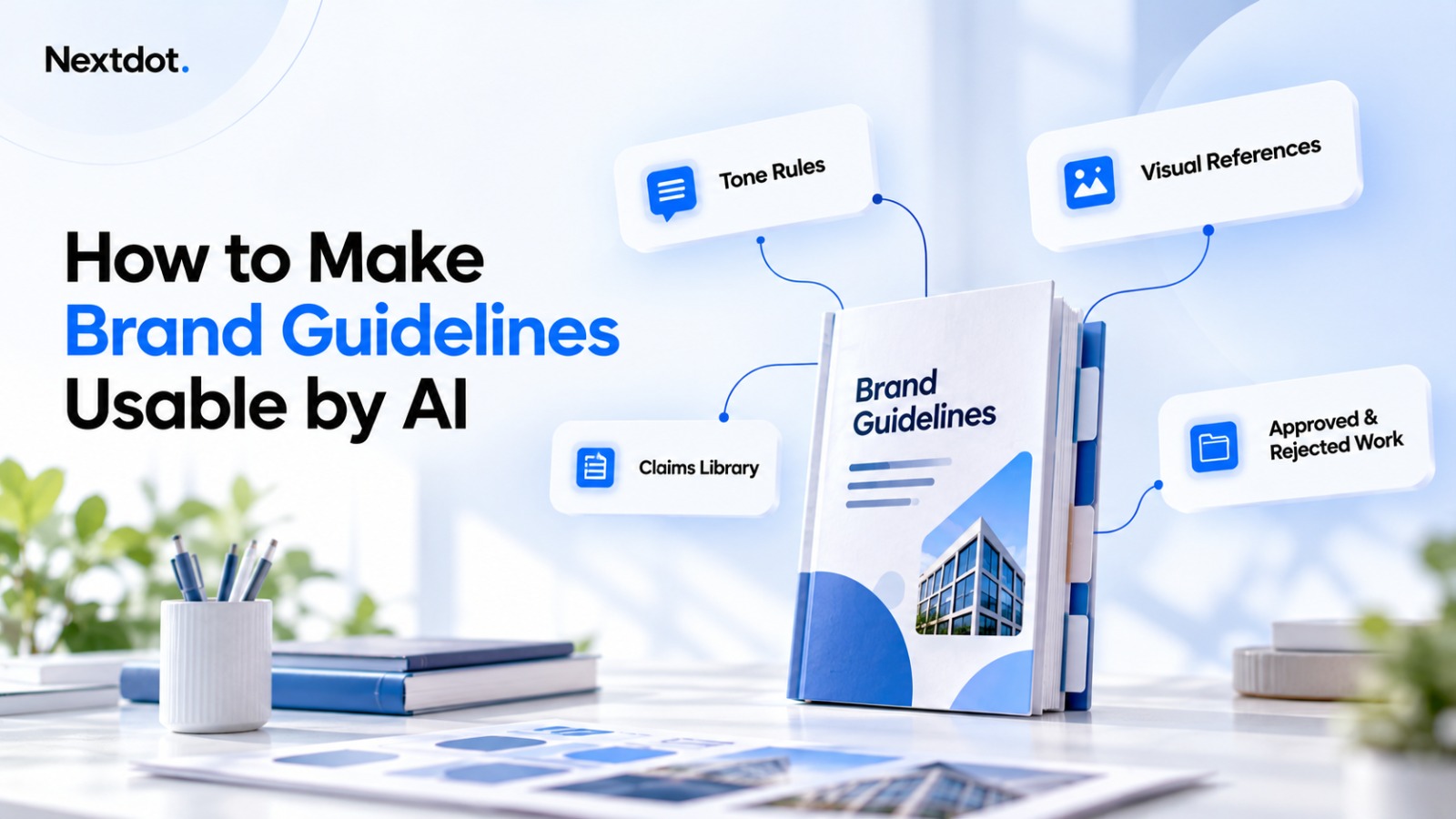
To make brand guidelines work with AI tools, rebuild the brand book as a brand system: tone rules written as instructions with paired examples, tagged visual references, a claims library, a do-not-say list, and a growing archive of approved and rejected work with the reason for each decision. A model follows rules it can read, test against and be corrected on. It cannot follow the judgement of the three senior people who interpret your PDF today.
Most brand books were designed for a human designer who reads them once, absorbs the spirit, and asks the brand manager when in doubt. That arrangement held while humans made every asset. It breaks when a marketing team starts producing at machine volume. Gartner's "Beyond ChatGPT" research, published in January 2023, predicted that by 2025, 30 percent of outbound marketing messages from large organisations would be synthetically generated, up from less than 2 percent in 2022. The brand book now has a reader that never asks a follow-up question.
Why the PDF fails the moment AI touches it
A brand PDF fails AI production for three reasons.
The first is that it describes and never instructs. "Warm, confident, human" is a mood. A writer with ten years in the category knows what it means for a cardiac hospital and what it means for a toothpaste. A model does not. It fills the gap with the average of everything it has read, and that average is exactly the generic voice your brand paid to escape.
The second is that it hides the rules that matter most. The rules a brand team actually enforces rarely sit in the PDF. The claim legal struck out last quarter, the doctor who must never appear without the consent file, the colour combination that failed accessibility review, the phrase the MD dislikes. That knowledge lives in email threads and in the heads of the people who sign off. When those people are busy, the rules are absent.
The third is that it never learns. In most companies the PDF changes only when the logo does. The real brand moves every week through approvals and rejections, and none of that movement flows back into the document.
Pasting the PDF into a prompt fixes none of this. The model receives the same mood words with less context than your designer had.
What a working brand system contains
A brand system is the brand book rewritten for a reader that needs explicit rules, concrete examples and a record of past decisions. It has five parts.
Tone rules, each with a pair of examples
Every tone rule becomes an instruction a reviewer can check, paired with one line that passes and one line that fails. "Confident" becomes "state the outcome first, name the department, avoid hedging words in headlines", followed by a real headline that follows the rule and a real headline that broke it. The failing example does more work, because it shows the model and the new copywriter where the edge sits.
Write rules per channel and per audience. A hospital speaks differently in a patient reel, a referring-doctor mailer and a recruitment post.
Visual references, tagged and annotated
Mood boards help people. Generation and review need references with labels attached: this frame is on-brand for lighting, this one for colour grade, this one for how we show clinicians at work. Each reference carries a note on what it demonstrates and what it must not be read as. Add the visual refusals too: the stock-photo handshake, the blue-tinted operating theatre, the smiling model in a lab coat who is plainly not a doctor.
For film, the visual system connects to the look reference and character sheet described in "The shot list is the prompt".
A claims library
Every factual claim the brand is permitted to make sits in one place, with its substantiation, its owner, its approval date and the exact wording that cleared review. "What healthcare brands need from creative in a regulated market" set out the claim ledger for a single campaign. The claims library is that ledger kept across campaigns, so an approved line and its source are on hand when the next brief arrives, and an expired claim cannot slip back in because somebody found it in an old deck.
For healthcare and pharma brands, this section carries the most risk. Whether a claim cleared for one asset can run in a new one without fresh review, and for how long that clearance holds, are questions to take to counsel and your medico-legal reviewer. A claim with no entry should not go in at all.
A do-not-say list
The do-not-say list holds the words, phrases, comparisons, subjects and tropes the brand rules out, each with a one-line reason. Superlatives the brand cannot substantiate. Competitor names. Clinical terms that imply a cure. "When the machine outthinks the brief" argued that a brand's identity increasingly lives in what it refuses. This list is where those refusals become enforceable, by a reviewer on every draft and by a generation pipeline before a human sees the draft.
Approved and rejected examples, with reasons
Every asset that ships goes into the archive with a note on why it passed. Every rejected asset goes in with the reviewer's reason. That record of real decisions by your own team on your own brand exists nowhere else until you write it down.
The rejected work matters more than the approved work. "Too clinical for a patient audience", "reads as a guarantee", "wrong department colour" are the corrections a new team member would otherwise learn one painful review at a time.
How to rebuild the brand book in practice
Start with the last six months of review, before touching the PDF. Pull every asset that went back for changes and log the reason in one sentence. That log shows which rules your brand actually enforces, and it will differ from the brand book's table of contents.
Then turn each recurring reason into a rule with a pass and fail example. Move every claim in live creative into the claims library with its source, and flag the ones nobody can source. Collect the words and themes reviewers keep striking into the do-not-say list. Tag the visual references against the rules they illustrate.
Assign one owner on the client side who can approve changes to the system. The marketing team has to hold the pen on what the brand is.
Finally, wire the system into review itself. Every rejection updates a rule, adds to the do-not-say list or goes into the rejected archive the same week. A brand system that stops taking corrections becomes the PDF again, in a different file.
Why AI content drifts off-brand
AI content drifts off-brand for predictable reasons, and each maps to a missing part of the system.
It drifts toward generic when tone rules are adjectives. The model regresses to the category average, which is how five hospital brands end up sounding identical on the same feed.
It drifts toward risk when there is no claims library. Asked to write persuasively about a procedure, a model reaches for the confident claim, often the one your reviewer cannot defend.
It drifts over time when corrections do not persist. A reviewer fixes the same mistake in week one, week four and week nine, because the fix lived in a comment on a single asset and never reached the rules.
It drifts across people when each copywriter keeps a private prompt. Three writers with three prompts produce three brands. A shared system, versioned and owned, produces one.
Why the brand system is the first thing a pod builds
In a Creative Intelligence Pod engagement, a working brand system is built before the first campaign goes into production. Throughput without it produces volume the brand team then corrects by hand, which moves the bottleneck from making to reviewing. How long the build takes depends on the state of the client's existing brand book and review records.
The system then compounds. "What the intelligence in a Creative Intelligence Pod is" described that intelligence as memory: every brief, approval, rejection reason and result is stored and retrieved when a new brief arrives. Performance data, read through the loop described in "Performance data should train your creative. Almost nobody does it", adds a layer the PDF never had: which on-brand choices moved leads and saves, and which only pleased the room.
The system belongs to the brand. Under Nextdot's position on creative memory, the client owns the briefs, the approval history, the performance learnings, the style and prompt libraries and the assets, and they are exported in usable form if the client leaves. Nextdot keeps only anonymised process know-how. The same record carries the brand's decision on labelling AI-generated creative. Nextdot offers labelling as a standard option and recommends it, and the client's choice is logged alongside every other brand rule.
A CMO can test any creative partner on this in one meeting. Ask to see the brand system they would build for you: the rules with examples, the claims library, the do-not-say list, the rejected archive. Then ask who owns it on the day the contract ends. The answers tell you whether you are buying production or a system that learns your brand.
Frequently asked questions
Can AI follow brand guidelines?
AI can follow brand guidelines written as explicit rules with examples, and it struggles with mood words in a PDF. A model applies "state the outcome first and avoid hedging in headlines" far more reliably than "warm and confident". Pair every rule with a passing and a failing example, keep a list of words and claims the brand rules out, and feed reviewer corrections back into the rules.
What is a machine-readable brand system?
It is a brand book rebuilt as structured, testable parts that a person or a model can apply and check: tone rules with paired examples, tagged visual references, a claims library with substantiation and approval dates, a do-not-say list with reasons, and an archive of approved and rejected work with reasons.
What should a brand book include for AI?
Rules phrased as instructions, a good and a bad example for every tone rule, voice rules per channel and audience, labelled visual references, every approved claim with its source and owner, a list of banned words and themes, and a record of past approvals and rejections. For healthcare and pharma brands the claims library carries the most weight, because an unsubstantiated claim is where regulatory exposure begins.
Why does AI content drift off-brand?
Because the model fills every gap in its instructions with the average of what it has read. Adjective-only tone rules pull output toward the generic category voice, a missing claims library lets unsupported claims in, corrections on single assets never reach the next draft, and private prompts per writer split one brand into several.