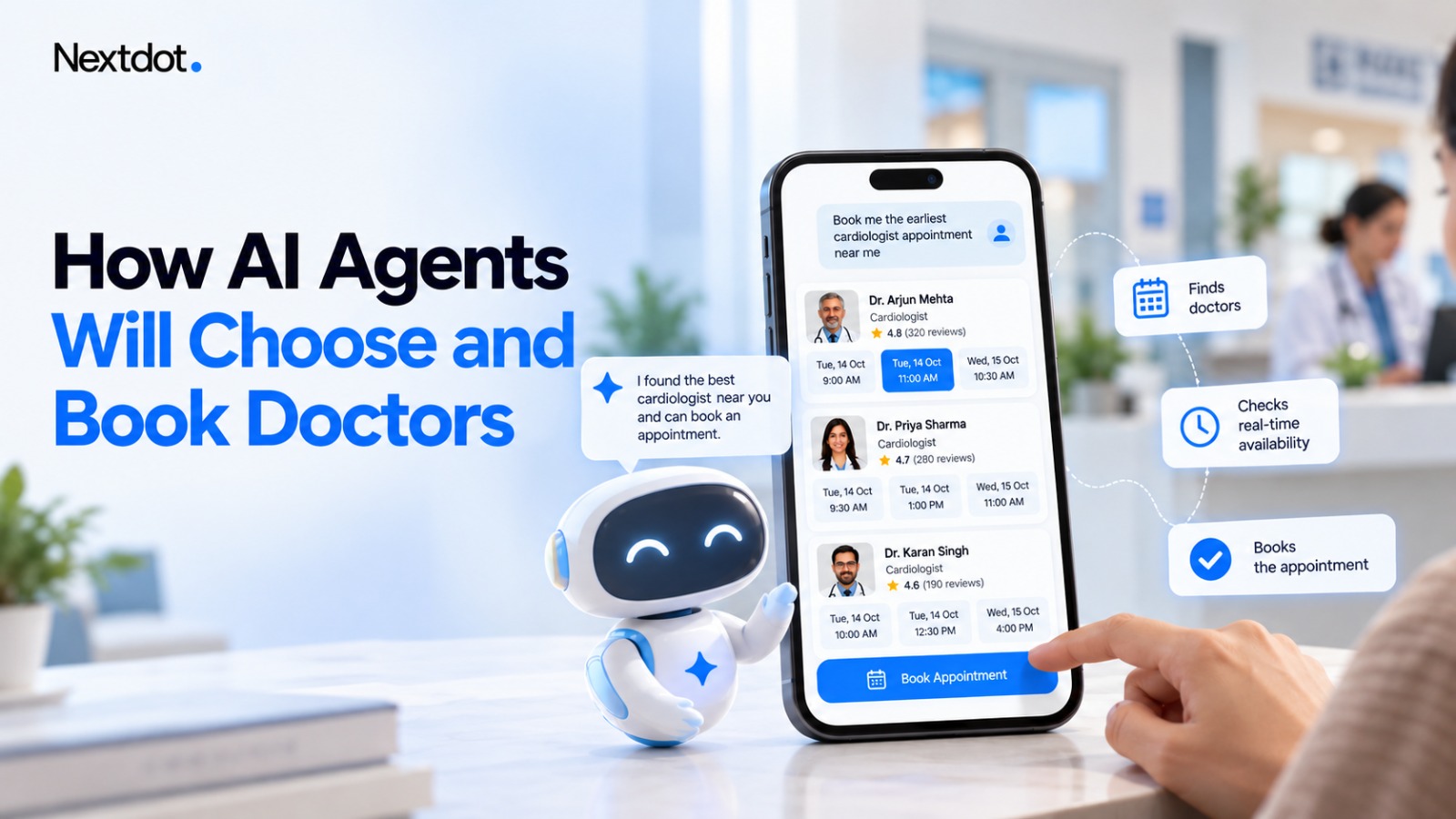
AI agents already book doctor appointments for some patients. Since August 2026, US users of a major AI assistant can find and book providers on a large doctor-booking platform's network, and in India Google's AI Mode already books restaurant tables. When agentic booking reaches Indian hospitals, the agent will likely favour doctors it can verify and book, so a hospital that is recommended but cannot be booked by a machine risks dropping out at the last step. This piece is forward-looking analysis, and the time to prepare is before health booking launches in India, because the preparation takes longer than the launch.
From recommending to acting
For two years, hospital AEO has been about one question: when a patient asks an AI assistant for a cardiologist in their city, does the answer name you? A second question is arriving behind it: when the patient says "book me the earliest slot", can the assistant finish the job?
Google began testing "Ask for Me" in January 2025, a Search feature that phones nail salons and auto shops about pricing and availability on a user's behalf (Source: TechCrunch, 30 January 2025). OpenAI launched ChatGPT agent on 17 July 2025, an assistant that completes tasks through its own browser and returns a finished result (Source: OpenAI, 17 July 2025). Google's AI Mode started booking restaurant reservations in August 2025 and added event tickets and beauty and wellness appointments in the US on 4 November 2025 (Source: TechCrunch, 4 November 2025). On 10 April 2026, agentic restaurant booking expanded to eight new markets, India among them (Source: 9to5Google, 10 April 2026).
Each step started with a category where booking data was already structured and a reservation platform already exposed it. Healthcare followed the same rule. In August 2026, a US doctor-booking platform announced a connected app inside a major AI assistant that lets US users see real-time availability and book with providers on its network (Source: the platform's press release, PR Newswire, 12 August 2026). The agent books through an aggregator that already held structured slots. Indian hospital availability has less of that structure, which slows the arrival here and gives the hospitals that build it first a thinner field inside the agent's shortlist.
Why healthcare comes later, and what the delay buys
Booking a table and booking a consultation look alike to an agent. They differ in four places.
The first is triage. A restaurant takes any party of four. A hospital needs to know whether a patient with chest pain belongs in OPD at all, and whether the right doctor is a general physician or a cardiologist. An agent that books without that judgment creates clinical risk, so we expect health booking in India to start with routine, low-acuity slots.
The second is data. The patient's name, phone number and reason for visit travel with the booking, and the reason for visit can reveal health status. That raises questions to take to counsel before any agent integration: what lawful basis covers data an agent passes to the hospital under DPDP 2023, what consent record the hospital should keep, and who carries which obligations once the data arrives.
The third is money. Consultation fees vary by doctor, by visit type and by payer. Agents struggle where the price depends on insurance or package terms.
The fourth is fragmentation. A large Indian hospital group can run a call centre, its own app, a web form, WhatsApp and listings on aggregators, each with a different view of availability. An agent picks the path it can complete. If that path runs through an aggregator, the aggregator owns the patient relationship at the moment of booking. The US launch runs exactly that way.
These four frictions set the order of arrival.
What an agent needs from a hospital
For an agent to recommend and then book a doctor, it needs three things, in this order.
Facts it can trust. Doctor name, specialty, qualifications, the branches they consult at, OPD days and timings, and languages spoken, stated identically on the hospital site, the Google Business Profile, the major directories and the registry. Where the hospital site says a doctor consults on Tuesdays and a directory says Thursdays, the agent has a reason to pick someone else. "The doctor profile is the unit of hospital AEO" covers why the profile matters for recommendation. For booking, it is also the unit of trust.
Availability it can read. A patient asking for "the earliest cardiology slot this week" needs an answer grounded in real slots. Today most hospital availability sits inside an HMIS or a scheduling tool that no outside system can query. Publishing OPD timings as structured data is a start. Exposing actual open slots through a feed or an API is the step that makes a hospital bookable. Schema.org already defines types for Physician, MedicalClinic and Hospital, and a ReserveAction that marks a page as a place where a reservation can be made. "Structured data for hospitals" covers which markup to publish. Treat it as groundwork, since the engines do not document how they weigh it.
An endpoint it can complete. The agent has to finish the booking somewhere. That can be a booking page an automated browser can navigate without a CAPTCHA wall or a forced app download, a documented booking API, or a phone line that answers and confirms. Consultation pricing belongs here too, where the hospital already publishes it. An agent comparing two surgeons will likely favour the one whose fee and slot it can state over one that says "call for details".
A hospital that has all three is bookable. A hospital with only the first is recommendable. The gap between those two words is the problem this piece is about.
How the shortlist changes
In search, a patient saw ten results and chose. In an answer engine, the patient saw three names and chose. With an agent, the patient may see one confirmed booking and a line of reasoning.
Reputation and clinical depth still decide whether the agent considers you. Operational legibility decides whether it completes the booking. A hospital with a better cardiology department and an unreadable booking flow can lose the appointment to a smaller clinic with clean profiles and an open API.
It also changes what marketing measures. Share of answer, covered in "Share of answer", tracks how often AI assistants name you for a fixed panel of patient questions. Agentic booking adds a harder metric: how often an agent, asked to book, completes a booking with you. Nobody can report that figure yet. The hospital that builds its measurement panel now will have a baseline when health booking launches in India.
The India layer
India has a public design for this problem. The Unified Health Interface, part of the ABDM stack, is described by the National Health Authority as an open protocol through which patient-facing apps can discover health services and book appointments with participating providers (Source: NHA, UHI repository and uhi.abdm.gov.in). The Union Health Minister launched UHI as a network for digital health services in June 2026 (Source: PIB, June 2026). If UHI reaches wide participation, agents in India could book across it. Check current participation before planning around it.
A CMO does not need to settle that question to act. The facts, availability and endpoint work above makes a hospital legible to a global assistant, a domestic aggregator and a government protocol alike: one source of truth for every doctor, kept current, and exposed where machines can read it.
What to prepare now
Five pieces of work, in order of payoff.
- Clean the doctor data. Audit every consultant's profile across the hospital site, Google Business Profile and major directories. Remove doctors who have left. Correct timings. "When the AI gets your hospital wrong" walks through correcting wrong AI answers.
- Publish structure. Mark up doctors, specialties, branches and OPD timings with schema.org types, and keep them consistent with the Business Profile.
- Make one booking path machine-completable. Pick the path the hospital controls, usually the website, and test whether an automated browser can book an OPD slot on it. Every forced login, app redirect or CAPTCHA on that path is a point where an agent gives up.
- Decide the booking scope. Which specialties and visit types may an outside agent book without human triage, and which need a call back? That is a joint decision for marketing, patient access and the medical director, and it should be written down before any platform asks.
- Assign an owner. Agentic booking sits between marketing, which owns discovery, and patient access, which owns the slot. Without a named owner, it falls between them.
Where to start
Every item above depends on knowing what AI assistants say about your hospital and your doctors today. The Doc Mirror audit answers that. It queries ChatGPT, Perplexity, Google AI Overviews and other major assistants to see how a hospital and its doctors are described, repeats those queries to track share of answer over time against named competitors, reads and validates the schema.org markup on hospital and doctor pages, and audits Google, search results, YouTube and page speed. The gaps it finds in the facts layer are the gaps an agent will hit when it tries to book. Run the audit, fix what it shows, and build bookability on top.
Frequently asked questions
Can AI assistants book doctor appointments?
Yes, in the US, where a major AI assistant has booked providers on a large doctor-booking platform's network since August 2026. In India, as of September 2026, Google's AI Mode books restaurant tables and ChatGPT agent can attempt a booking on any website it can navigate. Doctor booking is the next step to watch.
What does a hospital need for AI agents to book it?
Three things: consistent facts about each doctor across the hospital site, Google Business Profile and directories; availability an outside system can read, from structured OPD timings up to real slots through a feed or API; and a booking endpoint an agent can complete, such as a web flow without logins or CAPTCHAs, a documented API, or a phone line that answers and confirms.
Does agentic search replace SEO?
Agentic search depends on SEO. Agents discover hospitals through crawlable pages, structured data and consistent listings, which is the ground SEO and AEO already cover. What agentic search adds is a final requirement: after the assistant recommends you, it must be able to complete the booking.
When will AI booking agents be common?
Any single year quoted today for Indian hospital booking is a guess. The sequence so far runs from restaurants to tickets to beauty and wellness appointments, and in the US to doctor appointments since August 2026. In India, healthcare is slowed by triage, patient data questions under DPDP 2023, pricing complexity and fragmented booking systems. Preparing the data layer takes time, so starting before launch is the safer course.