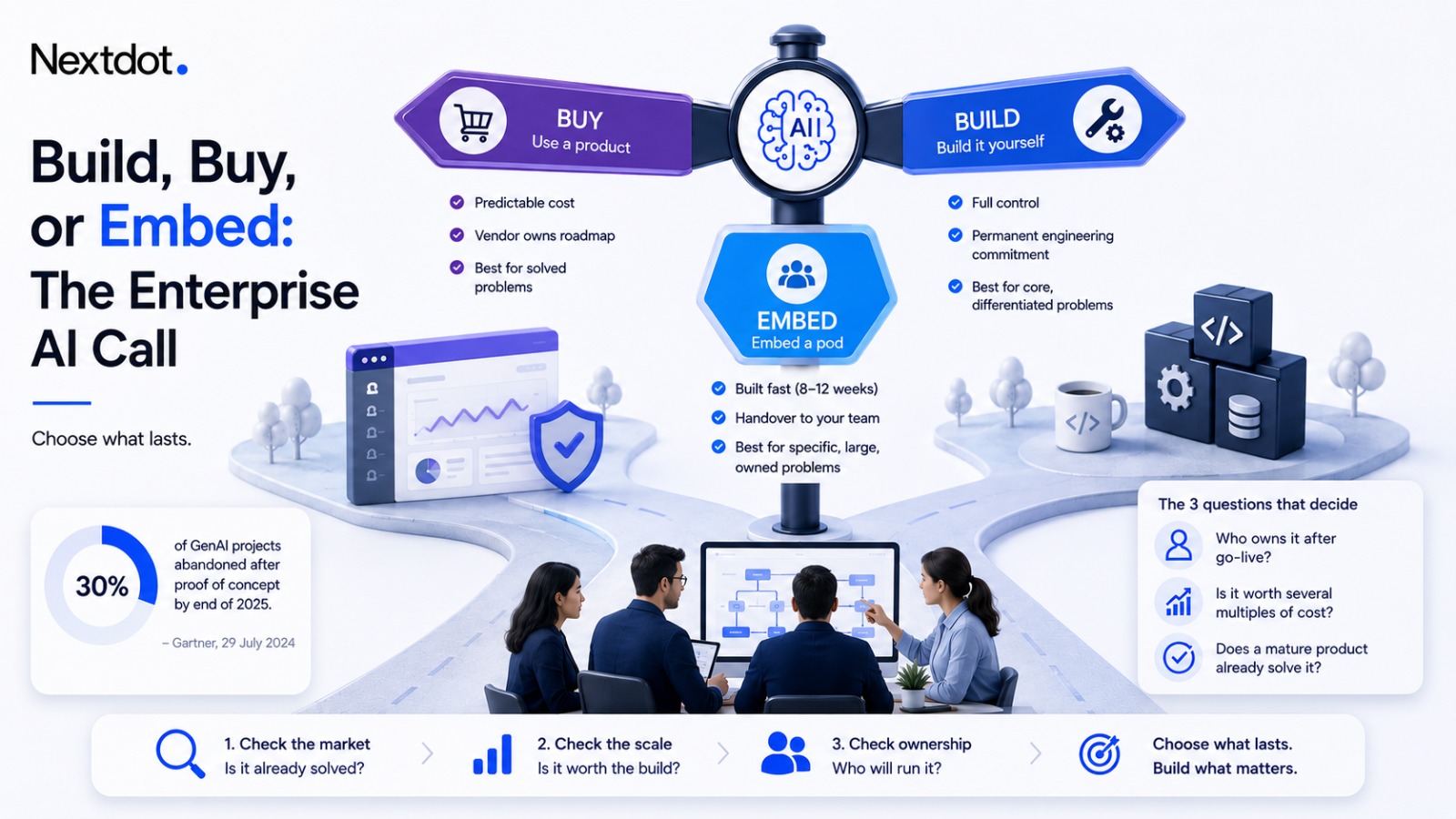
Whether you should build, buy, or embed for an enterprise AI project depends on three things most teams never check before choosing: who owns the system after go-live, whether the problem is worth several multiples of the delivery cost, and whether a mature product already solves it. Get those three right and the decision usually makes itself. Get them wrong and you land in the failure column, where Gartner predicted at least 30 percent of generative AI projects would be abandoned after proof of concept by the end of 2025 (Source: Gartner press release, 29 July 2024).
The reason the decision is framed wrong is that most CTOs frame it as a technology question. It is a total-cost-of-ownership and ownership question. The model is rarely the thing that fails. The surrounding work, integration, monitoring, on-call, versioning, retraining, and the human who owns all of it, is the thing that fails. So frame the three options by who carries that weight, and for how long.
The three options, stated plainly
Buy means you license a product. Someone else owns the roadmap, the uptime, the security posture, and the upgrade path. You own configuration and the integration into your stack. Your cost is predictable: a subscription or a per-entity licence, plus your own integration effort. Your ceiling is also fixed. You get what the product does, and no more.
Build means your own engineers write and run the system. You own everything: the model choice, the data pipeline, the eval suite, the observability, the on-call rotation, and every rupee of the run rate for as long as the system lives. The upside is a system shaped exactly to your workflow. The downside is that you have signed up for a permanent engineering commitment, not a project with an end date.
Embed sits between the two, and it is the option most vendors describe badly. A Forward Deployed pod is a small team of engineers who work inside your environment for a fixed window, typically 8 to 12 weeks, to build and ship a system against your real data and your real workflow, then hand it over. The pod is not a staffing contract and it is not a product. It is a way to get a production system built fast when the problem is specific enough that no product fits, and large enough to justify the spend. The pod builds, ships, and leaves. What happens after it leaves is the whole question.
Total cost of ownership is the only honest comparison
Compare the three on sticker price and buy wins almost every time. That comparison is a trap, because it ignores the cost that arrives after month three.
A bought product carries a licence fee and your integration cost, and then it mostly runs. A built system carries the build cost once, and then it carries a run rate forever: infrastructure, model inference, monitoring, the fraction of an engineer who keeps it alive, and the larger fraction who rebuilds it when the underlying model or the upstream API changes. An embed engagement carries a concentrated build cost over a fixed window, and then it converts into either a build-style run rate that your team now owns, or nothing if there is nobody to own it.
That last clause is where most of the money is lost. A pod that ships a working system into an organisation with no one to run it has not saved money. It has created a dependency that degrades quietly until someone notices the system is wrong, usually around month six. The total cost of ownership of an unowned system is the build cost plus the cost of the incident that eventually forces a rebuild.
So the honest TCO question is not "what does each option cost to deliver." It is "what does each option cost to keep running for three years, and who signs up to do that." Ask it that way and the choice narrows quickly.
When embed is the wrong answer
Embed is attractive because it feels like the best of both: a bespoke system without a permanent build team. That is exactly why it gets chosen when it should not be. There are three cases where a pod is the wrong call, and a CTO can check all three before the first scoping call.
The first is no engineering counterpart on your side. A pod builds, ships, and leaves. If there is nobody on your team who can own the handover, read the code, run the eval, and take the pager, the pod has not delivered a capability. It has delivered a dependency, and it fails by month six. When Nextdot sees this, we tell the prospect to buy a product instead, because a product ships with a vendor who owns the run. If you cannot name the person who owns the system in production before the build starts, you are not ready to embed.
The second is scale mismatch. A pod engagement only makes sense when the problem is worth several multiples of the pod's cost. A concentrated 8 to 12 week build is expensive by design, and it earns that cost only against a problem large enough to repay it many times over. A small facility, or a narrow workflow that touches a handful of users, does not clear that bar. It should buy a product, or in some cases build a thin internal tool, but it should not commission a pod to solve a problem that a subscription solves for a fraction of the money.
The third is already solved. Where a mature product exists that does the job, a custom build spends your money to prove a point. The engineering is real, the outcome may even be marginally better, but the marginal gain rarely justifies the run rate you have just signed up for. If a category has three credible products with reference customers who look like you, that is the market telling you the problem is commoditised. Buy it, integrate it well, and spend your engineers on the problem that no product solves.
None of these three is a technology judgment. Each is a question about ownership, scale, and market maturity, and each can be answered before anyone writes a line of code.
How to actually run the decision
Start with the third disqualifier, because it is the cheapest to check. Does a mature product already solve this. If yes, and it fits your compliance and integration constraints, buy it. Stop.
If no product fits, check scale. Is the problem worth several multiples of a concentrated build. If no, buy the nearest product and accept the imperfect fit, or build a thin internal tool if your team has the slack. If yes, the problem may justify a build.
If the problem justifies a build, check ownership. Do you have an engineering counterpart who will own the system after go-live. If yes, embed is the fastest route to a production system your team then runs, or you build it in-house if you have the bandwidth and the domain is core enough to keep permanently. If no, you are back to buy, because an unowned custom system is the most expensive option of the three once you count the rebuild.
The pattern underneath is consistent. Buy is the default for solved, small, or unowned problems. Build and embed are for problems that are specific, large, and owned. Embed is build with a faster start and a fixed window, and it only works when your side of the table is ready to catch what the pod throws.
Frequently asked questions
Should we build or buy AI?
Buy when a mature product already solves your problem and fits your compliance and integration constraints, because the product vendor owns the roadmap, uptime, and upgrades, and your total cost of ownership is predictable. Build when the problem is specific to your workflow, large enough to justify a permanent engineering commitment, and core enough that you want to own it for years. The deciding factor is not model quality, it is who owns the running system after go-live and whether the three-year cost of running it is worth the fit you gain by building.
When is embedding a team the right choice?
Embedding a Forward Deployed pod is right when three conditions all hold: no existing product fits the problem, the problem is worth several multiples of the pod's cost, and you have an engineering counterpart who will own the system after the pod leaves. A pod gives you a production-grade system built fast against your real data, typically in an 8 to 12 week window, then hands it over. If any of the three conditions is missing, embed is the wrong call.
When should you buy an AI product instead of a pod?
Buy a product instead of commissioning a pod in three cases: when a mature product already solves the problem, when the problem is too small to justify a concentrated build, or when you have nobody on your side to own a custom system after it ships. In all three, a product wins because it arrives with a vendor who owns the run rate, the security posture, and the upgrade path, and a custom build would either duplicate solved work or leave you with an unowned system that degrades within months.
What is an embedded AI pod?
An embedded AI pod, or Forward Deployed pod, is a small team of engineers who work inside your environment for a fixed window, usually 8 to 12 weeks, to build and ship a production system against your real workflow and data, then hand it over to your team. It is not a staffing contract and not a product. It is a fast route to a bespoke system for problems that are specific, large, and owned by someone on your side who can run the system once the pod leaves.