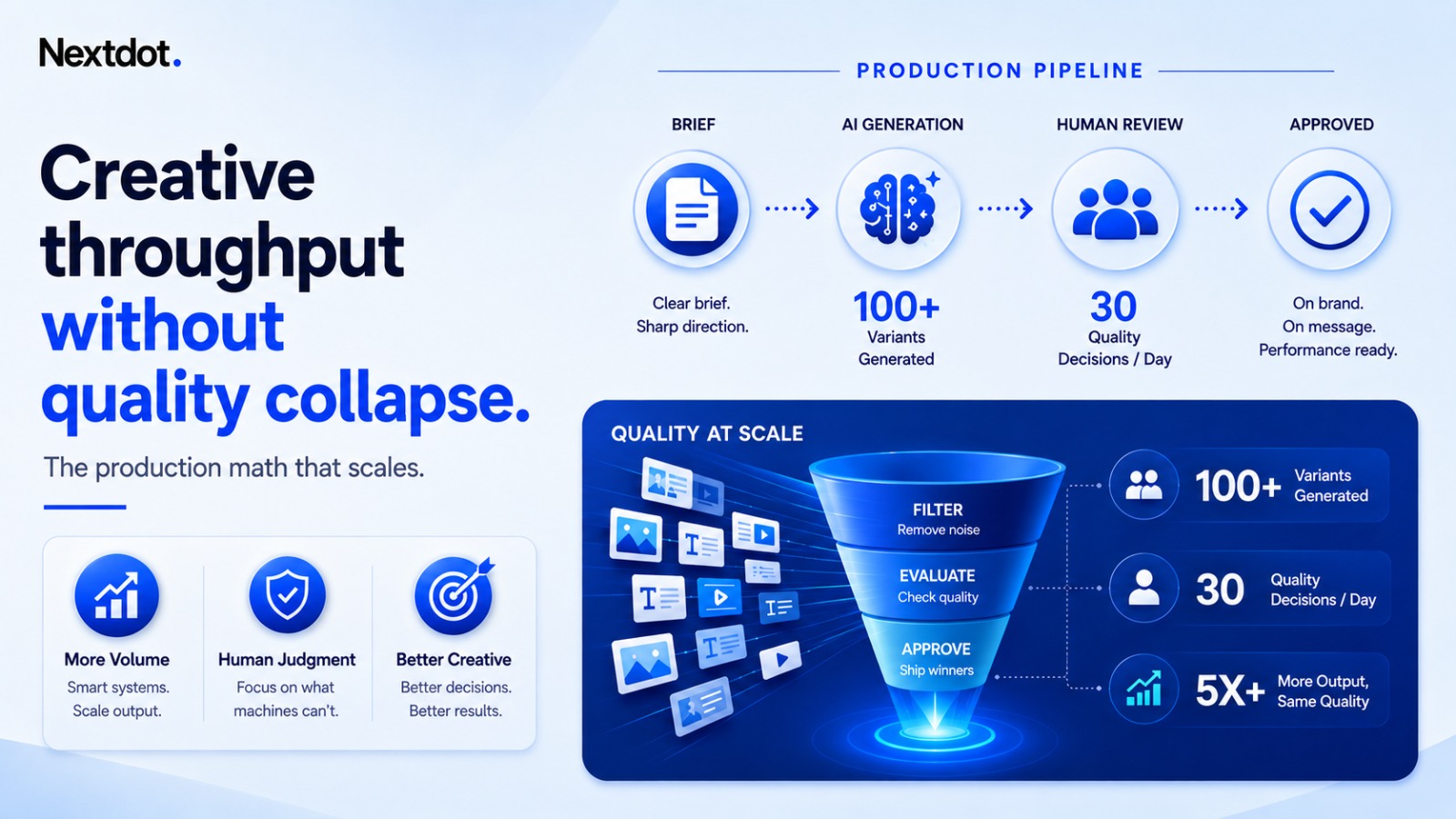
You scale creative volume without losing quality by fixing the review cycle first and the output volume second. Quality does not collapse because a team makes more work. It collapses because the number of things needing human judgment grows faster than the hours of human judgment available, and the review step silently becomes a rubber stamp. Get the ratio of machine-generated drafts to human decisions right, and you can multiply output several times over while the quality bar holds. Get it wrong, and every extra creative you ship is a liability moving faster than anyone can check it.
Most conversations about creative volume skip the part that actually breaks. The generation is the easy half now. Any team with the current tools can produce fifty variants of an ad by lunch. The hard half is that a human still has to look at each one, decide whether it is on brand, whether the claim is defensible, whether the hook lands, and whether it is worth spending media behind. That decision does not get faster because the drafting got faster. That mismatch is where quality dies.
The demand is real and the budget is not following it
The pressure a CMO feels is not imagined. A global study of marketers presented at Cannes Lions found that 62 percent say demand for content has risen by at least five times over the past two years, and 71 percent expect it to rise fivefold again by 2027 (Source: Adobe global marketer study, reported by Forbes, 18 June 2025). Read that as a marketer, not a technologist. Your channels multiplied, your formats fragmented, and every platform now wants native, fresh, frequent work. The brief count went up. The calendar did not get longer.
The money did not move with the demand. A 2025 report on B2B content found that 91 percent of marketers are increasing output this year and 46 percent are producing three to five times more than in 2024, while 75 percent received budget increases of only one to ten percent (Source: 2025 B2B content report, BusinessWire, 5 August 2025). That is the whole problem stated in two numbers. Output up three to five times. Budget up almost nothing. Something in the middle has to absorb the difference, and traditionally the thing that absorbs it is quality.
Where quality actually breaks at scale
Quality does not degrade evenly. It breaks at specific, predictable points, and naming them is the first step to defending against them.
The first break is the review bottleneck. When a team doubles drafting capacity but keeps one creative director and one brand reviewer, every new draft joins a queue in front of the same two people. Past a threshold, the reviewers stop reading closely and start pattern-matching. A carousel gets a glance instead of a read. A claim in a healthcare ad passes because it looks like last week's approved claim, not because anyone checked the substantiation. The volume looks healthy on the dashboard. The judgment behind it has quietly thinned out.
The second break is sameness. High volume produced from a narrow set of templates and prompts converges. The tenth variant looks like the first with the colours swapped. Performance data flattens because the audience is seeing the same idea repeated, and the team mistakes activity for range. This is the failure mode that makes CMOs distrust volume in the first place, and they are right to, because most volume is padding.
The third break is drift. Without a fixed reference for what on brand means, a fast pipeline wanders. Tone shifts week to week. The logo lockup gets sloppy. Three months in, the brand looks like it was made by six different teams, because in effect it was, each one optimising for their own brief with no shared memory of the last decision.
The math that keeps quality intact
The way through is not to slow down. It is to change what humans spend their time on. In a well-built production line, machine generation handles the first draft and the variant expansion, and human judgment concentrates on three things: the brief, the creative direction, and the final approval. Everything a person touches is a decision. Nothing a person touches is manual labour they could have automated.
Work the arithmetic. If a reviewer can make thirty genuine quality decisions a day and hold the bar, then thirty is your real capacity, no matter how many drafts the machines produce. Push six hundred drafts at that reviewer and you have not built capacity, you have built a rubber stamp. So the volume you promise a client has to be sized to the review capacity you actually staffed, not the generation capacity you can theoretically reach. This is the single most common place vendors lie, to themselves and to buyers. They quote generation throughput and call it production throughput. They are not the same number.
Three structural moves keep the two numbers aligned.
Fix the quality bar in writing before volume goes up. A brand reference the whole pipeline reads from, machine and human alike, turns brand consistency from a judgment call into a check. That is what stops drift, and it is what lets you add drafting capacity without adding proportional review load, because more of the review becomes a defined pass or fail rather than an open question.
Tier the review. Not every asset needs the same scrutiny. A static for an evergreen awareness set and a performance creative carrying a health claim do not belong in the same queue. Route the high-risk, high-spend, and regulated work to senior human review, and let the low-risk work clear on a lighter path. This is how you protect the reviewer hours that matter instead of spreading them evenly and thinly across everything.
Feed outcomes back in. A pipeline that learns from what performed stops producing the ninth flat variant, because the data tells it which directions are worth expanding and which to drop. That is how volume gets sharper over time instead of just larger. The month-six output beats the month-one output because the system is being trained on real results, not because anyone is working harder.
What a realistic number looks like
CMOs ask how many creatives per month is realistic, and the honest answer is that the number is meaningless without the review model attached to it. As an internal benchmark, Nextdot's AI Creative Pod runs a production line built to deliver 250 fresh creatives a month for a hospital network, a mix of reels and statics across performance and branding, with human creative direction and a fixed brand bar governing the pipeline. Treat that as a clearly labelled Nextdot internal benchmark, not as proof of what any team can do. The number is only defensible because the review capacity and the brand reference were built to carry it. Lift the number out of that structure and it means nothing.
That is the practitioner point a senior marketer should take from all of this. Anyone can quote a volume figure. The question that separates a real production operation from a content mill is what happens to each of those creatives before it ships, who looked at it, against what standard, and whether that standard is written down or lives in one overloaded person's head. Ask a vendor for their monthly number and they will give you one. Ask them for their review capacity and their quality bar, and you find out whether the number is real.
Throughput without quality collapse is an operations problem, not a tooling problem. The tools that generate the work are largely commodity now. The advantage is in how the human decisions are structured around them: what gets reviewed, by whom, against what fixed standard, and how the outcomes train the next batch. Build that, and volume stops being a threat to quality and starts compounding it.
Frequently asked questions
How do you scale creative production?
Scale the review model and the quality standard first, then scale the output. Machine generation should handle first drafts and variant expansion, while human hours concentrate on the brief, the creative direction, and final approval. Fix a written brand reference the whole pipeline works from, tier your review so high-risk and regulated work gets senior scrutiny, and feed performance outcomes back in so the pipeline sharpens over time. Volume sized to real review capacity scales cleanly. Volume sized to generation capacity does not.
Does high-volume creative lose quality?
It loses quality only when the volume outruns the review and the brand standard behind it. Quality breaks at three predictable points: a review bottleneck where overloaded reviewers start rubber-stamping, sameness where a narrow set of templates produces convergent variants, and drift where a pipeline with no fixed brand reference wanders off tone. Each of those is preventable by design. High volume with a matched review model and a written quality bar holds up. High volume bolted onto an old review process does not.
How many creatives per month is realistic?
The number is meaningless without the review model attached. A pipeline built with human creative direction and a fixed brand standard can deliver a few hundred fresh creatives a month across reels and statics. As a clearly labelled Nextdot internal benchmark, our AI Creative Pod runs a line built for 250 a month for a hospital network. That figure is only defensible because the review capacity and brand reference were built to carry it. Any monthly number quoted without a stated review model and quality bar should be treated as generation throughput, not production throughput.
Where does creative quality break at scale?
At the review step, not the generation step. Modern tools make drafting fast and cheap, so the constraint moves to human judgment: the fixed number of genuine quality decisions a reviewer can make in a day while holding the bar. When drafting capacity grows faster than that, the review becomes a rubber stamp, sameness creeps in from over-templated output, and brand consistency drifts without a written reference. Quality collapse is almost always a review-capacity and standards failure, not a shortage of creative output.